Agricultural and Forest Meteorology 93 (1999) 283-285
Comments on "A comparison of spray drift predictions to
lidar data"
by Thomas E. Stoughton, David R. Miller,
Xiusheng Yang, Kirk M. Ducharme
Milton E. Teske*, Harold W. Thistle
Continuum Dynamics, Inc., PO Box 3073, Princeton, NJ 08543, USA
Received 17 August 1998; accepted 25 September 1998
0168-1923/99/$ - see front matter c 1999 Elsevier Science B.V. All rights reserved.
PII: 50168-1923(98)00117-8
*Corresponding author.
Recently, Stoughton et al. (1997), hereafter identified as SMYD, published deposition predictions generated by the computer model FSCBG. Their results showed the deposition pattern ending within 200 m downwind of the point of release of the spray material. This deposition behavior is at odds with the generally accepted assumption that drift would continue for great distances downwind, and must therefore be managed (with buffer zones) near critical ecological areas. Bird (1995) surveyed 42 existing downwind deposition data sets found in the open literature, and demonstrated that drift cannot simply `end' as the FSCBG model runs by SMYD indicate it would. In this Comment, we correct the mistakes that produced these erroneous results.
We have been developing the AGDISP (Bilanin et al., 1989) and FSCBG (Teske et al., 1993) models for the USDA Forest Service (FS), and the AGDRIFTTM (Teske et al., 1997) model for the Spray Drift Task Force (SDTF) and the US Environmental Protection Agency for the prediction of the aerial application of pesticides. Several technical developments have taken place over the last six years, all aimed at improving the accurate prediction of downwind drift. These improvements include the following:
- The inclusion of smaller drop sizes, specifically extending the minimum drop size of 34 pm present in the FS database in FSCBG to 10pm or less, and
- splitting the drop size distribution (typically contained in fewer than 32 size categories) into size classes that each contain no more than 2% of the total volume fraction.
The first improvement expands the drop size distribution into the finer drops thought to play a major role in drift, and the second more evenly distributes the volume fraction. Drop size distribution is one of the critical inputs into any model simulation (Teske and Barry, 1993a; Bird et al., 1996), and it is extremely important that the distribution be accurately represented. The first improvement typically requires a reconstruction of the drop size distribution by either the root-normal approach of Simmons (1977) or the exponential approach of Rosin and Rammler (1933), while the second requires volume interpolation between drop sizes.
The need for an extended and more discrete drop size distribution was first discussed in a paper presented in Spokane at the annual meeting of the American Society of Agricultural Engineers (Teske and Barry, 1993b), subsequently made available as an
advanced option in FSCBG version 4.3 and above (Teske and Curbishley, 1994), and reiterated in a book chapter published thereafter (Teske et al., 1996). The observation was first made by Gaidos et al. (1990) and applied in ongoing and continuing work performed on the development and evaluation of the AGDRIFTTM model, an extension of the near-wake AGDISP model in FSCBG, and validated by 180 SDTF field trials (Bird et al., 1997). These extensions to the drop size distribution are now considered essential to the success of any model in accurately predicting downwind drift and deposition.
We requested copies of the five model input files developed by SMYD. Upon reviewing them, we discovered that these authors had not implemented the model improvements discussed above - improvements available within their version of FSCBG and had also corrupted both their aircraft and drop size distribution library file entries for the aircraft and the nozzle/spray material combination they were simulating. In addition, while they mixed the spray material 1 : 1 with water in the field study, and entered an active fraction of 0.5 into FSCBG to correct for the presence of volatile material in the tank mix, they did not activate the evaporation option in their subsequent calculations. Thus, within these limitations, it would be extremely difficult for SMYD to generate a meaningful downwind drift prediction consistent with their field study.
The prediction improvement may be seen by comparing the results presented in SMYD with the correct model predictions using the proper model inputs and options. A typical example in this case for their first spray run (the other four spray runs are very similar in appearance and not shown here for brevity), is shown in Fig. 1. It may be seen that the deposition behavior is now consistent with the notion of drift in the sense discussed above. The effect of evaporation (and the expanded drop size distribution) is to reduce the deposition level near the aircraft flight line and drift the spray material downwind.
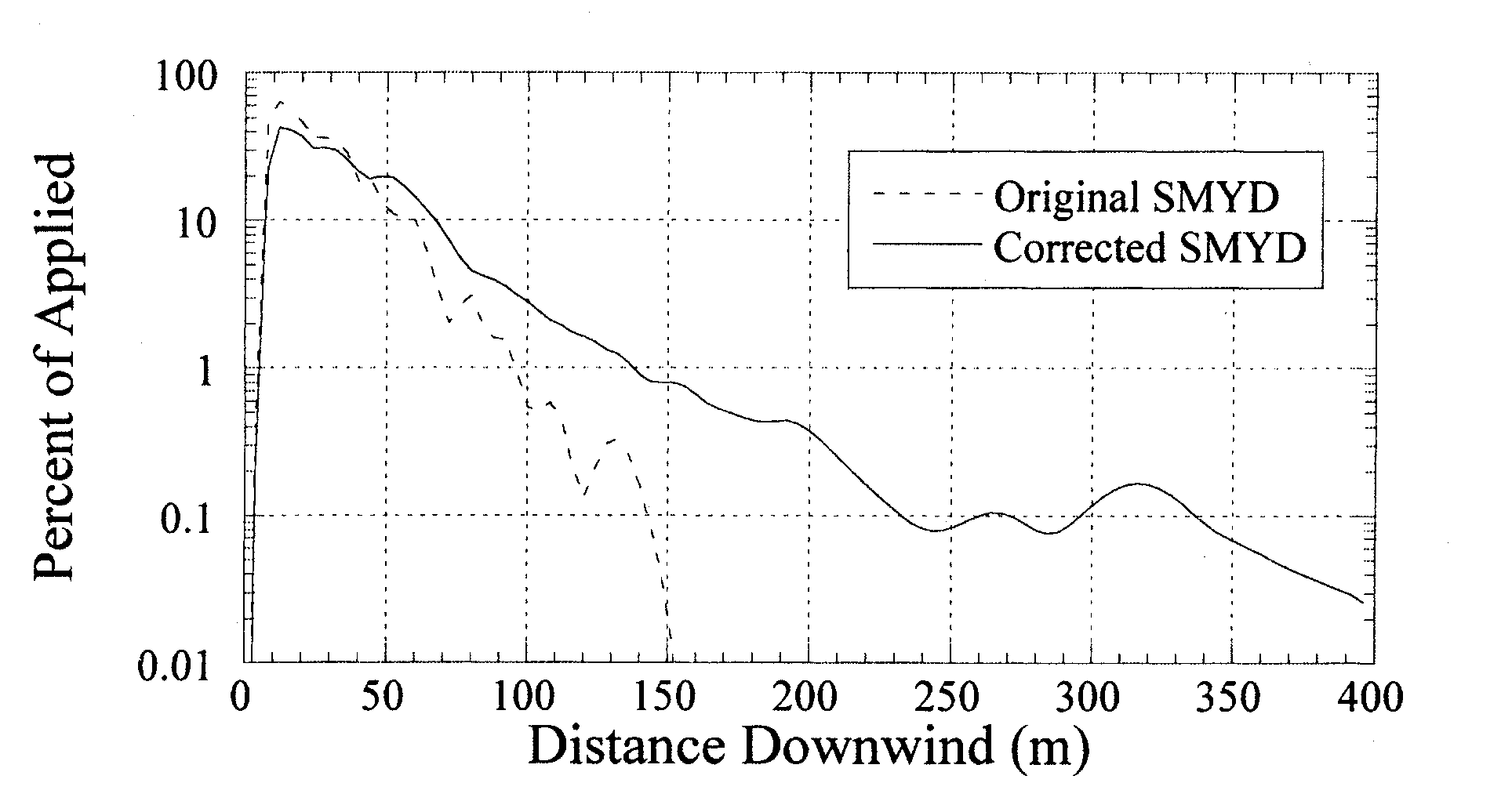
Fig. 1. A comparison of downwind deposition predictions for the conserved active spray material between the original FSCBG prediction by SMYD (dashed curve) and the corrected prediction (solid curve) using an extended and corrected drop size distribution, corrected aircraft description, and active evaporation consistent with the field study.
At 200 and 500 m downwind, characteristics of the spray material aloft may be found by using a toolbox option in AGDRIFTTM not presently available in FSCBG (Table 1).
Table 1
Characteristics of spray material aloft
| SMYD spray run | % Active aloft at 200 m | Maximum drop size at 200 m (um) | % Active aloft at 500 m | Maximum drop size at 500 m (um) |
| 1 | 1.58 | 121 | 0.18 | 58 |
| 2 | 1.21 | 129 | 0.18 | 58 |
| 3 | 0.82 | 98 | 0.12 | 50 |
| 4 | 1.23 | 121 | 0.14 | 58 |
| 5 | 1.19 | 111 | 0.13 | 50 |
These results are a significant departure from the much lower % aloft levels and larger drop sizes reported by SMYD, and suggest that drop sizes are actually no larger than 60 Etm for the downwind field conditions recorded by SMYD when the effects of evaporation are included in the analysis. Difference in drop sizes, particularly at the distances reported here, may be traced to spray material, release height, and application and meteorological conditions. Thus, while the use of a formula in Bache and Johnstone (1992) - one that also does not include the effects of evaporation - suggests to SMYD that suspended drops between 150 and 250 pm may exist at these distances, other field studies conclude otherwise: 30 to 150 pm (Yates et al., 1985), 50 to 150 pm (Byass and Lake, 1977; Shewchuck et al., 1988), and less than 200 ftm (Bode, 1984). The actual drop sizes encountered would depend on field conditions, but may be accurately estimated for long-range drift by the proper use of modeling tools such as FSCBG and AGDRIFTTM. The effects of evaporation and the importance of an expanded drop size distribution cannot be understated when predicting downwind drift and deposition.
References
Bache, D.H., Johnstone, D.R., 1992. Microclimate and Spray Dispersion. Ellis Horwood, New York, pp. 115-118, 181-183.
Bilanin, A.J., Teske, M.E., Barry, JW., Ekblad, R.B., 1989. AGOISP: the aircraft spray dispersion model, code development and experimental validation. Trans. ASAE 32(1), 327-334.
Bird, S.L., 1995. A compilation of aerial spray drift field study data for low-flight agricultural application of pesticides. Agrochemical Environmental Fate. In: Leng, M.L., Leovey, E.M.K., Zubkoff, PL. (Eds.), Lewis Publishers, pp. 195-207.
Bird, S.L., Esterly, D.M., Perry, S.G., 1996. Off-target deposition of pesticides from agricultural aerial spray applications. J. Environ. Quality 25(5), 1095-1104.
Bird, S.L., Perry, S.G., Ray, S.L., Teske, M.E., Scherer, P.N., 1997. An evaluation of AgDRIFTTM 1.0 for use in aerial applications. Draft report, National Exposure Research Laboratory, Ecosystems division, Office of Research and Development, US Environmental Protection Agency, Athens, GA.
Bode, L.E., 1984. Downwind drift deposits by ground applications. Proc. Pesticide Drift Manage. Symp., South Dakota State University, Brookings, SD.
Byass, J.B., Lake, JR., 1977. Spray drift from a tractor-powered field sprayer. Pesticide Sci. 8, 117-126.
Gaidos, R., Patel, M., Valcore, D., Fears, R., 1990. Prediction of spray drift deposition from aerial applications of pesticides. Paper no. AA90-007, NAAA/ASAE Joint Technical Session, Reno, NV.
Rosin, P., Rammler, E., 1933. The laws governing the fineness of powdered coal. J. Inst. Fuel 7(31), 29-36.
Shewchuck, S.R., Wallace, K., Maybank, J., 1988. A review of methodology for measuring the drift and deposition of herbicides and insecticides for forestry applications. Report no. 220, Saskatchewan Research Council.
Simmons, H.C., 1997. The correlation of drop-size distributions in fuel nozzle sprays. Trans. ASME J. Engineering for Power 99, 309-314.
Stoughton, T.E., Miller, DR., Yang, X., Ducharme, K.M.A., 1997. A comparison of spray drift predictions to lidar data, Agric. For. Met. 88 (1-4), 15-26.
Teske, M.E., Barry, JW., 1993a. Parametric sensitivity in aerial application, Trans. ASAE 36(1), 27-33.
Teske, M.E., Barry, JW., 1993b. FSCBG spray drift predictions. Paper no. 931101. ASAE Summer Meeting, Spokane, WA.
Teske, M.E., Bowers, J.F., Rafferty, J.E., Barry, JW., 1993. FSCSG: an aerial spray dispersion model for predicting the fate of released material behind aircraft. Environ. Toxicol. Chem. 12(3), 453-464.
Teske, M.E., Curbishley, T.B., 1994. Forest service aerial spray computer model FSCBG 4.3 user manual extension, Report no. FPM 94-10, USDA Forest Service, Davis, CA.
Teske, M.E., Thistle, H.W., Barry, Jw., 1996. Topics in aerial spray drift modeling. In: Zannetti, P. (ed.), Environmental Modeling vol. III: Computer Models and Software for Simulating Environmental Pollution and its Adverse Effects, Computational Mechanics Publications, Southhampton, UK, 17-53.
Teske, M.E., Bird, S.L., Esterly, D.M., Ray, S.L., Perry, S.G., 1997. A user's guide for AgDRIFTTM 1.0: a tiered approach for the assessment of spray drift of pesticides, Technical Note No. 9510, Continuum Dynamics, Inc., Princeton, NJ.
Yates, W.E., Cowden, R.E., Akesson, N.B., 1985. Drop size spectra from nozzles in high-speed airstreams. Trans. ASAE 28(2), 405-4 10.
This page last modified January 19, 2000
Visitor


 since January 19, 2000