| Appendix
F - Regional Summary of Permanent and Temporary Road
Construction Suspensions
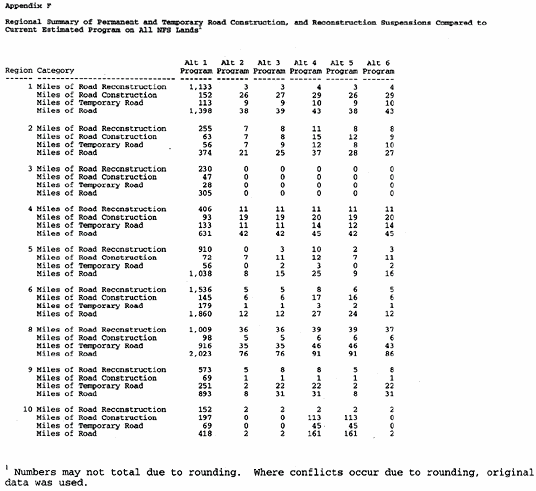
Compared to Current
Estimated Program, on all NFS Lands
Appendix G - Regional
Summary of Projects and Road Construction Suspensions

Compared to Current
Estimated Program, by Alternative for 18-month
Suspension (unroaded areas of NFS lands)
Appendix H -
Benefit-Cost Analysis Executive Summary
Benefit-Cost
Analysis Executive Summary
An environmental
assessment (EA) has been prepared in conjunction with
this final interim rule. The most tangible effects
from this interim rule are reductions in timber
offered for sale. The analysis estimates that, of the
5.4 billion board feet of timber planned for sale
nationwide during the 18-month period of the final
interim rule, the timber volume actually offered may
be reduced by an estimated 170 to 260 million board
feet. This is less than 5% of the planned sales during
the 18-month period. The estimated potential losses in
payments-to-states range from $6 million to $8 million
and could affect between 270 and 420 direct timber
jobs nationwide. Alternatively, indirect benefits to
wildlife, aquatic habitat, threatened, endangered and
sensitive species, and ecological functions are also
identified but are not quantified in the EA.
Introduction
The Forest Service is
in the process of revising regulations regarding the
management of the National Forest Transportation
System. An Advanced Notice of Proposed Rulemaking was
published on January 28, 1998, that announced the
agency's intent to develop new and improved analytical
techniques to help determine the size, purpose, and
extent of the future forest road transportation system
and any specific road building activities.
Simultaneously, the
Forest Service proposed an interim rule to temporarily
suspend permanent and temporary road construction and
reconstruction in unroaded areas of NFS lands. The
suspension would be effective from the publication
date of the final interim rule and would remain in
effect until adoption of a revised road management
policy or 18 months, whichever occurs first.
The Forest Service
proposes to revise the policy concerning management of
the NFS transportation system to address changes in
how the road system is developed, used, maintained,
and funded. The existing road system on NFS lands was
largely funded and constructed to develop areas for
timber harvesting and for the development of other
resources. In the last 2 decades, interest in the
appropriate uses of the resources of the national
forests, as well as the costs associated with resource
developments including road-building, has generated
much public debate. The proposed temporary suspension
is intended to provide time to adopt a revised road
management policy for land managers and resource
specialists. The improved analysis process will assure
that the ecological, social, and economic impacts of
proposed construction and reconstruction of NFS roads
are objectively evaluated, and that there is a full
consideration of public demand on NFS roads in the
context of current scientific information.
The environmental costs
of road construction are difficult to quantify,
especially in monetary terms, and therefore are
difficult to incorporate into the decision-making
process. Many of these costs are nonmarket in nature.
As a result of these known environmental costs and the
public concern, the Forest Service believes the public
interest is best served by suspending any road
construction activities in roadless areas until the
improved analytical process has been completed.
Framework for the
Economic Analysis of the Proposed Interim Rule
The proposed temporary
suspension is intended to last for 18 months or until
the adoption of a revised road management policy,
whichever comes first. The economic analysis focused
on analyzing the impacts of suspending road
construction activities in unroaded areas during this
time period. The resource impacts of timber harvest
are expected to last for more than 18 months, so a
longer time frame was used to analyze timber harvest
effects. The analysis did not attempt to predict
potential outcomes after the suspension is lifted.
Such predictions would be highly speculative, given
that the guidance for future management decisions is
still under development.
The EA for the Interim
Rule Suspending Road Construction in Unroaded Areas of
NFS describes 6 alternatives that were considered for
implementing the proposed interim rule. These
alternatives were analyzed to consider the economic
effects on social welfare, employment, and
payments-to-state. This document provides additional
detail on the economic effects of the alternatives.
Alternative 1 is the
current management alternative, referred to in the
benefit-cost analysis as the baseline. Under this
alternative, decisions involving road construction
would be made using existing analytical techniques and
decision-making guidance. No suspensions would occur
under this alternative. The estimated permanent and
temporary road construction and reconstruction for the
18-month period is what is expected to occur under
continuation of existing forest plans. All resource
effects are compared to this alternative.
Alternatives 2 through
6. The alternatives vary with regard to the NFS lands
included in the suspension and the number of
exemptions from the suspension. The EA included an
analysis of environmental consequences on the
following resource areas:
× access and
public safety
× fire, insects,
and disease
× forest
management (timber)
× land uses
(non-recreational)
× minerals
× noxious weeds
and nonnative invasive plants
× recreation,
heritage, and wilderness resources
× watershed and
air
× wildlife,
fish, and threatened, endangered, and sensitive
species
Both economic
efficiency and distributional effects were considered
for each of the listed environmental consequence.
Quantitative data for these consequences is severely
limited. The broad scale of the analysis precluded the
collection of site-specific data. Therefore, much of
the economic analysis for this interim rule is
descriptive. Despite these limitations, the
consequences of the suspension were estimated to be
negligible for most resources. The exception is the
effect of the rule on timber harvest. The proposed
temporary suspension has measurable effects on the
proposed timber harvest in unroaded areas, which are
quantified.
The economic effects
are described by category of environmental
consequence, rather than by alternative. The potential
economic effects between alternatives can be compared,
but the most important comparison is to the baseline
(i.e. continuation of the current situation).
The analysis of
economic effects assumed that planned projects
involving road construction or reconstruction in
unroaded areas would be suspended for the 18-month
period. Some projects may proceed without road
construction or the suspension could be cut short by
implementation of the revised road management policy,
so this assumption could overestimate effects. Once a
final interim rule is proposed, each unit will be
required to evaluate all potentially affected projects
(under the provisions of P.L. 105-174 Section 3006 of
the 1998 Supplemental Appropriations and Rescissions
Act) to determine if the project can be implemented
without the road work.
Economic Effects
Access and Public
Safety
In all alternatives,
exemptions are included to guarantee access required
for protecting public safety and to assure access
provided by statute, or reserved or outstanding
rights. As a result, public safety and legal access
would be unaffected by the suspension, resulting in no
economic effects. General new access would be
minimally affected by the suspension. The greatest
effect occurs under alternative 4, which would result
in suspension of less than 1% of the new access miles
under the baseline. The effects on general new access
would be negligible.
Fire, Insects, and
Disease
Under the baseline, 6
miles of temporary roads are estimated to be
constructed specifically for fire purposes. Of course,
other roads could also be used to fight fires and to
treat forest health problems. No effects are expected
from the suspension for several reasons:
× Treatment
needs for fire, insects, and disease on NFS
lands are far greater than can be accomplished
in any year. Therefore, there are numerous
treatment opportunities available to substitute
for treatments on suspended areas.
× Many
treatments can be accomplished without roads
such as prescribed burns.
× Roads increase
access for firefighting, but they also increase
human access, which increases the risk of
human-caused fire. Given the existing road
system, the effects of the suspension on
fire-fighting capability are expected to be
negligible.
Assuming that the
substitute treatment opportunities are as beneficial
in achieving forest health goals as the projects they
replaced, no social benefits would be lost. There
could be a distributional effect, if the replacement
projects create non-Forest Service employment in a
different geographic area. Overall employment would be
unaffected, but job location could shift. This effect
would be small, since only 3% of all treatment acres
are potentially affected by the suspension.
Forest Management
The economic effects of
the proposed temporary suspension on timber sales can
be quantified. Timber sales are used to achieve
vegetation management objectives. Timber sales are
often used as a least-cost method to manage vegetation
for improving wildlife habitats, reducing fuels,
recovering values from natural disasters, combating
insect and disease infestations, and improving tree
growth. Timber sales include timber commodity purpose
sales made primarily to supply timber in response to
society's demand for wood, as well as for personal use
made primarily to supply firewood, Christmas trees and
other miscellaneous forest products to individuals for
their own consumption. Roads are generally required
for timber harvest.
Under alternative 1, a
planned timber harvest volume over 18 months was
estimated. Alternatives 2 through 6 would result in
reduced volume in comparison to alternative 1. A range
of harvest effects was estimated for alternatives 2
through 6, over 18 months. The effects of a suspended
timber harvest would occur over a longer period than
the 18-month suspension because timber sold is not
harvested immediately. The usual delay from the time
that timber is sold until all timber is harvested is
between 2 and 3 years. Therefore, the potential
suspended harvest was assumed to occur over 3 years in
equal proportions.
The effects are assumed
to be identical in each of the 3 years. For the
economic analysis, the harvest effects of the proposed
suspension were converted into annual effects. The
18-month planned program in alternative 1 was also
converted into annual effects over 3 years. Table 1
shows timber volume effects on an annual basis by
alternative.
A range of volumes is
presented in alternatives 2 through 6 for potential
suspended sold volume. Some timber sales encompass
unroaded areas potentially subject to suspension and
roaded areas. Suspending the unroaded portion may
require suspending the entire project. The low
estimate is the portion of potential sales within the
unroaded area being considered for suspension and the
high estimate includes the roaded area of the project.
Once a final interim rule is published, each unit will
evaluate these split projects to determine if the
portion outside of the unroaded area can proceed.
Table 1 displays the
potential harvest suspensions before consideration of
alternative sources of timber. There are options
available for replacing some of the suspended volume
from other ownerships in the United States. The
availability of substitute harvest opportunities
varies by region. Key factors include the proportion
of NFS lands in the region, the type of timber being
harvested on the NFS lands versus availability on
other ownerships, and current timber prices.
Substitute harvest opportunities are most available in
the eastern United States (Regions 8 and 9), where it
was assumed that 90% of the NFS harvest could be
replaced on other ownerships. Opportunities are more
limited in the West, where the NFS lands occupy a
higher proportion of the forest-land base. Region 2
was assumed to have opportunities to replace 40% of
the suspended volume; Regions 1 and 4 were assumed to
be able to replace 20% of the volume, and Regions 3,
5, and 6 were assumed to have no substitution
opportunities.
Data Sources
The economic efficiency
effects of the timber sales program include the
economic value of the timber, the economic value of
other associated positive resource impacts of timber
harvest, the costs of harvest, and environmental costs
or other negative effects of the harvest. The
non-timber economic effects are an important component
of the efficiency analysis, since an increasing
proportion of timber sales on the NFS are undertaken
to achieve forest management objectives other than
commercial harvest.
Since the total planned
volume in the baseline and the estimated suspended
volumes of alternatives 2 through 6 are not tied to
any particular sales, the estimates of the economic
benefits and costs had to reflect some representative
range for each region. The data used for the benefits
and costs of harvest were taken from the Forest
Service's Timber Sales Program Information Reporting
System (TSPIRS) reports. The TSPIRS annual reports
contain data on the benefits and costs of timber
harvest by national forest.
Report 2 of TSPIRS is
an economic analysis of the benefits and costs of the
timber harvest accomplished in a fiscal year. A
traditional with-without analysis is undertaken to
estimate the incremental benefits and costs associated
with the timber harvest in the relevant fiscal year.
This analysis captures the effects of timber harvest
on all resources for which monetary value estimates
are available. For example, effects on recreation use,
forage for domestic livestock and wildlife, and water
quality are considered. Some of the effects of timber
harvest are positive, while others are negative. The
benefits and costs are estimated over the life of the
effects and then discounted to a present net value.
Each national forest
completes TSPIRS Report 2 (unless no timber was
harvested). The national TSPIRS annual report includes
data on the present value of the costs and benefits
associated with timber
sale by national
forest. The forest-level data was used to calculate a
2-year average for the present value of costs and
benefits from timber sales. Data from fiscal years
1996 and 1997 were used. Harvest data from the
national forests were used to calculate a present
value of costs and benefits per million board feet
(also averaged over 1996 and 1997), which was then
used as the per unit value to apply to potential
harvest effects of the proposed suspension.
Data from all forests
were used to calculate the regional and national
present net values of the baseline. The benefits and
costs for each of the alternatives were based on data
from a subset of forests in each region that are
likely to be affected by the suspension. Therefore,
the cost and benefit estimates for each alternative
should more closely estimate the effects than a
regional average across all forests.
The distributional
effects of the proposed rule were measured as effects
on employment and payments-to-states. Employment
effects can be described as direct, indirect, and
induced. Direct effects include jobs associated with
the harvest of timber and processing of the raw logs.
Indirect effects include jobs associated with
industries that supply inputs to the harvesting and
processing sector. Induced effects include jobs
associated with increased spending in the economy from
the salaries created from the direct and indirect
effects.
Direct job effects are
not reported separately from total effects in TSPIRS.
Therefore, regional estimates of direct job effects
per million board feet were based on the best judgment
of Forest Service economists. Although the ratio is
constant within a region, direct jobs per million
board feet varies across regions.
Estimates of total
employment impacts (the sum of direct, indirect, and
induced effects) were based on TSPIRS data. Each
national forest reports total employment associated
with NFS harvest. As with the benefits and costs data,
a 2-year average (1996 and 1997) of data was used to
calculate total jobs per million board feet. Total job
effects of the suspension alternatives were calculated
using only the subset of forests likely to be affected
by the suspension.
Effects on
payments-to-states are linked to Forest Service
receipts for timber sales. Average receipts per
million board feet were calculated for each region,
based on fiscal year 1997 TSPIRS data.
Payments-to-states were estimated as 25% of the
potential receipts.
Benefits and Costs of
Timber Sales Suspensions
Under the baseline
alternative, the annual net benefit of planned timber
sales would be about $376 million (table 2). Assuming
the same level of total harvest in each year, the
discounted present net value over the 3-year period
would be $1.1 billion. The annual present net values
for alternatives 2 through 6 describe the change to
the annual net present value of the baseline.
The effect of the
suspension of timber harvest is a loss of the net
benefits associated with the harvest volume. In most
cases, the proposed suspension would reduce the
present net value of the baseline (the negative
values). The only exception occurs in Region 10, in
which case the suspension would actually increase the
net present value of the planned program because the
costs of harvest exceed the benefits (indicated by a
positive value for the Region 10 harvest
alternatives). At the national level, alternatives 2,
3, and 6 result in a loss to society from suspending
harvest. The total values for alternatives 4 and 5
indicate that the suspension would be beneficial.
However, this result is dominated by Region 10. All
other regions under those alternatives would lose
benefits as a result of the proposed suspension.
Overall, the loss of benefits is relatively minor in
comparison to total net benefits of the planned
program. The greatest loss occurs in alternative 6,
with a loss of only 1% of the total benefit of the
baseline.
Although the national
effects are minor, Regions 1 and 4 have a higher than
average proportion of the effects. Net benefit losses
in Region 1 range from 4% to 7% of total baseline
benefits, while Region 4 losses range from 4% to 6%.
Regions 6 and 8 have higher net losses under some
alternatives than Regions 1 and 4, but the relative
impact is greater in the latter regions.
Total United States
wood consumption would be unaffected by the proposed
temporary suspension. Harvest from NFS lands was only
4% of total United States production in 1997. The
maximum potential suspended volume is less than .2% of
total United States production. Therefore, the total
supply effect is marginal, and no price impacts are
expected as a result.
The effects described
in table 2 do not include the possible offset from
harvest on other lands. As described earlier, the
possibilities for substitute domestic harvest of
timber varies by region.
Timber harvest that
cannot be substituted domestically could be replaced
through imports, primarily from Canada. After
subtracting domestic substitution, a maximum of 348
million board feet would need to be replaced by
imports (under alternative 4). In 1997, 17.2 billion
board feet of softwood lumber were imported from
Canada. If the board feet were converted to equivalent
softwood lumber measure, then the total import volume
needed to replace suspended harvest would equal 2% of
the 1997 import level.
Since no price effect
is likely to occur as a result of the proposed
temporary suspension, there should be no net welfare
loss from the perspective of consumers of wood
products. The alternative sources of timber harvest
will have associated benefits and costs that would not
be reflected in the prices of wood products. The
benefits and costs associated with NFS harvest may be
quite different from harvest on other ownerships and
in Canada. Therefore, no attempt was made to estimate
the benefits and costs of the alternative harvest,
although those effects would likely offset some of the
lost benefits from reduced NFS harvest.
Employment Effects
The traditional Forest
Service approach to evaluating the employment effects
of timber harvest is to use the IMPLAN model to
estimate total job effects of timber harvest including
direct, indirect, and induced effects. For this
analysis, direct jobs and total jobs were estimated
separately. Two scenarios were considered for both
direct jobs and total jobs: effects with no domestic
harvest substitution and effects with domestic harvest
substitution.
Direct job impacts
without harvest substitution (table 3) are the lowest
in alternative 2 (347-501 jobs) and the greatest in
alternative 4 (723 to 1322 jobs). These impacts are
between 1% and 5% of the total direct jobs associated
with the baseline. Under the preferred alternative
(alternative 6), job impacts are about 2% of the
total. Although the national effect is a small
percentage of the total jobs under the baseline, the
impacts are concentrated in primarily Regions 1 and
10. However, Region 10 would be exempt from suspension
in the preferred alternative.
When the effects of
harvest substitution are considered, the distribution
of direct job impacts changes slightly (table 4).
Region 1 has the highest impacts across all
alternatives, while the impacts in Regions 8 and 9 are
minimal because of the high degree of substitution in
those regions. Since the harvest
substitution occurs
within the same region, the jobs created by the
substitute harvest would be a direct offset to the
jobs lost from suspended NFS harvest. The same
individuals may not have employment, but the same
number of people would be employed in the region.
Therefore, the real job impacts are those caused by
harvest reductions that are not replaced domestically
as described in table 4.
Direct job effects are
the most obvious effect of suspended timber harvest.
Indirect and induced effects are distributed over a
wide range of economic sectors. The impact of reduced
harvest on these jobs varies widely by community.
Communities with diverse economies that have strong
overall job growth may be able to provide substitute
opportunities for the indirect and induced effects.
Local communities with a strong timber-related sector
and less economic diversity will be most impacted
through indirect and induced effects.
Substitution
opportunities for induced and indirect job effect seem
likely in today's economic environment of tight job
markets, but those effects can vary greatly by
location and type of employment. Substitution effects
may not occur immediately, so that a lag effect may
occur. Even if communities are able to replace
indirect and induced effects, the overall impact of
the suspension is to reduce one segment of employment
opportunities. Therefore, the total employment effects
of the suspended harvest were estimated as the
potential maximum effects of the suspension.
Total jobs per million
board feet were based on total timber-harvest related
employment in the national TSPIRS report. The
forest-level data was used so that each alternative
could be evaluated based on the forests likely to be
affected in each alternative. Tables 5 and 6 display
total job effects for each alternative. Under the
baseline, about 59,000 total jobs would be associated
with planned timber harvest. Without considering
harvest substitution effects, the impacts range from
983 jobs to 3112 jobs (2% to 5% of total jobs). The
effects for total jobs are distributed the same as
direct jobs. Region 1 effects are accentuated because
of the high multiplier effect in that region compared
to other regions. Including harvest substitution
reduces the job impacts (table 6). Maximum impacts
under substitution range from 1% to 3%. As explained,
the harvest substitution would allow for a direct
offset of job impacts within the region but may affect
different individuals.
Payments-to-states
The final economic
effect to be considered by the suspension of timber
harvests is the reduction in payments-to-states. The
size of the effect depends on harvest level and the
value of harvest. Region 6 has the highest average
receipts per thousand board feet ($198), while the
lowest average was in Region 10 ($23). Total receipts
and associated payments-to-states were estimated for
the baseline (table 7). Losses in payments-to-states
because of the suspension range from $4 million to $13
million, which is 3% to 12% of total estimated
payments. Under the preferred alternative, the loss of
payments-to-states would range from 5% to 6%. The
greatest effects would be on Region 1, with impacts
ranging from 14% to 22%. Region 8 also has a
relatively large effect. Even though most of the
suspended harvest in Region 8 can be substituted on
other lands, that harvest does not replace
payments-to-states. However, harvest on non-NFS lands
would generate other forms of revenues for states.
Although all
alternatives result in some loss of revenue from
payments-to-states, these losses will be mitigated by
requirements of the 1998 Supplemental Appropriation
and Rescissions Act. It is impossible to estimate the
extent of the mitigation until implementation
guidelines are established. When the final interim
rule is published, specific implementation direction
will be established to evaluate projects and determine
the extent of the compensation needed for lost
revenue.
Land Uses
(non-recreational)
Non-recreational
special use authorization on NFS lands include
communication sites, public and private roads, and
transmission rights-of-way (e.g., pipelines). More
than 47,000 active special use authorizations
currently exist; approximately 8,000 applications for
new or renewed authorizations are expected in fiscal
years 1998 and 1999.
All private interest
access projects needed to satisfy the Alaska National
Interest Lands Conservation Act or other statutory
rights-of-access are exempt from the proposed
temporary suspension. Access provided pursuant to
statutory rights-of-access and reserved or outstanding
rights are also exempt. Cost-share road agreements
would also be exempt under all alternatives.
The only potential
effects of the proposed suspension would be on
applications for authorizations that are not required
by law. Included would be private access permits (to
access private property within NFS boundaries) and
linear rights-of-way (e.g., electric transmission
lines, oil pipelines, and railroads). Under the
baseline, an estimated 417 private access permit
applications would request 174 miles of road
construction and reconstruction on all NFS lands. A
total of 4 miles of roads are affected in each of the
alternatives. For linear rights-of-way, a total of 123
miles of roads would be constructed or reconstructed
under the baseline alternative. Less than 2 miles of
roads would be affected by the suspension. Given the
small percentage of total roads affected by the
proposed suspension, economic effects are assumed to
be negligible.
Minerals
The baseline includes
an estimated 58 miles of roads in unroaded areas
during the 18-month suspension, involving an estimated
685 new mineral exploration or development proposals.
The expected economic effects of the suspension are
assumed to be negligible, largely because reasonable
access to privately owned minerals, mineral claims,
leases, permits, and contract are exempt from
suspension. Access to new leases, licenses, permits,
and contracts issued in unroaded areas would be
subject to the final interim rule. However, the
suspension does not affect leasing decisions, which
can go forward. About 334,000 acres of unroaded areas
are scheduled for auction, but many of these leases
are not expected to receive bids because of low oil
prices that do not encourage exploration. Therefore,
no or very few proposals to explore newly issued
leases would be affected by the temporary suspension.
As a result, no economic effects are expected from the
temporary suspension.
Noxious Weeds and
Nonnative Invasive Plants
Approximately 6 to 7
million acres of NFS lands are infested with noxious
weeds and nonnative invasive plants. Their estimated
rate of spread is between 8% and 12% per year.
Suspending road construction reduces the opportunity
for vehicles to serve as a conduit for further
infestation. Any type of ground-disturbing activity
increases the potential for aiding the spread of these
species. However, the number of miles suspended in any
of the alternatives is minor compared to the overall
road system in the NFS. Therefore, the suspension will
not appreciably alter the overall spread.
Roads allow easy access
to treat weed infestations. However, given the size of
the problem and the number of acres that can be
treated per year, the benefits of suspension far
outweigh the advantages of easy treatment. No planned
treatment projects are affected by the suspension.
Therefore, the overall the net benefits of the
suspension are probably positive but not large. The
greatest benefits would accrue from the alternative
with the greatest miles suspended (alternative 4).
Recreation, Heritage,
and Wilderness Resources
The impacts of the
proposed temporary suspension vary by type of
recreation. Developed recreation facilities depend on
roaded access. In the baseline, 195 miles of permanent
and temporary road construction and reconstruction
would be undertaken for the primary purpose of access
to developed recreation facilities. Less than one mile
of that total would occur on unroaded areas in all
alternatives. Therefore, recreation use at developed
sites would be virtually unchanged. The effect is
limited to a few developed sites in Region 8.
Scenic quality adds
value to recreation experiences. Generally, road
construction poses a threat to scenic quality,
depending on the road design and the purpose of road
construction. To the extent that road development
leads to activities, such as mining or timber harvest,
scenic quality may decline. Therefore, the proposed
temporary suspension would be expected to a protect
existing areas of high scenic quality in comparison
with the baseline. Those alternatives that suspend the
most miles (alternatives 4 and 5) will provide the
most protection.
However, roads can also
bring people into contact with scenery that was
previously unavailable and provide new benefits. Roads
also provide access for management actions that may
directly or indirectly improve areas of low scenic
quality. It is impossible to evaluate the trade-offs
between the positive and negative impacts with the
existing data. Since the suspension is temporary, the
options for future improvements remain, while areas of
high scenic quality are protected.
Resort development
includes ski areas and other recreation facilities on
NFS lands that are primarily owned and operated by the
private sector. These resorts are authorized by
special use permits. Road development is important to
provide access to resort areas. Under all
alternatives, roads authorized under special use
permits within a Master Development Plan would be
exempt.
Under the baseline, 18
miles of roads associated with private resort
development are estimated to occur in unroaded areas.
Alternatives 2, 3, and 6 potentially affect 2 new ski
areas and one ski expansion. The expansion could
proceed without the temporary road construction. Road
construction for the 2 new areas could not proceed
during the suspension. Alternatives 4 and 5 also
potentially affects 2 new ski areas and one ski
expansion. Although the economic impacts of suspending
a ski development could be large, such developments
take place over a number of years. It is most likely
that the temporary suspension will have a negligible
impact on these ski developments.
Dispersed recreation
includes a wide variety of recreation activities that
occur in a many different recreation settings.
Unroaded areas are most important for providing
primitive and semi-primitive non-roaded recreation
opportunities such as backpacking and hiking. Solitude
is a key characteristic of these types of recreation
settings. Roads are important in providing access to
the entry in unroaded areas. Although the number of
miles of roads primarily for the purpose of recreation
is small, all roads are used to provide opportunities
to access the forest for dispersed activities.
Some economic effects
of the suspension on dispersed recreation will be
positive, while others will be negative. Suspending
road development limits the potential for new
recreation access, which would have a negative impact
on potential recreation benefits. Alternatives with
the highest road suspension (alternatives 4 and 5)
will have the greatest negative impacts on roaded
recreation use. With increased recreation demand,
limiting road access may lead to increased congestion
in available roaded areas. However, new roads do not
necessarily result in additional recreation visits in
the affected areas. The new roads may only serve to
redistribute existing users. Over an 18-month period,
the effects are likely to be minimal.
Some types of
recreation users would be positively impacted by the
suspension of road development. All alternatives would
maintain recreation opportunities for low-density
recreation opportunities in the primitive and
semi-primitive non-motorized recreation environment.
The temporary suspension would guarantee protection of
these recreation environments for the 18 months.
Alternatives with the greatest miles of suspended
roads (alternatives 4 and 5) would offer the most
protection to these benefits.
Wildlife-associated
recreation is a subset of dispersed recreation. Road
building tends to have negative effects on water
quality, fish habitat, and biological diversity.
Therefore, the interim policy would tend to protect
environmental quality that is a key factor in the
quality of the wildlife recreation experience.
However, these recreationists also require access to
pursue these activities, and managers require access
for management action to maintain or improve habitat
quality.
No spatial data exists
to demonstrate current patterns of use on the NFS
lands. Therefore, it is difficult to estimate the
effects of proposed temporary suspension on different
types of recreation use. Without such information, it
is not possible to determine which mix of recreation
opportunities is the most beneficial to society.
However, over the 18-month period it is unlikely that
any of the potential effects will be large in
comparison to total recreation use on the NFS.
Watershed and Air
Road construction and
the associated activities that may occur because of
roads generally have negative effects on air and water
quality. The effects of road construction on
watersheds include loss of ground cover, soil
compaction, reduced transpiration, increased water
runoff, increased soil erosion, loss of productive
soils, and increased levels of dust. Employment of
best management practices minimizes these effects but
cannot eliminate them.
Therefore, the proposed
temporary suspension has positive effects for
protecting air and water quality. Alternatives 4 and 5
would likely result in the most benefits, since they
suspend the most road miles. Protecting air and
watershed quality provides benefits to other National
Forests users, particularly recreationists who engage
in water-related activities and benefit from increased
visibility for scenic viewing.
These benefits would
not necessarily be large in comparison to the
baseline, but the temporary suspension would protect
those benefits until new direction is available for
evaluating road construction projects.
Wildlife, Fish and
Threatened, Endangered, and Sensitive Species
The important impacts
on wildlife, fish, and TES species are the beneficial
effects from suspension of road-related environmental
degradation and the detrimental effects from
suspension of projects with a primary wildlife, fish,
or TES species purpose.
The beneficial effects
of road suspension will dominate the effects in this
area. Although benefits are most affected by site
characteristics, it is likely that benefits would
increase as the number of road miles suspended
increases; the greater the suspension the greater the
averted risk to wildlife, fish, and TES species.
Alternatives 4 and 5 will provide the most benefits,
but all alternatives provide greater benefits than the
baseline. The overall effects of suspending wildlife,
fish, and TES species projects is minimal since a
large majority of the total projects are estimated to
be outside NFS unroaded areas.
Passive Use Values
Passive use values were
not addressed under any of the individual resource
effects because they are applicable to several
different types of resource effects. Passive use or
non-use values are derived from personal motivations
to protect environmental values either for personal
satisfaction or for future generations. These values
are not traded in markets nor subject to fees. Passive
use values are likely to be positively affected by all
alternatives that limit road development because these
values are most often linked to protection of
ecological values such as old growth, protection of
endangered and threatened species, and protection of
biological diversity. The only possible negative
aspect of road suspension for passive use values is
the limitation on management actions that are designed
to protect ecological integrity. Passive use values
would be higher under all alternatives in comparison
to alternative 1. These values would likely be highest
under alternatives 4 and 5 and lowest under
alternatives 2 and 3.
Conclusions
The estimated economic
consequences of the Interim Rule Suspending Road
Construction in Unroaded Areas of NFS are minor in
comparison to the baseline. Exemptions will prevent
any adverse effects on public safety and access. The
effect on most resources were estimated to be
negligible. In most cases, very few road miles were
planned into unroaded areas and the suspension of
those roads had limited effect. In several cases,
activities could be moved to other NFS areas. The
suspension would likely have positive impacts on
wildlife, fish, and TES species, on some recreation
uses, and on passive use values.
The only measurable
economic effects were the efficiency and
distributional effects of potential timber harvest
suspensions. The scenario with the most severe
economic effects (Alternative 4 with no domestic
harvest substitution) would result in a 2% to 5%
decline in total jobs and a 1% decline in the annual
net present value of total timber harvest. With
harvest substitution, total jobs decline from 1% to
3%. Payments-to-states could drop 3% to 12%
nationally, with a decline of 5% to 6% estimated for
the preferred alternative.
Although all
alternatives result in some loss of revenue from
payments-to-states, these losses will be mitigated by
requirements of the 1998 Supplemental Appropriation
and Rescissions Act. It is impossible to estimate the
extent of the mitigation until implementation
guidelines are established. When the final interim
rule is published, specific implementation direction
will be established to evaluate projects and determine
the extent of the compensation needed for lost
revenue.
Table H-1. Comparison
of Estimated Annual Timber Harvest Volume Effects by
Alternative
(rounded to nearest
million board feet)
| Forest
Service Region |
Alternative
1
(Baseline) |
Alternative
2
RARE II with
exemptions
|
Alternative
3
Proposed action
|
Alternative
4
Broadest
Safeguards
|
Alternative
5
RARE II w/o
Exemptions
|
Alternative
6
Preferred
Alternative
|
|
1
|
317
|
Low
15
|
High
23
|
Low
15
|
High
23
|
Low
16
|
High
24
|
Low
15
|
High
23
|
Low
16
|
High
24
|
|
2
|
166
|
4
|
6
|
5
|
9
|
11
|
25
|
5
|
19
|
5
|
8
|
|
3
|
101
|
0
|
0
|
0
|
0
|
0
|
0
|
0
|
0
|
0
|
0
|
|
4
|
211
|
6
|
9
|
6
|
10
|
6
|
10
|
6
|
9
|
6
|
10
|
|
5
|
453
|
0
|
0
|
5
|
11
|
8
|
14
|
0
|
0
|
6
|
12
|
|
6
|
976
|
3
|
4
|
3
|
4
|
11
|
14
|
9
|
13
|
3
|
4
|
|
8
|
675
|
9
|
10
|
9
|
10
|
11
|
37
|
11
|
37
|
9
|
10
|
|
9
|
537
|
1
|
2
|
6
|
11
|
6
|
11
|
1
|
2
|
6
|
11
|
|
10
|
189
|
0
|
0
|
0
|
0
|
33
|
40
|
33
|
40
|
0
|
0
|
|
Total
NFS
|
3626
|
38
|
54
|
49
|
78
|
101
|
176
|
80
|
143
|
51
|
80
|
Table H-2.Comparison of
Baseline Annual Net Present Value to Annual Net
Present Value of Potential Suspended Harvest Volume in
each Alternative (thousand 1997 dollars)
| Forest
Service Region |
Alternative1
(Baseline) |
Alternative
2
RARE II with
exemptions
Low
|
Alternative
3
Proposed action
Low
|
Alternative
4
Broadest
Safeguards
Low
|
Alternative
5
RARE II w/o
Exemptions
Low
|
Alternative
6
Preferred
Alternative
Low
|
|
1
|
27,852
|
-1,180
|
-1,835
|
-1,180
|
-1,835
|
-1,080
|
-1,620
|
-1,179
|
-1,834
|
-1,080
|
-1,620
|
|
2
|
15,247
|
-220
|
-379
|
-231
|
-429
|
-835
|
-1,842
|
-374
|
-1,421
|
-239
|
-358
|
|
3
|
41,351
|
0
|
0
|
0
|
0
|
0
|
0
|
0
|
0
|
0
|
0
|
|
4
|
18,918
|
-650
|
-1,070
|
-664
|
-1,070
|
-671
|
-1,060
|
-643
|
-1,060
|
-646
|
-1,077
|
|
5
|
16,379
|
0
|
0
|
-191
|
-433
|
-481
|
-862
|
0
|
0
|
-113
|
-246
|
|
6
|
173,123
|
-360
|
-468
|
-343
|
-447
|
-1,129
|
-1,517
|
-1,702
|
-2,372
|
-344
|
-447
|
|
8
|
83,072
|
-303
|
-338
|
-303
|
-338
|
-645
|
-2,216
|
-645
|
-2,216
|
-313
|
-348
|
|
9
|
41,869
|
-107
|
-161
|
-258
|
-473
|
-258
|
-473
|
-107
|
-161
|
-258
|
-473
|
|
10
|
-32,105
|
0
|
0
|
0
|
0
|
5,376
|
6,637
|
5,376
|
6,637
|
0
|
0
|
|
Total
NFS
|
375,616
|
-2,820
|
-4,251
|
-3,170
|
-5,025
|
277
|
-2,953
|
726
|
-2,427
|
-2,993
|
-4,569
|
Table H-3. Estimated
Annual Direct Job Effects of Potential Harvest
Suspension without Non-NFS Harvest Substitution
(Number of direct jobs)
|
Forest
Service Region
|
Alternative
1 (Baseline)
|
Alternative
2
RARE II with
exemptions
Low
|
Alternative
3
Proposed action
Low
|
Alternative
4
Broadest
Safeguards
Low
|
Alternative
5
RARE II w/o
Exemptions
Low
|
Alternative
6
Preferred
Alternative
Low
|
|
1
|
3,173
|
150
|
233
|
150
|
233
|
160
|
240
|
150
|
233
|
160
|
240
|
|
2
|
996
|
21
|
36
|
27
|
49
|
65
|
142
|
29
|
108
|
30
|
46
|
|
3
|
912
|
0
|
0
|
0
|
0
|
0
|
0
|
0
|
0
|
0
|
0
|
|
4
|
1,896
|
51
|
84
|
54
|
87
|
57
|
90
|
51
|
84
|
54
|
90
|
|
5
|
3,173
|
0
|
0
|
33
|
74
|
52
|
94
|
0
|
0
|
37
|
80
|
|
6
|
7,808
|
27
|
35
|
27
|
35
|
85
|
115
|
75
|
104
|
27
|
35
|
|
8
|
6,747
|
89
|
99
|
89
|
99
|
109
|
376
|
109
|
376
|
92
|
102
|
|
9
|
3,761
|
9
|
14
|
41
|
75
|
41
|
75
|
9
|
14
|
41
|
75
|
|
10
|
947
|
0
|
0
|
0
|
0
|
154
|
190
|
153
|
190
|
0
|
0
|
|
Total
NFS
|
29,413
|
347
|
501
|
421
|
652
|
723
|
1,322
|
576
|
1,109
|
441
|
668
|
Table H-4. Estimated
Annual Direct Job Effects of Potential Harvest
Suspension with Non-NFS Harvest Substitution
(Number of direct jobs)
|
Forest
Service Region
|
Alternative
1 (Baseline)
|
Alternative
2
RARE II with
exemptions
Low
|
Alternative
3
Proposed action
Low
|
Alternative
4
Broadest
Safeguards
Low
|
Alternative
5
RARE II w/o
Exemptions
Low
|
Alternative
6
Preferred
Alternative
Low
|
|
1
|
3,173
|
120
|
186
|
120
|
186
|
128
|
192
|
120
|
186
|
128
|
192
|
|
2
|
996
|
13
|
22
|
16
|
29
|
39
|
85
|
17
|
65
|
18
|
28
|
|
3
|
912
|
0
|
0
|
0
|
0
|
0
|
0
|
0
|
0
|
0
|
0
|
|
4
|
1,896
|
41
|
67
|
43
|
70
|
46
|
72
|
41
|
67
|
43
|
72
|
|
5
|
3,173
|
0
|
0
|
33
|
74
|
52
|
94
|
0
|
0
|
37
|
80
|
|
6
|
7,808
|
27
|
35
|
27
|
35
|
85
|
115
|
75
|
104
|
27
|
35
|
|
8
|
6,747
|
9
|
10
|
9
|
10
|
11
|
38
|
11
|
38
|
9
|
10
|
|
9
|
3,761
|
1
|
1
|
4
|
8
|
4
|
8
|
1
|
1
|
4
|
8
|
|
10
|
947
|
0
|
0
|
0
|
0
|
154
|
190
|
153
|
190
|
0
|
0
|
|
Total
NFS
|
29,413
|
210
|
321
|
252
|
412
|
519
|
793
|
418
|
651
|
267
|
424
|
Table H-5. Estimated
Annual Total Employment Effects of Potential Harvest
Suspension without Non-NFS Harvest Substitution
(Number of total jobs)
|
Forest
Service Region
|
Alternative
1 (Baseline)
|
Alternative
2
RARE II with
exemptions
Low
|
Alternative
3
Proposed action
Low
|
Alternative
4
Broadest
Safeguards
Low
|
Alternative
5
RARE II w/o
Exemptions
Low
|
Alternative
6
Preferred
Alternative
Low
|
|
1
|
12,693
|
569
|
884
|
569
|
884
|
612
|
918
|
569
|
885
|
612
|
918
|
|
2
|
2,324
|
53
|
91
|
66
|
123
|
169
|
373
|
73
|
276
|
76
|
114
|
|
3
|
1,824
|
0
|
0
|
0
|
0
|
0
|
0
|
0
|
0
|
0
|
0
|
|
4
|
3,370
|
103
|
170
|
109
|
176
|
116
|
183
|
104
|
171
|
109
|
182
|
|
5
|
4,987
|
0
|
0
|
53
|
120
|
86
|
154
|
0
|
0
|
60
|
132
|
|
6
|
13,664
|
47
|
61
|
49
|
64
|
155
|
208
|
138
|
192
|
49
|
64
|
|
8
|
12,819
|
191
|
213
|
191
|
213
|
240
|
826
|
240
|
826
|
199
|
221
|
|
9
|
5,911
|
20
|
30
|
69
|
127
|
69
|
127
|
20
|
30
|
69
|
127
|
|
10
|
1,515
|
0
|
0
|
0
|
0
|
261
|
323
|
261
|
323
|
0
|
0
|
|
Total
NFS
|
59,106
|
983
|
1,449
|
1,106
|
1,707
|
1,708
|
3,112
|
1,405
|
2,703
|
1,174
|
1,758
|
Table H-6. Estimated
Annual Total Job Effects of Potential Harvest
Suspension with Non-NFS Harvest Substitution (Number
of total jobs)
|
Forest
Service Region
|
Alternative
1 (Baseline)
|
Alternative
2
RARE II with
exemptions
Low
|
Alternative
3
Proposed action
Low
|
Alternative
4
Broadest
Safeguards
Low
|
Alternative
5
RARE II w/o
Exemptions
Low
|
Alternative
6
Preferred
Alternative
Low
|
|
1
|
12,693
|
455
|
707
|
455
|
707
|
490
|
734
|
455
|
708
|
490
|
734
|
|
2
|
2,324
|
32
|
55
|
40
|
74
|
101
|
224
|
44
|
166
|
46
|
68
|
|
3
|
1,824
|
0
|
0
|
0
|
0
|
0
|
0
|
0
|
0
|
0
|
0
|
|
4
|
3,370
|
82
|
136
|
87
|
141
|
93
|
146
|
83
|
137
|
87
|
146
|
|
5
|
4,987
|
0
|
0
|
53
|
120
|
86
|
154
|
0
|
0
|
60
|
132
|
|
6
|
13,664
|
47
|
61
|
49
|
64
|
155
|
208
|
138
|
192
|
49
|
64
|
|
8
|
12,819
|
19
|
21
|
19
|
21
|
24
|
83
|
24
|
83
|
20
|
22
|
|
9
|
5,911
|
2
|
3
|
7
|
13
|
7
|
13
|
2
|
3
|
7
|
13
|
|
10
|
1,515
|
0
|
0
|
0
|
0
|
261
|
323
|
261
|
323
|
0
|
0
|
|
Total
NFS
|
59,106
|
638
|
983
|
710
|
1,140
|
1,217
|
1,885
|
1,007
|
1,611
|
758
|
1,179
|
Table H-7. Estimated
Annual Payments to States Effects of Potential
Suspended Harvest (million 1997 dollars).
|
Forest
Service Region
|
Alternative
1 (Baseline)
|
Alternative
2
RARE II with
exemptions
Low
|
Alternative
3
Proposed action
Low
|
Alternative
4
Broadest
Safeguards
Low
|
Alternative
5
RARE II w/o
Exemptions
Low
|
Alternative
6
Preferred
Alternative
Low
|
|
1
|
$12.10
|
$1.70
|
$2.70
|
$1.70
|
$2.70
|
$1.80
|
$2.70
|
$1.70
|
$2.70
|
$1.80
|
$2.70
|
|
2
|
$5.90
|
$0.40
|
$0.70
|
$0.50
|
$0.90
|
$1.20
|
$2.70
|
$0.50
|
$2.10
|
$0.60
|
$0.80
|
|
3
|
$2.00
|
$0.00
|
$0.00
|
$0.00
|
$0.00
|
$0.00
|
$0.00
|
$0.00
|
$0.00
|
$0.00
|
$0.00
|
|
4
|
$6.90
|
$0.60
|
$0.90
|
$0.60
|
$1.00
|
$0.60
|
$1.00
|
$0.60
|
$0.90
|
$0.60
|
$1.00
|
|
5
|
$13.70
|
$0.00
|
$0.00
|
$0.40
|
$1.00
|
$0.70
|
$1.30
|
$0.00
|
$0.00
|
$0.50
|
$1.10
|
|
6
|
$48.30
|
$0.50
|
$0.60
|
$0.50
|
$0.60
|
$1.60
|
$2.10
|
$1.40
|
$1.90
|
$0.50
|
$0.60
|
|
8
|
$26.00
|
$1.00
|
$1.10
|
$1.00
|
$1.10
|
$1.20
|
$4.20
|
$1.20
|
$4.20
|
$1.00
|
$1.10
|
|
9
|
$13.50
|
$0.10
|
$0.20
|
$0.50
|
$0.80
|
$0.50
|
$0.80
|
$0.10
|
$0.20
|
$0.50
|
$0.80
|
|
10
|
$1.10
|
$0.00
|
$0.00
|
$0.00
|
$0.00
|
$0.60
|
$0.70
|
$0.60
|
$0.70
|
$0.00
|
$0.00
|
|
Total
NFS
|
$129.50
|
$4.00
|
$6.00
|
$5.00
|
$8.00
|
$8.00
|
$16.00
|
$6.00
|
$13.00
|
$6.00
|
$8.00
|
Appendix I -
Alphabetical List of Preparers
Team Leader
Mary O'Brien -
Washington Office, Ecosystem Management Coordination
Primary
Marsha Butterfield -
Washington Office, Lands
Alice Carlton - Washington Office, Recreation,
Heritage, and Wilderness Resources
Val Chambers - Washington Office, Office of
Communication
Anne P. Hoover - Washington Office, Ecosystem
Management Coordination
Ralph Giffen - Washington Office, Range Management
Russ LaFayette - Washington Office, Watershed and Air
Management
Bruce Ramsey - Washington Office, Minerals and Geology
Management
Cindy Swanson - Washington Office, Wildlife, Fish, and
Rare Plants
Bill Timko - Washington Office, Forest Management
Barbara Timberlake - Washington Office, Ecosystem
Management Coordination
Secondary
Max Copenhagen - Region
10, Wildlife, Fisheries, Ecology, and Watershed
Sue Cummings - Washington Office, Ecosystem Management
Coordination
Deborah Childs Hayes - Washington Office, Range
Management
Jerry Ingersoll - Region 2, Renewable Resources
Linda Langner - Washington Office, Resources Program
and Assessment
Robert Ragos - Washington Office, Civil Rights
Julia Riber - Washington Office, Ecosystem Management
Coordination
Jonathan Stephens - Washington Office, Ecosystem
Management Coordination
Richard Sowa - Washington Office, Engineering
Gary Yeck - Region 8, Holly Springs Ranger District
Larry Warren - Region 4, Information Systems
Eric Johnston - Washington Office, Wildlife, Fish, and
Rare Plants
Bob Sutton- Region 10, Operations
Acknowledgments
Appreciation is
extended to Madelyn Dillon, technical publications
editor, for editorial review and printing
coordination, and to the Rocky Mountain Research
Station for their support. In addition, the
contributions of Michael Cummings, data-base manager,
and Brian Lesser, graphics compiler, have been
invaluable.
<<
Previous Section 1
- 2 - 3
- 4 - 5 |