|
Richard A. Birdsey and John
L. Hom - Part 1
USDA Forest Service, NERS, Newtown Square, PA 19073
ABSTRACT: The Forest Service goal for
global change research is to establish a sound scientific basis
for making regional, national, and international resource management
and policy decisions in the context of global change issues. The
objectives of the Northern Global Change Program (NGCRP) are to
understand: (1) what processes in forest ecosystems are sensitive
to physical and chemical changes in the atmosphere, (2) how future
physical and chemical climate changes will influence the structure,
function, and productivity of forest and related ecosystems, and
to what extent forest ecosystems will change in response to atmospheric
changes, and (3) what are the implications for forest management
and how must forest management activities be altered to sustain
forest productivity, health, and diversity. The NGCRP currently
emphasizes scientific inquiry into the effects of multiple air pollutants
and climate changes on forest ecosystems. As the program matures,
the impacts of prospective changes on interactions between forest
ecosystems and social and economic processes will be evaluated,
as will policy options for mitigating or adapting to predicted changes.
Introduction
Global change adds a new dimension to forest management
policy and practice. Historically, management planners assumed that
the physical and chemical environments on which a forest ecosystem
depends would remain roughly stable. Our incomplete understanding
of landscape-scale processes and our inability to predict how ecosystems
will be affected by future environmental changes limit effective
management planning and application. Furthermore, since we cannot
predict the fate of many plants and animals under changing climatic
conditions, we cannot adequately evaluate the mitigation and adaptation
strategies under consideration by policy makers in response to increasing
atmospheric CO2 and possible climate changes.
Forest resources in the Northeastern, North Central, and Midwestern
United States are intensively utilized for many different purposes.
Population density is high and people are intimately associated
with forest values in the Northeast, the most densely forested region
of the United States. In the North Central and Midwestern states,
forests scattered throughout agricultural landscapes play an important
role in reducing sediment and nutrient runoff from farmlands to
aquatic ecosystems. Both large and small municipalities rely on
forested watersheds for water supplies. Local communities are tied
to forest resources for outdoor recreation, hunting, maple syrup
production, wood fiber production, and aesthetic values. The mix
of urban, agriculture, and forest cover produces a fragmented landscape
that in some areas may affect the ability of tree and wildlife species
to adapt to major environmental stress or to migrate along with
the changing environment.
Along with climate change, air pollution and acidic deposition
exert strong influences on forest ecosystems in the northern region.
Gradients of moisture and temperature are supplemented by strong
pollutant deposition gradients, generally from very low levels in
the Midwestern plains to the highest national levels in the East.
Climate and pollution stresses, and their interactions with pests,
humans, and other environmental changes are likely to cause unprecedented
cumulative effects on northern forest ecosystems.
GENERAL PROGRAM DESCRIPTION
Program Goals
The Forest Service goal for global change research
is to establish a sound scientific basis for making regional, national,
and international resource management and policy decisions in the
context of global change issues. This is accomplished through a
broad research initiative addressing the three national research
questions concerning global change and forest ecosystems:
1. What processes in forest ecosystems are sensitive to physical
and chemical changes in the atmosphere?
2. How will future physical and chemical climate changes influence
the structure, function, and productivity of forest and related
ecosystems; and to what extent will forest ecosystems change in
response to atmospheric changes?
3. What are the implications for forest management and how must
forest management activities be altered to sustain forest productivity,
health, and diversity?
Answers to these research questions will provide guidance to policy
makers and resource managers.
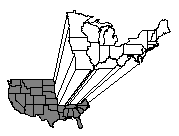
Research in the North (As seen below in the figure) will lead to
understanding of how changes in the physical and chemical environment
will impact forests and people's associations with them. The challenge
and opportunity facing the NGCRP is to increase understanding of
ecosystem processes and global change effects at various temporal
and spatial scales, and to identify key processes that link temporal
and spatial scales. The NGCRP currently emphasizes scientific inquiry
into the effects of multiple pollutants, atmospheric change, and
increased climatic variability on forest ecosystems. As the Program
matures the impacts of prospective changes on interactions between
forest ecosystems and social and economic processes will be evaluated,
as will policy options for mitigating or adapting to predicted changes.
Program Budget
The annual budget for the NGCRP has been approximately $6.5 million
per year. Of this amount, approximately half is appropriated directly
to field locations and half to program management for funding research
studies selected through a competitive, peer-reviewed process. The
operating goal is to fund 50 percent internal and 50 percent external
research by interdisciplinary teams of federal and nonfederal scientists.
Research Emphasis - 1991 to 1993
Initial priorities focused research on the effects of global change
on forest health and the productivity of forest lands. Approximately
50 percent of the research effort was a continuation of studies
related to acid deposition and ozone effects, and 50 percent was
allocated to study the effects of stresses identified with climate
change (CO2, temperature, precipitation, weather events). The approximate
percentage of funds allocated to six broad research areas for the
first three years was:
Studies of physiological processes 25%
Studies of ecosystem processes 48%
Landscape-scale studies 8%
Model development and application 15%
Social interactions and economics 2%
Assessment and policy 2%
Research Emphasis - 1994
to 1995
More recent studies increased the program emphasis on the complicated
issues of species migrations and composition changes, and effects
of expected changes on human interactions with forests, including
model development and application to support policy assessments
(regional and national) and technology transfer. As a result, funding
allocations to the six research areas has shifted to the following
approximate distribution:
Studies of physiological processes 20%
Studies of ecosystem processes 40%
Landscape-scale studies 10%
Model development and application 15%
Social interactions and economics 5%
Assessment and policy 10%
Specific subject areas have been identified as lacking sufficient
resources to complete regional and national assessments by 1997.
These subject areas may receive emphasis in new research initiatives.
The relative emphasis of these and possibly other subject areas
is part of an ongoing review process.
Executive
Summary: Part 2
|


 Executive
Summary: Part 1
Executive
Summary: Part 1

