Housing Development and Other Pressures on Private Forest Contributions
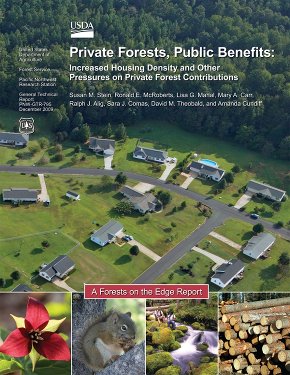
Download the report
Learn how to obtain a hard copy
Overview
This report is one of several produced by the U.S. Department of Agriculture, Forest Service as part of the Forests on the Edge project. It displays and describes information at a national level that can improve understanding of forest land development issues.
Key Points Covered
- Areas nationwide where private forests make substantial contributions to clean water, timber volume, habitat for at-risk plant and animal species or interior forests
- Where private forest contributions are likely to change because of increased housing density
- Locations where change from increased housing density is likely to be exacerbated by other factors such as insect pests and diseases, wildfire, or air pollution
- Private forest lands that are making the most important contributions are also facing the greatest pressures in certain areas throughout the country
Top 15 watersheds in terms of total acreage of private forest projected to experience increased housing density

Study Results
Private Forests, Public Benefits has identified areas where the following goods and services will be most affected by future forest land development:
- Forest cover: Watersheds in the East rank highest for increased housing density on private forests. Highly ranked watersheds are also located in Washington, Colorado, and California.
Click here for national map - Water quality: Watersheds in the East have the highest potential for future change in water quality as a result of future housing density increases on private forests.
Click here for national map
Click here for a table of the top 15 watersheds - Timber volume: Watersheds throughout the East, and especially in New England, and the southern Appalachians, as well as in Washington, Oregon, and California rank highest with respect to likelihood of change in timber volume due to increased housing density.
Click here for national map
Click here for a table of the top 15 watersheds - At-Risk Species: Watersheds in most of Florida, as well as the southern Appalachians, and parts of Michigan, eastern Texas, western Oregon, and central California are most likely to experience future change in the number of at-risk species due to future development of private forests.
Click here for national map
Click here for a table of the top 15 watersheds - Interior forest: Watersheds where interior forest is most likely to be reduced by increased housing density are found along an axis stretching from Maine to Louisiana, as well as along the coasts of South Carolina, Georgia, and northern Florida. High-ranking watersheds are also found in coastal Washington, California's Sierra Nevada range, and in the vicinity of Denver, Colorado.
Click here for national map
Click here for a table of the top 15 watersheds - Top 15 watersheds in terms of total acreage of private forest projected to experience increased housing density
Private Forest, Public Benefits also identifies areas where the impacts of future development could be exacerbated by the following threats:
- Insect Pests and Diseases: Watersheds with private forests under greatest pressure from insect pests and diseases as well as housing development are scattered throughout the country. Eastern watersheds are found in New England, New Jersey, Pennsylvania, North Carolina, South Carolina, and Michigan. In the West, high-ranking watersheds are found in western Montana, Oregon, California, and the southwest.
Click here for national map
Click here for a table of the top 15 watersheds - Wildfire: Many of the western watersheds included in this study are classified as having high wildfire potential. Watersheds with private forests most at-risk from wildfire and housing development combined are scattered across the West and the southeast.
Click here for national map
Click here for a table of the top 15 watersheds - Ozone pollution: Watersheds with forests most exposed to ozone pollution as well as most likely to experience future development are found primarily in the East and California.
Click here for national map
Click here for a table of the top 15 watersheds
Private forests are experiencing increases in housing density in every region of the United States. With the U.S. population projected to increase by at least another 80 million people by 2030, forest resource managers should anticipate and prepare for continued development pressures on the Nation's private forests.

Reference:
Stein, S.M.; McRoberts, R.E.; Mahal, L. G.; Carr, M.A.; Alig, R.J.; Comas, S.J.; Theobald, D.M.; Cundiff, A. 2009. Private Forests, Public Benefits: Increased Housing Density and Other Pressures on Private Forest Contributions. Gen. Tech. Rep. PNW-795. Portland, OR: U.S. Department of Agriculture, Forest Service, Pacific Northwest Research Station. 74 p.