INTRODUCTION
As the popularity of our national forests grows, greater demands are placed
on areas to park, view, and enjoy the beauty of the outdoors. In the past,
parking areas that were not defined with asphalt and/or striping were adequate
to handle traffic. However, as more people use recreation areas, the need
to direct traffic and provide an orderly arrangement for parking increases.
Considerations for
designing effective traffic flow and parking arrangements include:
- Clearly marked designated
spaces for emergency or other kinds of access.
- Adequate pullout and turnaround
areas to ensure visitor safety.
- Clearly designated parking
areas for visitor use.
|
| Figure 1. Stacked
parking in an unmarked parking area. |
The goal of the project was
to conduct a search for suitable products or methods to designate parking
on unpaved and gravel parking areas. The ideal method would increase visitor
enjoyment both by eliminating confusion and stacked parking problems and
by reducing traffic problems in busy areas.
|
| Figure 2. Traffic
congestion and stacked parking. |
Researchers learned two important
facts from this project.
- If a design is provided,
a majority of visitors will use it properly and follow directions.
- In order to increase the
pleasure, ease of use, and safety of visitors, the Forest Service needs
to provide them with directions to follow in parking areas.
METHODOLOGY
Researchers conducted a search of products to identify those that seemed
best suited to designate parking on unpaved and gravel parking areas and
were cost-effective in their application
Wheel
stops
Landscape timbers or railroad ties
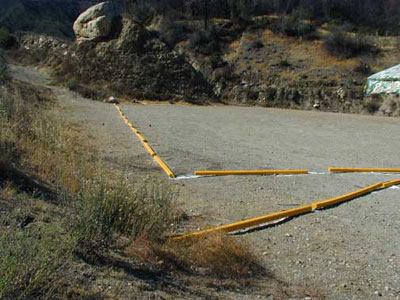
A traditional parking lot was laid out so it could easily be recognized
by visitors. Landscape timbers, the least expensive product at approximately
$2 per timber, were chosen to delineate the parking perimeter and parking
spaces. The 8-ft timbers were primed, painted safety yellow, and drilled
with 1/2-in holes at a distance of 8 in from each end of the timber.
|
Figure
3. Primed, painted, and drilled timber ready for installation. |
The timbers were anchored around
the perimeter of the parking lot with ½-in rebar. When the layout was
complete, the timbers, which appear as wheel stops, define the parking
lot and the parking spaces.
|
| Figure 4. Rincon
Fire Station crew helps install timbers. |
|
| Figure 5. Defined
parking area and spaces. |
Cement stops
Cement stops can be used in place of landscape timbers. They are installed
similarly but at a much higher cost. They are also much heavier. Plastic
or rubber stops, or parking blocks Plastic or rubber stops, or parking
blocks can also be used in place of landscape timbers. Like the cement
stops, cost and weight are a factor. Each stop or block costs approximately
$75 and weighs 35 lb.
Striping
Chalk or paint lines
Chalk, lime, or paint are often used to identify parking on unpaved areas.
Using a liner or striper is recommended when applying the line to delineate
parking spaces. The price of the striper ranges from $100 to $300. Striping
an area is a temporary method. Since the weather is always changing, restriping
should occur as needed.
Construction whiskers
or stake chasers
Construction whiskers or stake chasers are heavy-duty polyethylene bristles
secured by a metal band. They can be attached to wooden stakes or hubs,
or nailed directly into the ground. To delineate parking spaces, the construction
whiskers were installed with a 60 penny (60d) nail, 6 in apart and 10
ft in length. Around the perimeter of the parking area, the whiskers were
installed 1 ft apart. Yellow colored whiskers were tried, but because
their color blended in with the surrounding vegetation, a fluorescent
pink was used instead. A lime striping was also used over the whiskers
to outline the parking spaces. It was discovered that visitors did not
recognize the area as parking, but instead associated the fluorescent
pink whiskers with a possible construction zone. If a sign was used denoting
this space as a "parking zone," visitors may have used it. In the future
it may be advisable to use whiskers as markers at the top and bottom of
each stripe for ease in restriping when the chalk or paint lines fade
with use.
Paving
Road Oyl® Resin Modified Emulsion
Road Oyl® is used to stabilize the soil so stops can be installed
for a more permanent parking area. Application rate is 1 gal/yd2 per 1-in
depth. The Road Oyl® is a more expensive alternative at a cost of
approximately $310 for a 55-gal drum. For large parking lots Road Oyl®
can be purchased less expensively in bulk quantities. Other methods of
delineation are available to mark parking spaces and areas. Rocks and
logs at the site may be readily available as native materials. Products
such as bollards, stakes, signs, and reflective markers are available
in a number of catalogs including EMED Co., Inc., Global Industrial Equipment,
P.S. Plus, Seton Identification Products, Barco Products Company, and
Allstate Traffic and Safety Signs.
OBSERVATIONS
The recommended ways to delineate parking areas are striping and landscape
timbers. These methods meet the need to control and organize vehicle parking.
Visitors recognized them as symbols for parking and responded accordingly.
The landscape timbers are effective and people organized their vehicles
in a parking pattern. When chalk lines are added to the center of the
large lot to further delineate another parking area, people not only used
this simple mark to line up their vehicles, but they also repeated the
pattern closer to the road without having a chalked area present. In high-use
recreation areas, such as southern California where these methods were
tried, it may be advantageous to pave and use striping to delineate parking
areas. This improves safety and achieves maximum utilization and efficiency.
In areas that get high use only occasionally or seasonally, landscape
timbers and striping may be sufficient.
|
Figure
7. Shows pattern of vehicles arranged using landscape timbers and
chalk lines. Note the vehicles in the foreground that line up without
the use of chalk lines. |
If an area is overcrowded or
insufficient parking area is provided, monitoring and management control
may be the best way to manage high-use areas.
Finally, the most significant
observation of researchers was that when an area was laid out to be easily
recognized as an orderly way to park, people responded, which resulted
in increased safety and enjoyment for all.
Wheel stops were installed
in August 2000. At the same time, the center of the parking area was marked
with chalk. One year later, the timber wheel stops remain in place and
are being used. The chalk lines are gone, but visitors park in an organized
manner throughout the parking area. |
|
For Additional Information
Contact:
Project Leader, Recreation Management
San Dimas Technology & Development Center
444 East Bonita Avenue, San Dimas CA 91773-3198
Phone 909-599-1267; TDD: 909-599-2357; FAX: 909-592-2309
E-mail: mailroom_wo_sdtdc@fs.fed.us
Information
contained in this document has been developed for the guidance of employees
of the Forest Service, United States Department of Agriculture (USDA),
its contractors, and cooperating Federal and State agencies. The USDA
assumes no responsibility for the interpretation or use of this information
by other than its own employees. The use of trade, firm, or corporation
names is for the information and convenience of the reader. Such use does
not constitute an official evaluation, conclusion, recommendation, endorsement,
or approval of any product or service to the exclusion of others that
may be suitable.
The U.S. Department
of Agriculture (USDA) prohibits discrimination in all its programs and
activities on the basis of race, color, national origin, sex, religion,
age, disability, political beliefs, sexual orientation, or marital or
family status. (Not all prohibited bases apply to all programs.) Persons
with disabilities who require alternative means for communication of program
information (Braille, large print, audiotape, etc.) should contact USDA’s
TARGET Center at (202) 720-2600 (voice and TDD).
To file a complaint
of discrimination, write USDA, Director, Office of Civil Rights, Room
326-W, Whitten Building, 1400 Independence Avenue, SW, Washington, D.C.
20250-9410 or call (202) 720-5964 (voice and TDD). USDA is an equal opportunity
provider and employer. |