| |
|
||
| |
June 2002 | |
|
| |
|||
| |
0251 1305-SDTDC | ||
| |
|||
| |
||||||||||||||||||||||||
New
and Improved Flap Cup Grinder Disc Lois Sicking, Mechanical Engineer Gary Moorhead, Region 6 Equipment Specialist INTRODUCTION Moving the grinder over the tool too slowly also generates extreme temperatures. This change in temper, or hardness properties, can occur on all or part of the tool blade. The change in temper is typically accompanied by discoloration of the metal to blue or purple tones. Moving the grinder too quickly requires excessive passes to achieve a uniform, smooth, sharp edge; thereby removing more metal than necessary. Only the most experienced tool manager is able to use a standard grinding disc without changing the temper of the tool blade. This change in tempering affects metal hardness and the ability to hand-file the tool during routine sharpening in the field. This decreases tool life and fireline productivity. See figures 1a and 1b.
Flap
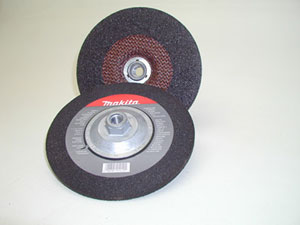
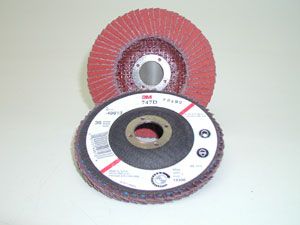
Cup Disc Technology A standard grinding stone or sanding disc wears uniformly before needing to be replaced. Flap cup discs provide a slight bevel to the grinding surface, angled for better surface coverage, enhancing the tool manager's ability to create a uniform sharp edge. See figures 2a and 2b.
Flap cup discs wear more quickly than traditional sanding discs but require less time to sharpen tools. Consequently, a flap cup disc can sharpen about the same number of tools, 60 to 80, as the traditional sanding grinder. Field users report favorably on the use of a flap cup disc with a small, lightweight, variable-speed grinder that allows slower speeds. Variable speed grinders are commercially available from hardware stores. Several brands of flap cup grinder discs are commercially available at hardware stores. They are moderately priced between $7 and $10 per disc. No specific brands or stores are rated superior to any others. Using
Abrasive Discs and Grinders
Grinder Safety
Changing Abrasive Discs
Grinding
For further information on sharpening, care, use, and maintenance of fire handtools, see the publication Firefighters Guide, PMS 414-1, NFES 1571, July 1986.> For further information or to share comments and recommendations for further study, contact SDTDC by phone at 909-599-1267 or by e-mail at mailroom_wo_sdtdc@fs.fed.us. |
||||||||||||||||||||||||

Project Leader, Fire Management San Dimas Technology & Development Center 444 East Bonita Avenue, San Dimas CA 91773-3198 Phone 909-599-1267; TDD: 909-599-2357; FAX: 909-592-2309 E-mail: mailroom_wo_sdtdc@fs.fed.us Information contained in this document has been developed for the guidance of employees of the Forest Service, United States Department of Agriculture (USDA), its contractors, and cooperating Federal and State agencies. The USDA assumes no responsibility for the interpretation or use of this information by other than its own employees. The use of trade, firm, or corporation names is for the information and convenience of the reader. Such use does not constitute an official evaluation, conclusion, recommendation, endorsement, or approval of any product or service to the exclusion of others that may be suitable. The U.S. Department of Agriculture (USDA) prohibits discrimination in all its programs and activities on the basis of race, color, national origin, sex, religion, age, disability, political beliefs, sexual orientation, or marital or family status. (Not all prohibited bases apply to all programs.) Persons with disabilities who require alternative means for communication of program information (Braille, large print, audiotape, etc.) should contact USDA’s TARGET Center at (202) 720-2600 (voice and TDD). To file a complaint of discrimination, write USDA, Director, Office of Civil Rights, Room 326-W, Whitten Building, 1400 Independence Avenue, SW, Washington, D.C. 20250-9410 or call (202) 720-5964 (voice and TDD). USDA is an equal opportunity provider and employer. |