- home -
Introduction
Acid mine drainage (AMD) from abandoned mines contributes to the degradation of streams and riparian areas and may harm fish and wildlife. Plugging mine openings to eliminate or reduce the flow of AMD has only had limited success. Expensive water treatment plants that require power and frequent maintenance are not feasible for abandoned mine sites on remote lands managed by the Forest Service. The Missoula Technology and Development Center (MTDC) has been asked to investigate passive AMD treatments that may work on small, remote abandoned mine sites typical of National Forests.
 |
| Figure 1-More than 3,000 mine sites were inventoried on National Forests and Bureau of Land Management Resource Areas in Montana. Of these, 336 sites had one or more adits discharging water at least part of the year. A total of 141 adit discharges were sampled. |
The Montana Bureau of Mines and Geology (MBMG) lists 8,120 sites in its abandoned and inactive mines data base. The Bureau of Mines has inventoried and collected information for 3,678 of these sites on lands administered by the USDA Forest Service and USDI Bureau of Land Management (Figure 1). In a program developed by the Bureau of Mines and the Forest Service, the location of each site is verified and compared to a set of screening criteria that determines the action taken at each site. In general, the sites are investigated on a watershed-by-watershed basis within each National Forest or BLM Resource Area. Inventories and preliminary evaluations have been completed for the Beaverhead-Deerlodge, Helena, Kootenai, and Lewis and Clark National Forests and for BLM-administered lands statewide. Sites in the Lewis and Clark National Forest were not included in this report because all of discharging adits inventoried to date are on private land. All the information collected is stored in the Bureau of Mines Abandoned and Inactive Mines data base and Groundwater Information Center data bases. The site evaluations for each drainage are summarized in a series of reports by the Montana Bureau of Mines and Geology.
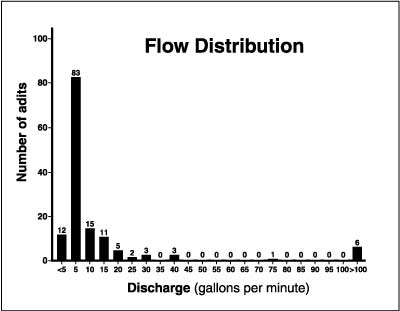 |
| Figure 2-Of the 141 adit discharges sampled, only six were discharging more than 100 gallons per minute. Most discharges were from 5 to 10 gallons per minute. |
The majority of the adits (78 percent) discharge water at rates of less than 10 gal/min (Figure 2). Only six adits had discharges over 100 gal/min. The primary factor in controlling the rate of discharge is the relative depth and extent of the underground workings. Mines with extensive horizontal workings or with adits on the lower slopes of a watershed have larger capture zones to intercept ground water. The same is true for the horizontal extent of the workings. Sites with adit discharges greater than 50 gal/min generally have at least 1,500 feet of vertical and horizontal workings.