



Tony Petrilli, Project Leader
All firefighters are encouraged to carry the New Generation fire shelter. According to the National Fire and Aviation Executive Board (Federal wildland fire directors and the National Association of State Foresters fire director), target dates for transition to the New Generation fire shelter are December 31, 2008, for Federal agency wildland firefighters and December 31, 2009, for all other wildland firefighters.
Many wildland firefighters already have been issued the New Generation fire shelter. The National Fire and Aviation Executive Board recognizes the need for an interagency transition strategy to meet the target dates. A small group will identify the factors involved in the transition. This group will include representation from Federal and State agencies as well as the county, local, and rural firefighters who assist with the suppression of wildland fires.
Highlights...
- Target dates for transition to the New Generation fire shelter are December
31, 2008, for Federal agency wildland firefighters and December 31, 2009,
for all other wildland firefighters.
- An Interagency Fire Shelter Advisory Board has been established to guide
the fire shelter program into the future.
- Although the New Generation fire shelter has less airspace than the old-style
fire shelter, tests show it performs much better.
- The pull-strap attachment point on PVC shelter bags manufactured since 2005 has been reinforced to prevent the pull strap from tearing off. This tech tip includes instructions for retrofitting older PVC fire shelter bags.
Interagency Fire Shelter Advisory Board
The Forest Service, U.S. Department of Agriculture, has provided the specifications and requirements for the fire shelter since the shelter's development during the 1960s. Because the fire shelter program is one of the most critical for the interagency wildland firefighting community, a new Interagency Fire Shelter Advisory Board has been established. The board held its first meeting in February 2006 in Boise, ID. The board's purpose is to guide the fire shelter program into the future, to involve stakeholder groups in decisions on fire shelter management, and to ensure that technical specialists at the Missoula Technology and Development Center (MTDC) receive needed support and direction from leadership.
Rips or Tears in Material and SeamsThe fire shelters are designed to be used just once. For more realistic training, many units practice deployments with actual shelters. Most reports of damage to fire shelters involve multiple deployments of the same shelter. MTDC has received two reports of open seams in the shelter shell, two reports of floor material tears after a single practice deployment, and one report of a missing holddown strap. MTDC has inspected more than 300 shelters. No open seams and no missing hold-down straps have been found. In 2005, three fire shelters received slight damage to floor seams during deployment at the Tarkio Fire, I-90 Complex, in western Montana. Manufacturing inspections by the General Services Administration and MTDC have increased to meet the goal of zero defects. If you encounter a problem with a New Generation fire shelter, contact MTDC project leader Tony Petrilli at 406-329-3965.
Shake Handle DetachmentThere have been reports of shake handles becoming detached from shelters during practice deployments. MTDC performs shake and deployment tests as part of shelter inspections and has experienced no problems.
Shelter ShapeThe New Generation fire shelter holds its shape well when deployed. However, the midsection of the shell may droop in windy conditions. During design of the New Generation fire shelter, several support systems were evaluated, but no acceptable systems were found. MTDC continues to search for an acceptable support system to increase shelter rigidity.
Reduced AirspaceThe ability of the old-style shelter to protect firefighters depends on the reflectivity of the aluminum foil and the airspace inside the shelter. The New Generation fire shelter protects its occupant with a more heat-resistant material than the old-style fire shelter and with a shape that is more aerodynamic and rounded to better reflect radiant heat. Testing shows that even though the New Generation fire shelter has less airspace inside, it performs much better than the old-style shelter. During the development of the New Generation fire shelter in 2001 and 2002, fire shelter testing (figures 1 to 5) was performed by the Protective Clothing and Equipment Research Facility of the University of Alberta in Edmonton.

Figure 1—A New Generation fire shelter was exposed to
a radiant
heat panel
during fire shelter testing at the
University of Alberta in Edmonton.

Figure 2—Internal temperatures in full-scale radiant heat tests.

Figure 3—Internal heat flux in full-scale radiant heat tests.|
Heat flux
is defined as the rate of energy transfer.
Death
is likely
if a person is exposed
to 14 to 18 kilowatts of heat per
square meter for 30 seconds.
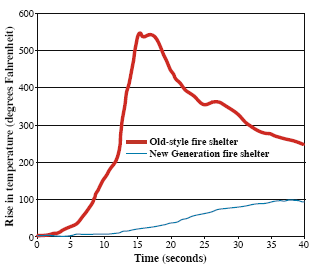
Figure 4—Internal temperatures in full-scale direct flame tests. The
flames
burned through the old-style shelter within 15 seconds. The
facility was not
able to run the burners for longer than 20 seconds.

Figure 5—Internal heat flux in full-scale direct flame tests.
The flames
burned
through the old-style shelter within 15 seconds.
Death is likely
if
a
person
is exposed to 14 to 18 kilowatts of heat per
square meter
for
30 seconds.
The facility was not able to run the burners
for longer than 20 seconds.
