Nomenclature
| Rod |
The rod is high carbon octagonal steel bar, 3/4 to
7/8 inches wide. Length may vary from 10 inches to several feet. |
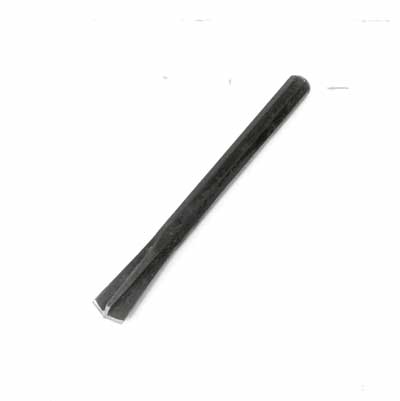 Star pattern bit
 |
| Bit |
The bit is the sharpened end of the rod. |
| Bit Gage |
The cutting edge is flared on 7/8 inch steel to a length of 1'/4
inches.* Other thicknesses of rod have similarly proportioned cutting
edges. |
| Effective length |
The effective length is the length of the steel that is available
for drilling, the total length less the shank or hand hold area. |
| Shank |
The shank is the area near the head where the driller or holder
grips the steel. |
| Head |
The head is the end of the rod opposite the cutting edge, and
receives the blow of the hammer. |
 Straight pattern bit
 |
| Plastic caps |
These are convenient for protecting sharpened cutting edges during
transportation and storage. The top cap also keeps ragged edges
from snagging other items. |
| Cutting edge angle |
This angle must be precisely maintained during sharpening and
reconditioning so the cutting edge remains in the center of the
rod. |
| Bits |
|
| Star Pattern Bit |
Two perpendicular cutting edges, flared and raised slightly, intersect
at the center of the bit. These are common on modern drilling steel. |
| Straight Pattern Bit |
These have a single flared, slightly raised, cutting edge. They
are old style bits, and may be found in second hand or antique stores. |
*We have not arbitrarily chosen this size rod. Water gels
approved for Forest Service blasting are packaged in polyester cartridges.
The length of these varies, but the smallest available diameter package
is 1 inch. A 1 1/4 inch hole is the minimum size that could easily accept
that package.



 E-mail: wo_mtdc_webmaster@fs.fed.us