Sclerocactus papyracanthus
Table of Contents
|
|
 |
| Paperspine fishhook cactus. Image by Rebou at the German language Wikipedia. |
Introductory
SPECIES: Sclerocactus papyracanthus
AUTHORSHIP AND CITATION :
Matthews, Robin F. 1994. Sclerocactus papyracanthus. In: Fire Effects
Information System, [Online]. U.S. Department of Agriculture, Forest Service,
Rocky Mountain Research Station, Fire Sciences Laboratory (Producer).
Available: Available: https://www.fs.usda.gov/database/feis/plants/cactus/sclpap/all.html
[].
Revisions:
On 20 March 2018, the common and scientific names of this species were changed in FEIS
from: Pediocactus papyracanthus, grama-grass cactus
to: Sclerocactus papyracanthus, paperspine fishhook cactus. Images were also added.
ABBREVIATION :
SCLPAP
SYNONYMS :
Pediocactus papyracanthus (Engelmann) L. Benson (Cactaceae) [2,17,18]
Toumeya papyracanthus (Engelm.) Britt. & Rose [4,8,17]
NRCS PLANT CODE :
SCPA10
COMMON NAMES :
paperspined cactus
grama-grass cactus
toumeya
TAXONOMY :
The scientific name of paperspine fishhook cactus is Sclerocactus papyracanthus
(Engelm.) N.P. Taylor (Cactaceae) [16].
LIFE FORM :
Cactus
FEDERAL LEGAL STATUS :
None
OTHER STATUS :
Paperspine fishhook cactus has only 6 to 20 occurrences globally and is
imperiled and vulnerable to extinction throughout its range. It is on
the Texas Natural Heritage Program's Special Plant List and is
critically imperiled and vulnerable to extirpation from Texas [13].
DISTRIBUTION AND OCCURRENCE
SPECIES: Sclerocactus papyracanthus
GENERAL DISTRIBUTION :
Paperspine fishhook cactus is found in the southern portion of Navajo County,
Arizona, and from southeast Rio Arriba County and McKinley County to
Grant and Dona Ana counties in New Mexico [1,2].  Additional populations
have been located in Hudspeth County, Texas [1,13].  Paperspine fishhook cactus
is inconspicuous and probably irregular in occurrence; it may be more
widespread than presently known [1,2].
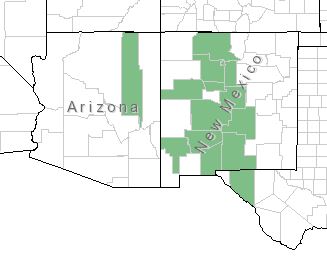 |
| Distribution of paperspine fishhook cactus. Map courtesy of USDA, NRCS. 2018. The PLANTS Database.
National Plant Data Team, Greensboro, NC [16] [2018, January 29]. |
ECOSYSTEMS :
   FRES35  Pinyon - juniper
   FRES40  Desert grasslands


STATES :
     AZ  NM  TX


BLM PHYSIOGRAPHIC REGIONS :
    7  Lower Basin and Range
   12  Colorado Plateau


KUCHLER PLANT ASSOCIATIONS :
   K023  Juniper - pinyon woodland
   K053  Grama - galleta steppe
   K054  Grama - tobosa prairie


SAF COVER TYPES :
   220  Rocky Mountain juniper
   239  Pinyon - juniper


SRM (RANGELAND) COVER TYPES :
504 Juniper-pinyon pine (Juniperus-Pinus spp.) woodland
735 Sideoats grama-sumac-juniper
 |
| Paperspine fishhook cactus habitat. Image by Rebou at the German language Wikipedia |
HABITAT TYPES AND PLANT COMMUNITIES :
Paperspine fishhook cactus grows in pinyon-juniper woodlands and in desert
grasslands and is almost always associated with grama (Bouteloua spp.),
especially blue grama (B. gracilis) [2,17].  It may also be associated
with dropseed (Sporobolus spp.) [11].
MANAGEMENT CONSIDERATIONS
SPECIES: Sclerocactus papyracanthus
IMPORTANCE TO LIVESTOCK AND WILDLIFE :
NO-ENTRY


PALATABILITY :
NO-ENTRY


NUTRITIONAL VALUE :
NO-ENTRY


COVER VALUE :
NO-ENTRY


VALUE FOR REHABILITATION OF DISTURBED SITES :
NO-ENTRY


OTHER USES AND VALUES :
NO-ENTRY


OTHER MANAGEMENT CONSIDERATIONS :
In New Mexico, populations of paperspine fishhook cactus are in decline, some
severely so.  However, its highly inconspicuous nature makes it a
difficult species to study.  Paperspine fishhook cactus is affected by
disturbances such as urban development, grazing, recreational use of
land, and cactus collection.  It was once common on grassy outwash fans
at the western edge of the Sandia Mountains, but that entire area is now
consumed by the eastern expansion of the city of Albuquerque.  Both
paperspine fishhook cactus and its habitat are destroyed by heavy off-road
vehicle traffic.  Paperspine fishhook cactus populations have often been quickly
depleted by cactus collectors.  Fairly tall paperspine fishhook cactus plants
may be common in ungrazed areas, but under moderate grazing intensities
plants are often trampled and taller plants are less frequent.  Soil
compaction due to grazing is also a problem since most paperspine fishhook
cactus seedlings are found on loose soil.  Light grazing may open the
grass cover and facilitate seedling establishment, whereas more intense
grazing reduces grass cover and exposes paperspine fishhook cactus to increased
predation by small herbivores.  Also, the loss of grass cover results in
increased erosion of topsoil and accelerates the loss of potential sites
for seedling establishment [11].
BOTANICAL AND ECOLOGICAL CHARACTERISTICS
SPECIES: Sclerocactus papyracanthus
GENERAL BOTANICAL CHARACTERISTICS :
Paperspine fishhook cactus is a native stem succulent with solitary stems 1 to 3
inches (2.5-7.5 cm) tall and 0.4 to 0.8 inch (1-2 cm) in diameter.  It
has no ribs and tubercles are elongate.  Areoles are 0.04 to 0.06 inch
(0.1-0.15 cm) in diameter and generally 0.12 inch (0.3 cm) apart.  The
spines are dense, often obscuring the surface of the stem.  The central
spines are up to 1.2 inches (3 cm) long and strongly flattened.  Radial
spines lie parallel to the stem surface and are up to 0.12 inch (0.3 cm)
long.  Flowers are found on new growth of the current season and are
therefore near the apex of the stem.  The fruit is green, often changing
to tan, and is dry at maturity.  The fruits are dehiscent along a dorsal
slit and around the circumscissile apex [2,17].  Paperspine fishhook cactus has
fibrous roots that are 2 to 4 inches (5-10 cm) long [4].


RAUNKIAER LIFE FORM :
   Stem succulents


REGENERATION PROCESSES :
NO-ENTRY


SITE CHARACTERISTICS :
Paperspine fishhook cactus is restricted to fine, sandy clay loams and red sandy
soils of open flats at 5,000 to 7,200 feet (1,500-2,200 m) elevation
[1,2].  It is often found on highly erodable sites [11].  Paperspine fishhook
cactus grows in or near fairy rings of blue grama, and is inconspicuous
because its spines resemble dried blue grama leaves [2,17].


SUCCESSIONAL STATUS :
NO-ENTRY


SEASONAL DEVELOPMENT :
NO-ENTRY
FIRE ECOLOGY
SPECIES: Sclerocactus papyracanthus
FIRE ECOLOGY OR ADAPTATIONS :
Specific information concerning adaptations that paperspine fishhook cactus may
have for survival following fire is not available in the literature.
Its small stature and the fact that it often occurs in or near clumps of
grama may make it particularly vulnerable to destruction by fire.  Paperspine
fishhook cactus may survive fire mainly in refugia.

Thomas [14] cited references suggesting that fire intervals in desert
grasslands may be 3 to 40 years.

FIRE REGIMES:
Find fire regime information for the plant communities in which this
species may occur by entering the species name in the FEIS home page
under "Find Fire Regimes".

POSTFIRE REGENERATION STRATEGY :
NO-ENTRY
FIRE EFFECTS
SPECIES: Sclerocactus papyracanthus
IMMEDIATE FIRE EFFECT ON PLANT :
The immediate effect of fire on paperspine fishhook cactus is unknown [15].
Paperspine fishhook cactus is probably killed by even light fires.

Succulents in general rarely actually burn, but spines may ignite and
flames are then carried to the apex.  The cactus body may scorch and
blister without pyrolysis.  The primary cause of mortality is death of
the photosynthetic tissue and underlying phloem and cambium.  Cacti may
appear completely scorched with no green tissue visible, yet may survive
fire.  However, fire can cause delayed mortality in small succulents
such as paperspine fishhook cactus.  Removal of spines by fire also increases
subsequent herbivory [14].  Some succulents survive fire in refugia or
if the litter surrounding them is sparse [5,14].


DISCUSSION AND QUALIFICATION OF FIRE EFFECT :
NO-ENTRY


PLANT RESPONSE TO FIRE :
NO-ENTRY


DISCUSSION AND QUALIFICATION OF PLANT RESPONSE :
NO-ENTRY


FIRE MANAGEMENT CONSIDERATIONS :
REFERENCES
SPECIES: Sclerocactus papyracanthus
REFERENCES :

 1.  Anon. 1992. Handbook of Arizona's endangered, threatened, and candidate
       plants. Summer 1992. [Place of publication unknown]: [Publisher
       unknown]. 57 p. On file with: U.S. Department of Agriculture, Forest
       Service, Intermountain Research Station, Fire Sciences Laboratory,
       Missoula, MT.  [20963]

 2.  Benson, Lyman. 1982. The cacti of the United States and Canada.
       Stanford, CA: Stanford University Press. 1044 p.  [1513]

 3.  Bernard, Stephen R.; Brown, Kenneth F. 1977. Distribution of mammals,
       reptiles, and amphibians by BLM physiographic regions and A.W. Kuchler's
       associations for the eleven western states. Tech. Note 301. Denver, CO:
       U.S. Department of the Interior, Bureau of Land Management. 169 p.
       [434]

 4.  Britton, N. L.; Rose, J. N. 1963. The Cactaceae. Vol. 3. New York: Dover
       Publications, Inc. 258 p.  [22644]

 5.  Cable, Dwight R. 1973. Fire effects in southwestern semidesert
       grass-shrub communities. In: Proceedings, annual Tall Timbers fire
       ecology conference; 1972 June 8-9; Lubbock, TX. Number 12. Tallahassee,
       FL: Tall Timbers Research Station: 109-127.  [4338]

 6.  Eyre, F. H., ed. 1980. Forest cover types of the United States and
       Canada. Washington, DC: Society of American Foresters. 148 p.  [905]

 7.  Garrison, George A.; Bjugstad, Ardell J.; Duncan, Don A.; [and others].
       1977. Vegetation and environmental features of forest and range
       ecosystems. Agric. Handb. 475. Washington, DC: U.S. Department of
       Agriculture, Forest Service. 68 p.  [998]

 8.  Kearney, Thomas H.; Peebles, Robert H.; Howell, John Thomas; McClintock,
       Elizabeth. 1960. Arizona flora. 2d ed. Berkeley, CA: University of
       California Press. 1085 p.  [6563]

 9.  Kuchler, A. W. 1964. Manual to accompany the map of potential vegetation
       of the conterminous United States. Special Publication No. 36. New York:
       American Geographical Society. 77 p.  [1384]

10.  Raunkiaer, C. 1934. The life forms of plants and statistical plant
       geography. Oxford: Clarendon Press. 632 p.  [2843]

11.  Spellenberg, Richard. 1993. Species of special concern. In: Dick-Peddie,
       William A., ed. New Mexico vegetation: Past, present, and future.
       Albuquerque, NM: University of New Mexico Press: 179-224.  [21101]

12.  Stickney, Peter F. 1989. Seral origin of species originating in northern
       Rocky Mountain forests. Unpublished draft on file at: U.S. Department of
       Agriculture, Forest Service, Intermountain Research Station, Fire
       Sciences Laboratory, Missoula, MT; RWU 4403 files. 7 p.  [20090]

13.  Texas Parks and Wildlife Department. 1992. Special plant list: January
       31, 1992. Austin, TX: Texas Parks and Wildlife Department, Texas Natural
       Heritage Program. 29 p.  [20507]

14.  Thomas, P. A. 1991. Response of succulents to fire: a review.
       International Journal of Wildland Fire. 1(1): 11-22.  [14991]

15.  Thomas, P. A.; Goodson, P. 1992. Conservation of succulents in desert
       grasslands managed by fire. Biological Conservation. 60(2): 91-100.
       [19894]

16.  USDA Natural Resources Conservation Service. 2018. PLANTS Database, [Online].
      U.S. Department of Agriculture, Natural Resources Conservation Service
      (Producer). Available: https://plants.usda.gov  [34262]

17.  Weniger, D. 1970. Cacti of the Southwest. Austin, TX: University of
       Texas Press. 249 p.  [22645]

18.  Arp, Gerald. 1972. A revision of Pediocactus. Cactus & Succulent
       Journal. 44(5): 218-222.  [22646]
FEIS Home Page

