

|
|
FEIS Home Page |
|
|||
| Cushenbury milkvetch in the San Bernardino Mountains. Photo by Steve Matson. | |||
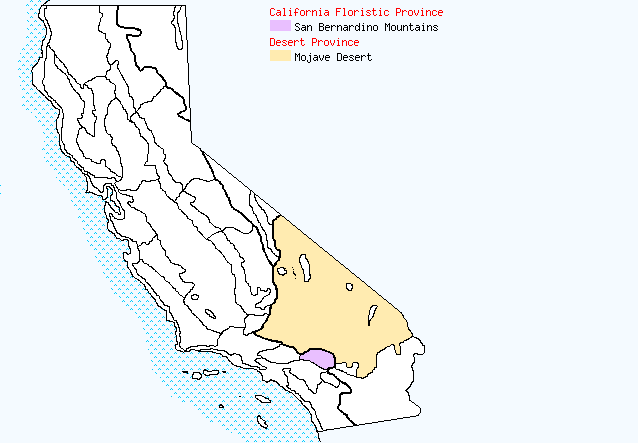 |
| Distribution of Cushenbury milkvetch. Map courtesy of the Jepson Herbarium [11]. |
Further information is needed on biology and life history of Cushenbury milkvetch, including its flowering and pollination biology, seed dispersal mechanisms, seed bank dynamics, seed viability, and seed predators [6,16].
FIRE REGIMES :
Find fire regime information for the plant communities in which this
species may occur by entering the species name in the FEIS home page under
"Find Fire Regimes".
As of 2012, two studies on the San Bernardino National Forest provided information on the fire ecology of Cushenbury milkvetch. Postfire monitoring of Cushenbury milkvetch was done following the August 1999 Willow Wildfire. The study was conducted in the carbonate habitat of Dry Canyon, where the Willow Wildfire burned at low to medium severity. Although burned and partially burned Cushenbury milkvetch plants were not identifiable, extensive prefire surveying of Dry Canyon showed Cushenbury milkvetch was present throughout the area; therefore, it was assumed that Cushenbury milkvetch was present on study plots prior to the wildfire. Ten 1-m² circular plots were established in burned plots and in adjacent unburned plots. The number of tree and shrub species was significantly higher in burned than in unburned plots in postfire year 2 (P=0.01), but Cushenbury milkvetch plants were significantly fewer on burned than unburned plots in postfire month 2, postfire year 1, (P=0.05), and postfire year 2 (P=0.1) [13].
| Average density of Cushenbury milkvetch (plants/m²) on 10 burned and 10 unburned plots [13] | ||||
| Survey Date | (postfire month 2) |
(postfire year 1) |
(postfire year 1.5) |
(postfire year 2) |
| Burned | 0 | 0.9 | 2.0 | 1.8 |
| Unburned | 3.8 | 6.0 | 9.0 | 8.6 |
Although Cushenbury milkvetch individuals were fewer in burned plots, the density of Cushenbury milkvetch plants changed at the same rate on burned and unburned plots through postfire year 2. The paper concluded that between June 2001 and August 2001, the decrease in the number of Cushenbury milkvetch individuals in both plot types resulted from extreme dry summer conditions. This decrease was not significant, but it suggests that favorable weather conditions are important for the postfire recovery of Cushenbury milkvetch. The paper also concluded that, due to the overall increase in the total number of Cushenbury milkvetch individuals on burned plots through postfire year 2, Cushenbury milkvetch has some resilience to fire. However, the method of postfire regeneration (seeds or sprouting) “was not evident”. An increase in Cushenbury milkvetch individuals in the unburned plots may indicate that heat scarification is not required for germination [13].
In a separate study of the carbonate habitats burned by the 1999 Willow Wildfire, Cushenbury milkvetch numbers increased slightly in postfire year 2 compared to prefire plots. Vegetation plots (0.1 acre (0.04 ha)) were established and monitored in 1994, 1995, and 1998. Cushenbury milkvetch was documented on 7 of the 42 prefire plots. After the wildfire, Cushenbury milkvetch was present on 5 of the 7 plots, and the total number of individuals increased from 297 in 1999 to 494 individuals in 2001 (postfire year 2) [61349]}.
The carbonate habitats where Cushenbury milkvetch occurs support sparse vegetation and minimal litter. Historically, carbonate habitats likely experienced low-severity fires [13], although the fire history of these habitats is unknown.
The Fire Regime Table summarizes characteristics of fire regimes for vegetation communities in which Cushenbury milkvetch may occur. Find further fire regime information for the plant communities in which this species may occur by entering the species name in the FEIS home page under "Find Fire Regimes".
Further research is needed on all aspects of Cushenbury milkvetch ecology.
LEGAL STATUS AND MANAGEMENT:| Fire regime information on vegetation communities in which Cushenbury milkvetch may occur. This information is taken from the LANDFIRE Rapid Assessment Vegetation Models [5], which were developed by local experts using available literature, local data, and/or expert opinion. This table summarizes fire regime characteristics for each plant community listed. The PDF file linked from each plant community name describes the model and synthesizes the knowledge available on vegetation composition, structure, and dynamics in that community. Cells are blank where information is not available in the Rapid Assessment Vegetation Model. | |||||
| Great Basin | |||||
| Vegetation Community (Potential Natural Vegetation Group) | Fire severity* | Fire regime characteristics | |||
| Percent of fires | Mean interval (years) |
Minimum interval (years) |
Maximum interval (years) |
||
| Great Basin Shrubland | |||||
| Basin big sagebrush | Replacement | 80% | 50 | 10 | 100 |
| Mixed | 20% | 200 | 50 | 300 | |
| Creosotebush (and Joshua tree) shrublands with grasses | Replacement | 57% | 588 | 300 | >1,000 |
| Mixed | 43% | 769 | 300 | >1,000 | |
| Great Basin Woodland | |||||
| Juniper and pinyon-juniper steppe woodland | Replacement | 20% | 333 | 100 | >1,000 |
| Mixed | 31% | 217 | 100 | >1,000 | |
| Surface or low | 49% | 135 | 100 | ||
| *Fire Severities— Replacement: Any fire that causes greater than 75% top removal of a vegetation-fuel type, resulting in general replacement of existing vegetation; may or may not cause a lethal effect on the plants. Mixed: Any fire burning more than 5% of an area that does not qualify as a replacement, surface, or low-severity fire; includes mosaic and other fires that are intermediate in effects. Surface or low: Any fire that causes less than 25% upper layer replacement and/or removal in a vegetation-fuel class but burns 5% or more of the area [1,4]. |
|||||
1. Barrett, S.; Havlina, D.; Jones, J.; Hann, W.; Frame, C.; Hamilton, D.; Schon, K.; Demeo, T.; Hutter, L.; Menakis, J. 2010. Interagency Fire Regime Condition Class Guidebook. Version 3.0, [Online]. In: Interagency Fire Regime Condition Class (FRCC). U.S. Department of Agriculture, Forest Service; U.S. Department of the Interior; The Nature Conservancy (Producers). Available: http://www.frcc.gov/. [85876]
2. California Native Plant Society. 2012. Inventory plant detail: Astragalus albens, [Online]. In: Inventory of rare and endangered plants. Version v8-01a. Sacramento, CA: California Native Plant Society (Producer). Available: http://www.rareplants.cnps.org/detail/292.html [2012, November 27]. [86302]
3. Gonella, Michael P.; Neel, Maile C. 1995. Characterizing rare plant habitat for restoration in the San Bernardino National Forest. In: Roundy, Bruce A.; McArthur, E. Durant; Haley, Jennifer S.; Mann, David K., compilers. Proceedings: wildland shrub and arid land restoration symposium; 1993 October 19-21; Las Vegas, NV. Gen. Tech. Rep. INT-GTR-315. Ogden, UT: U.S. Department of Agriculture, Forest Service, Intermountain Research Station: 81-93. [24830]
4. LANDFIRE Rapid Assessment. 2005. Reference condition modeling manual (Version 2.1), [Online]. In: LANDFIRE. Cooperative Agreement 04-CA-11132543-189. Boulder, CO: The Nature Conservancy; U.S. Department of Agriculture, Forest Service; U.S. Department of the Interior (Producers). 72 p. Available: https://www.landfire.gov /downloadfile.php?file=RA_Modeling_Manual_v2_1.pdf [2007, May 24]. [66741]
5. LANDFIRE Rapid Assessment. 2007. Rapid assessment reference condition models, [Online]. In: LANDFIRE. U.S. Department of Agriculture, Forest Service, Rocky Mountain Research Station, Fire Sciences Lab; U.S. Geological Survey; The Nature Conservancy (Producers). Available: https://www.landfire.gov /models_EW.php [2008, April 18] [66533]
6. MacKay, Pamela J. 2005. Species accounts: Cushenbury milkvetch (Astragalus albens), [Online]. In: Historical information. In: Final impact report and statement for the West Mojave Plan: A habitat conservation plan and California desert conservation area plan amendment. 7 p. Moreno Valley, CA: U.S. Department of the Interior, Bureau of Land Management, California Desert District (Producer). Available: http://www.blm.gov/style/medialib//blm/ca/pdf/pdfs/cdd_pdfs.Par.0a16d740.File.pdf/cushmilk1.PDF [2012, December 4]. [86262]
7. Padgett, Pamela E.; Dobrowolski, Wendy M.; Arbaugh, Michael J.; Eliason, Scott A. 2007. Patterns of carbonate dust deposition: implications for four federally endangered plant species. Madrono. 54(4): 275-285. [86278]
8. Raunkiaer, C. 1934. The life forms of plants and statistical plant geography. Oxford: Clarendon Press. 632 p. [2843]
9. Stephenson, John R.; Calcarone, Gena M. 1999. Southern California mountains and foothills assessment. Gen. Tech. Rep. PSW-GTR-172. Albany, CA: U.S. Department of Agriculture, Forest Service, Pacific Southwest Research Station. 402 p. [35525]
10. Stickney, Peter F. 1989. Seral origin of species comprising secondary plant succession in northern Rocky Mountain forests. FEIS workshop: Postfire regeneration. Unpublished draft on file at: U.S. Department of Agriculture, Forest Service, Rocky Mountain Research Station, Fire Sciences Laboratory, Missoula, MT. 10 p. [20090]
11. The Jepson Herbarium. 2013. Jepson online interchange for California floristics, [Online]. In: Jepson Flora Project. Berkeley, CA: University of California, The University and Jepson Herbaria (Producers). Available: http://ucjeps.berkeley.edu/interchange.html [70435]
12. U.S. Department of Agriculture, Forest Service, Pacific Southwest Region. 2005. Species account: Astragalus albens. In: Reading room--Species accounts-plants. In: Revised Land Management Plans and Final Environmental Impact Statement: Angeles National Forest, Cleveland National Forest, Los Padres National Forest, San Bernardino National Forest. R5-MB-086-CD [CD ROM]. Vallejo, CA: U.S. Department of Agriculture, Forest Service, Pacific Southwest Region (Producer). On file with: U.S. Department of Agriculture, Forest Service, Cleveland National Forest. [86264]
13. U.S. Department of Agriculture, Forest Service, San Bernardino National Forest. 2002. Effects of the 1999 Willow Fire on threatened, endangered, sensitive, and watch list plant species and their habitats on the San Bernardino National Forest. Final accomplishment report--monitoring funded under the National Fire Plan in 2001. San Bernardino, CA: San Bernardino National Forest. 41 p. Unpublished report on file with: U.S. Department of Agriculture, Forest Service, Rocky Mountain Research Station, Fire Sciences Laboratory, Missoula, MT; RWU 4403 files. [61349]
14. U.S. Department of Agriculture, Natural Resources Conservation Service. 2013. PLANTS Database, [Online]. Available: https://plants.usda.gov /. [34262]
15. U.S. Department of the Interior, Fish and Wildlife Service. 2016. Endangered Species Program, [Online]. Available: http://www.fws.gov/endangered/. [86564]
16. U.S. Department of the Interior, Fish and Wildlife Service. 1997. San Bernardino Mountains carbonate endemic plants draft recovery plan: Erigeron parishii (Parish's daisy), Eriogonum ovalifolium var. vineum (Cushenbury buckwheat), Astragalus albens (Cushenbury milk-vetch), Lesquerella kingii ssp. bernardina (San Bernardino Mountains bladderpod), Oxytheca parishii var. goodmaniana (Cushenbury oxytheca). Portland, OR: U.S. Fish and Wildlife Service, Region 1. 51 p. [86263]
17. U.S. Department of the Interior, Fish and Wildlife Service. 2009. Astragalus albens (Cushenbury milk-vetch). Five-year review: Summary and evaluation. Carlsbad, CA: Carlsbad Fish and Wildlife Office. 20 p. [86261]
