Index of Species Information
SPECIES: Halogeton glomeratus
|
|
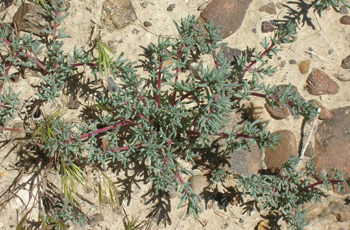 |
| Photo by Sheri Hagwood, hosted by the USDA-NRCS PLANTS Database. |
Introductory
SPECIES: Halogeton glomeratus
AUTHORSHIP AND CITATION :
Pavek, Diane S. 1992. Halogeton glomeratus. In: Fire Effects Information System, [Online].
U.S. Department of Agriculture, Forest Service, Rocky Mountain Research Station,
Fire Sciences Laboratory (Producer). Available:
https://www.fs.usda.gov/database/feis/plants/forb/grisqu/all.html [].
ABBREVIATION :
HALGLO
SYNONYMS :
NO-ENTRY
SCS PLANT CODE :
HAGL
COMMON NAMES :
halogeton
barilla
Aral barilla
TAXONOMY :
The currently accepted name of halogeton is Halogeton glomeratus (M.
Bieb.) C. A. Meyer; it is a member of the goosefoot family
(Chenopodiaceae). One author relegates halogeton to synonymy with the
European species, Halogeton sativus (L.) Moq. [98]. However, most
authors recognize halogeton as a separate and distinct species
[30,31,46,49,71,104]. There are no subspecies, varieties, or forms.
LIFE FORM :
Forb
FEDERAL LEGAL STATUS :
See OTHER STATUS
OTHER STATUS :
Halogeton is a noxious weed in the Pacific Northwest and Intermountain
states, and California, Hawaii, and New Mexico [102].
DISTRIBUTION AND OCCURRENCE
SPECIES: Halogeton glomeratus
GENERAL DISTRIBUTION :
Halogeton is an introduced species from southeastern Russia and
northwestern China [49,55,98].  In the United States, halogeton is found
in the Rocky Mountain and Great Basin regions and in two disjunct
infestations in Nebraska [30,31,46,71,77,104].

ECOSYSTEMS :
   FRES29  Sagebrush
   FRES30  Desert shrub
   FRES33  Southwestern shrubsteppe
   FRES40  Desert grasslands

STATES :
     CA  CO  ID  MT  NE  NV  NM  OR  UT  WY


BLM PHYSIOGRAPHIC REGIONS :
    5  Columbia Plateau
    6  Upper Basin and Range
    7  Lower Basin and Range
    8  Northern Rocky Mountains
    9  Middle Rocky Mountains
   10  Wyoming Basin
   11  Southern Rocky Mountains
   12  Colorado Plateau
   14  Great Plains
   16  Upper Missouri Basin and Broken Lands

KUCHLER PLANT ASSOCIATIONS :
   K038  Great Basin sagebrush
   K040  Saltbush - greasewood
   K055  Sagebrush steppe
   K056  Wheatgrass - needlegrass shrubsteppe
   K057  Galleta - three-awn shrubsteppe

SAF COVER TYPES :
   238  Western juniper
   239  Pinyon - juniper

SRM (RANGELAND) COVER TYPES :
NO-ENTRY

HABITAT TYPES AND PLANT COMMUNITIES :
Halogeton is typical in disturbed sites in salt-desert shrubland and
surrounding big sagebrush (Artemisia tridentata) steppe types, and in
transition zones from shadscale (Atriplex confertifolia) to big
sagebrush [9,24,103].  Where halogeton is the dominant forb, shadscale
is the dominant shrub in the salt-desert shrubland; halogeton may also
occur in various associations with other shrubs, such as winterfat
(Ceratoides lanata), bud sagebrush (Artemisia spinescens), greasewood
(Sarcobatus baileyi), and spiney hopsage (Atriplex spinosa) [12,13,14].
Infrequently, halogeton is a dominant understory forb in western juniper
(Juniperus osteosperma) communities.  Halogeton occurs as a dominant or
codominant with other annuals, such as cheatgrass (Bromus tectorum) and
tansymustards (Descurainia pinnata and D. sofia).

Publications that list halogeton as a dominant forb in habitat types in
Nevada are:

Vegetation and soils of the Crane Springs watershed [12],
Vegetation and soils of the Cow Creek watershed [13],
Vegetation and soils of the Duckwater watershed [14].
MANAGEMENT CONSIDERATIONS
SPECIES: Halogeton glomeratus
IMPORTANCE TO LIVESTOCK AND WILDLIFE :
Halogeton is high in oxalates and is a serious health threat to grazing
animals, especially sheep [25,49,55,104,107].  A sheep will be killed by
12 to 18 ounces [0.3-0.5 kg] of halogeton [23].  Symptoms of halogeton
poisoning have been described [70,102].  There is no treatment once an
animal is poisoned [99].

The amount of soluble oxalates in halogeton varies by season, locality,
and part of plant eaten [55].  As a halophyte, halogeton makes excessive
amounts of oxalic acid in response to excessive uptake of sodium ions
[41].  While halogeton is growing, oxalates are highly concentrated; 17
to 30 percent of dry plant weight is soluble oxalates [25,55].  Sheep
can safely consume halogeton after the soluble oxalate concentrations
are reduced through leaf loss or leaching by rain or snow [23,55,109].
Additionally, calcium-fortified pellets have been recommended as
supplements to sheep feeding in halogeton range, to compensate for the
calcium precipitation from the blood by oxalates [23,25,103].  Van Dyne
[103] recommends against using halogeton as forage [103].  However,
other studies indicate that halogeton is useable when it is mixed in
small amounts with other forage [70,96].  Krueger and Sharp [57]
reported that sheep can adapt to halogeton if it is fed to them in
gradually increasing amounts.  Adapted sheep can detoxify 75 percent
more oxalate than nonadapted sheep [57].

PALATABILITY :
Palatability is extremely low, and halogeton is seldom eaten by livestock
[24,99].  The palatability of halogeton is listed as poor for ungulates
in Montana, Utah, and Wyoming [28].  In Utah and Wyoming, halogeton
palatability is fair for small mammals, good for game and nongame birds,
and poor for waterfowl [28].

NUTRITIONAL VALUE :
NO-ENTRY

COVER VALUE :
Halogeton provides poor environmental protection for ungulates, game
birds, and waterfowl in Utah and Wyoming [28].  In these states, it provides
fair protection for small mammals and nongame birds [28].

VALUE FOR REHABILITATION OF DISTURBED SITES :
Halogeton is a noxious weed that must be prevented from establishing on
denuded or disturbed soils in the semiarid shrublands of the western
United States.  Halogeton makes an area less favorable for revegetation
with other species; it is difficult to establish desirable plants where
halogeton occurs [59].  At mine reclamation sites, several studies have
measured changes in halogeton establishment or abundance over many years
[2,7,68,75].  One study examined leachate from three levels of halogeton
mulch.  They found significant soil alteration:  increases in pH,
exchangeable sodium, potassium, magnesium, electrical conductivity, and
decreases in water percolation [25,33].  High salts inhibit
micro-organisms aiding nitrification, which depresses plant growth [33].
Halogeton does not form mycorrhizae and does well in mine spoils with
diluted or eliminated vesicular-arbuscular mycorrhizae [1,2,7].  Goodman
[42] added nitrogen to enhance native plant production, and halogeton
biomass doubled compared to unfertilized controls.

OTHER USES AND VALUES :
NO-ENTRY

OTHER MANAGEMENT CONSIDERATIONS :
Halogeton readily invades and dominates rangeland depleted by persistent
and continuous overgrazing [25,53,54,57,93].  Heavy sheep losses from
halogeton poisoning have occurred since 1940 on ranges in Idaho, Nevada,
and Utah [4,15,66,89,91,95].  The rapid spread of halogeton from 1935
through the 1940s, coupled with extensive livestock poisonings, resulted
in the Federal Halogeton Control Act [63].

The best defense against halogeton is a vigorous stand of perennial
range plants and variations in grazing patterns [4,15,47,77,101].
Moderate range use only after the growing season is the wisest halogeton
strategy [54,105].  Efforts must be taken to prevent vegetation
destruction by rodents and rabbits, road construction, surface mining,
or the use of off-road vehicles [15].

Three methods are used to control halogeton [24].

(1) Cultural control:  Introduced perennials, such as immigrant kochia
(Kochia prostrata), were planted with successful decrease in halogeton
cover [67,94].  Crested wheatgrass (Agropyron cristatum and A.
desertorum) was seeded extensively in depleted winter rangeland to slow
halogeton growth [65,111,113 but see 64,76].  Crested wheatgrass does
not suffer from halogeton competition, but from the saline-alkaline site
conditions where it occurs [20].  Some hybrids (for example, A.
desertorum cv.  Hycrest) can tolerate saline conditions.  Asay and
Johnson [3] found that a heavy halogeton infestation was essentially
elimated by year 2 after seeding with Hycrest.

(2) Biological control:  A stem-boring moth (Coleophora porthenica) from
Pakistan was released for halogeton control [77].  However, it failed to
establish.  The search for a biological control agent continues in
Soviet central Asia [77].  A case-bearing moth (Coleophora
atriplecivora) has been found on halogeton [69].  It is not currently
known what effect it has on halogeton; however, Moore and Stevens [69]
found that the case-bearing moth reduced seed production and foliage in
fourwing saltbush (Atriplex canescens).

Altered grazing practices can slow halogeton spread.  Studies showed
that high intensity grazing in early spring (March and April) increased
halogeton cover significantly in Utah [106].  Heavy spring grazing
causes rapid rangeland deterioration [60].  Halogeton was reported to
decrease in Nevada under early (mid-April to mid-June) grazing at
moderate intensity [85].

(3) Chemical control:  Halogeton is susceptible in the preflowering
stage to 2,4-D at 2 pounds active ingredients per acre (2.2 kg ai/ha)
[25,37,80].  Approximately 17 percent of the plants survive this rate
[101].  Higher 2,4-D rates of six pounds active ingredient per acre (6.7
kg ai/ha) are recommended to kill all halogeton; however, native plants
are severely impacted [23].  The application of 2,4-D must be repeated
annually for 6 to 10 years after the final halogeton seed crop [99].

Herbicide control is too expensive to be used on low-production ranges
on which halogeton occurs [77,78].  Widespread herbicide control of
halogeton was stopped because land managers did not have desirable
forage to replace halogeton, especially on saline-alkaline soils
[21,66,101].
BOTANICAL AND ECOLOGICAL CHARACTERISTICS
SPECIES: Halogeton glomeratus
GENERAL BOTANICAL CHARACTERISTICS :
Halogeton is an exotic succulent annual forb [42,104].  It has a
generalized type of root system; the taproot can penetrate as deep as 20
inches (51 cm), with a radial spread of 18 inches (46 cm) [32].  Many
main stems branch from the base of the plant and are low spreading
before becoming erect [107].  Halogeton can be a few inches high in
dense stands to 2 feet [61 cm] high in widely spaced stands [103,107].
Leaves are small, fleshy, and spine tipped [26,49].  Flowers are
inconspicuous in leaf axils and produce winged black and wingless brown
seeds [26,101].


RAUNKIAER LIFE FORM :
Therophyte

REGENERATION PROCESSES :
Halogeton can produce 75 seeds per inch (35 seeds per cm) of stem, which
is 200 to 400 pounds of seeds per acre (222-449 kg/ha) [25].  It
produces two types of seeds which are important to its spread and
persistence.  The production of brown seed is controlled by long
photoperiods; black seeds are produced during short photoperiods [114].
Black seeds have no dormancy and are viable for 1 year [24,88,114].
Late germinating and maturing plants only make black seeds [25,114].
Brown seeds have a dormancy and can survive buried for up to 10 years
[4,24,25,108].  This allows halogeton to survive during extended drought
periods.  Brown seeds readily germinated under moist conditions after a
3-month cold (35 degrees Fahrenheit [5.4 deg C]) treatment [24,88].

Halogeton has many agents of dissemination.  Halogeton seeds have a high
degree of viability after passing through the digestive tracts of sheep
and rabbits [24].  Animals are capable of spreading large amounts of
seed great distances; seeds pass with the feces [23,37,63,99].
Halogeton seeds are rapidly spread along roads by road equipment,
especially road graders [24].  Local spread of halogeton is primarily by
the wind [37,99].  Halogeton will break off at ground level when dry and
tumble with the wind, scattering mature seeds [109].  Whirlwinds or
dust-devils will transport dry stems with seeds up to 2 miles (3.2 km)
[24].  Western harvester ants collect seeds [39].  Brown seeds recovered
from anthills gave 5 to 20 percent germination [24].

SITE CHARACTERISTICS :
Halogeton is adapted to alkaline soils and semiarid environments
[47,107].  Halogeton is found from 2,526 to 7,218 feet (770-2,200 m) in
elevation throughout its range [19,38,43,44].  It occurs on soils that
are heavy clays, clay loams, sandy loams, and loamy sands [5,20,27,50].
Although halogeton can occur on many soil types, the sites usually are
saline [63].  Halogeton does best in soils where sodium chloride levels
are 5,800 p/m; increased salt does not increase the water requirements
of halogeton [25].  Soils may or may not have a prominent hardpan;
carbonates accumulate near the soil surface [16].  Soils are light
colored because little humus is present [50,97].  The soil pH ranges
from 8.0 to 9.0 [27,52].  Typically, there are large fluctuations in
daily temperatures [61].  Mean annual temperature is 42 degrees
Fahrenheit (5.5 deg C).  The abundance of halogeton depends upon year to
year precipitation, so outbreaks may sporadically appear [4,6,103].
Annual precipitation at most halogeton sites is from 5 to 13 inches
(127-330 mm) [21,50].  Approximately, 60 to 70 percent of precipitation
occurs as snow [21,50].

Halogeton has invaded open or disturbed ground such as dry lakebeds and
rodent workings [4,99].  Halogeton infests domestic stock trails,
overgrazed rangeland, and livestock congregation areas [46,49,71,82,86].
Halogeton invaded the disturbed areas left after dryland farms,
townsites, and mining camps were abandoned in the 1930's [25,33,52,56,
109].  Halogeton occurs in railroad rights-of-way, along road shoulders,
airstrips, and gravel pits [61,67,107].

Associated species, in addition to those previously mentioned (see
Habitat Types), are clasping pepperweed (Lepidium perfoliatum),
povertyweed (Iva axillaris), and bur buttercup (Ranunculus testiculatus)
[38,87].  Common grass associates are Indian ricegrass (Oryzopsis
hymenoides) and bottlebrush squirreltail (Elymus elymoides) [44].
Halogeton occurs with Gardner saltbush (Atriplex gardneri) in Colorado
and Wyoming [5].

SUCCESSIONAL STATUS :
Halogeton is a ruderal species that readily invades disturbed,
saline-alkaline ground where other species offer no or little
competition [37,47,74,77,105,107].  Halogeton does not establish in
vigorous competing vegetation because it does not grow a large shoot or
root system early in the growing season [32].

In the alkaline valley soils where halogeton occurs, shadscale
vegetation is considered an edaphic climax [115].  Human use leads to
permanent changes in the flora of disturbed arid environments [56].
After 70 years of grazing on some sites in the Great Basin, halogeton
was dominant on moderately disturbed areas with cheatgrass and shadscale
[56].  Halogeton may permanently change soil surfaces via salt pumping
which impedes moisture infiltration and enhances evaporation [88,105].
In a comparison of plots on areas that were grazed or protected for 15
years, Branson [17] observed that no succession occurred or that it
occurred very slowly.

Cleared big sagebrush areas follow a succession pattern that currently
climaxes in cheatgrass. Nelson and others [72] state that the succession
through introduced annuals to a cheatgrass climax is maintained by fire.
The order of appearance of vegetation changes are Russian thistle
(Salsola kali), tumblemustard (Sisymbrium altissimum), pinnate
tansymustard (Descurainia pinnata), and cheatgrass [112,116].  Young and
others [116] added halogeton to this sequence as an initial invader.
Halogeton is also a part of another seral continuum that climaxes with
medusahead (Taeniatherum caput-medusae) [116].

SEASONAL DEVELOPMENT :
Depending upon moisture, halogeton seedlings establish from February
through August, with a peak in April [24,99,101].  Halogeton builds its
root system during the cool weather, and topgrows during warmer weather
[54].  Seedlings begin rapid vegetative growth in May [24,109].  Growth
can continue through June; the best halogeton development occurs when
soil temperatures are between 60 and 80 degrees Fahrenheit (15-27 deg C)
[32].  In Utah, halogeton biomass was 4.1 pounds per acre (4.7 kg/ha)
over 5 years [6].  Near the first part of July, the plants cease
vegetative growth and begin reproductive growth [24].  Plants flower
during July and August.  Seeds begin to mature late August to early
September and are mature in October [24,25,96].  The frosts in October
and November will kill any plants not yet dried [51].  The majority of
black seeds are dropped by early November; however, brown seeds persist
and may remain on the plant until January or February [24].  Black seeds
may germinate after mid-December under favorable conditions [24].
Halogeton is a winter annual in the broad sense; plants may germinate in
the fall, winter, or spring, depending upon soil moisture [92].  Two
authors [96,103] state that halogeton is a warm-season plant; however,
since vegetative growth usually ceases at the end of June and seedling
establishment occurs predominantly in April, Parker [74] considers it a
cool-season plant.
FIRE ECOLOGY
SPECIES: Halogeton glomeratus
FIRE ECOLOGY OR ADAPTATIONS :
After halogeton dries, it does not readily decompose, which increases
fuel loads [24].  Dried halogeton is capable of spreading fire; flaming,
wind-thrown plants may enter unburned areas.  Halogeton can tumble
across burned areas, spreading seed [109].

FIRE REGIMES :
Find fire regime information for the plant communities in which this
species may occur by entering the species name in the FEIS home page under
"Find Fire Regimes".

POSTFIRE REGENERATION STRATEGY :
   Initial-offsite colonizer (off-site, initial community)
   Secondary colonizer - off-site seed
FIRE EFFECTS
SPECIES: Halogeton glomeratus
IMMEDIATE FIRE EFFECT ON PLANT :
Immediate effects of fire on halogeton were not found in the literature.
Halogeton is probably killed by fire; any seeds remaining on the plants
would also be killed.  Seeds present in the soil before fire are
probably destroyed.  Halogeton seeds are killed at 158 degrees
Fahrenheit (70 deg C), which is considerably lower than soil surface
temperatures that may occur in sagebrush fires [90].  Mack [63],
however, reported that halogeton seed survives summer fires in steppe
communities.

PLANT RESPONSE TO FIRE :
Halogeton seeds are probably transported from off-site into burned areas
within 1 or 2 years postfire [43].  Two years after a fall burn in
central Idaho where perennial plants were not damaged, halogeton
appeared [36].  One year following an Idaho burn that destroyed all
aboveground vegetation, halogeton increased in abundance, and by
postfire year 2, it had significantly increased in biomass [45].
Halogeton increased in frequency each year for 3 years postfire in
another study [90].


FIRE MANAGEMENT CONSIDERATIONS :
Prescribed burning will not control halogeton.  It colonizes from
off-site, readily invading bare or disturbed soils.
REFERENCES
SPECIES: Halogeton glomeratus
REFERENCES :

  1.  Allen, Edith B.; Allen, Michael F. 1988. Facilitation of succession by
       the nonmycotrophic colonizer Salsola kali (Chenopodiaceae)  on a harsh
       site: effects of mycorrhizal fungi. American Journal of Botany. 75(2):
       257-266.  [2921]

  2.  Allen, Michael F. 1989. Mycorrhizae and rehabilitation of disturbed arid
       soils: processes and practices. Arid Soil Research. 3: 229-241.  [9198]

  3.  Asay, K. H.; Johnson, D. A. 1987. Breeding for improved seedling
       establishment in cool-season range grasses. In: Frasier, Gary W.; Evans,
       Raymond A., eds. Proceedings of symposium: "Seed and seedbed ecology or
       rangeland plants; 1987 April 21-23; Tucson, AZ. Washington, DC: U.S.
       Department of Agriculture, Agricultural Research Service: 173-176.
       [2926]

  4.  Astroth, Kirk A.; Frischknecht, Neil C. 1984. Managing Intermountain
       rangelands--research on the Benmore Experimental Range, 1940-84. Gen.
       Tech, Rep. INT-175. Ogden, UT: U.S. Department of Agriculture, Forest
       Service, Intermountain Forest and Range Experiment Station. 44 p.  [361]

  5.  Baker, William L.; Kennedy, Susan C. 1985. Presettlement vegetation of
       part of northwestern Moffat County, Colorado, described from remnants.
       Great Basin Naturalist. 45(4): 747-783.  [384]

  6.  Beale, Donald M.; Smith, Arthur D. 1970. Forage use, water consumption,
       and productivity of pronghorn antelope in western Utah. Journal of
       Wildlife Management. 34(3): 570-582.  [6911]

  7.  Bernard, J. R.; Carter, R. P.; Cleaves, D. T.; [and others]. 1979. Land
       Reclamation Program annual report 1978. Argonne, IL: Argonne National
       Laboratory. 110 p.  [433]

  8.  Bernard, Stephen R.; Brown, Kenneth F. 1977. Distribution of mammals,
       reptiles, and amphibians by BLM physiographic regions and A.W. Kuchler's
       associations for the eleven western states. Tech. Note 301. Denver, CO:
       U.S. Department of the Interior, Bureau of Land Management. 169 p.
       [434]

  9.  Billings, W. D. 1951. Vegetational zonation in the Great Basin of
       western North America. Union Intl. Sci. Biol. Ser. B. 9: 101-122.  [443]

 10.  Billings, W. D. 1952. The environmental complex in relation to plant
       growth and distribution. Quarterly Review of Biology. 27(3): 251-265.
       [444]

 11.  Biswell, H. H. 1956. Ecology of California grasslands. Journal of
       Forestry. 9: 19-24.  [11182]

 12.  Blackburn, Wilbert H.; Eckert, Richard E., Jr.; Tueller, Paul T. 1969.
       Vegetation and soils of the Crane Springs Watershed. R-55. Reno, NV:
       University of Nevada, Agricultural Experiment Station. 65 p. In
       cooperation with: U.S. Department of the Interior, Bureau  of Land
       Management.  [456]

 13.  Blackburn, Wilbert H.; Eckert, Richard E., Jr.; Tueller, Paul T. 1969.
       Vegetation and soils of the Cow Creek Watershed. R-49. Reno, NV:
       University of Nevada, Agricultural Experiment Station. 77 p. In
       cooperation with: U.S. Department of the Interior, Bureau of Land
       Management.  [458]

 14.  Blackburn, Wilbert H.; Tueller, Paul T.; Eckert, Richard E., Jr. 1968.
       Vegetation and soils of the Duckwater Watershed. Reno, NV: University of
       Nevada, College of Agriculture. 81 p. In cooperation with: U.S.
       Department of the Interior, Bureau of Land Management.  [7439]

 15.  Blaisdell, James P.; Holmgren, Ralph C. 1984. Managing Intermountain
       rangelands--salt-desert shrub ranges. Gen. Tech. Rep. INT-163. Ogden,
       UT: U.S. Department of Agriculture, Forest Service, Intermountain Forest
       and Range Experiment Station. 52 p.  [464]

 16.  Bleak, A. T.; Frischknecht, N. C.; Plummer, A. Perry; Eckert, R. E., Jr.
       1965. Problems in artificial and natural revegetation of the arid
       shadscale vegetation zone of Utah and Nevada. Journal of Range
       Management. 18: 59-65.  [3992]

 17.  Branson, Farrel A. 1985. Vegetation changes on western rangelands. Range
       Monograph No. 2. Denver, CO: Society for Range Management. 76 p.  [5172]

 18.  Brotherson, Jack D.; Rasmussen, Lars L.; Black, Richard D. 1986.
       Comparative habitat and community relationships of Atriplex
       confertifolia and Sarcobatus vermiculatus in central Utah. Great Basin
       Naturalist. 46(2): 348-357.  [532]

 19.  Clark, William R.; Wagner, Frederic H. 1984. Role of livestock and
       black-tailed jackrabbits in changing abundance of Kochia americana.
       Great Basin Naturalist. 44(4): 635-645.  [634]

 20.  Cook, C. Wayne. 1961. Seeding response and soil characteristics on
       adjacent sagebrush and desert molly soils. Journal of Range Management.
       14: 134-138.  [674]

 21.  Cook, C. Wayne. 1965. Grass seedling response to halogeton competition.
       Journal of Range Management. 18: 317-321.  [3203]

 22.  Cook, C. Wayne. 1973. Forage utilization, daily intake, and nutrient
       value of desert range. In: Proceedings, 3rd Workshop of the United
       States/ Australia Rangelands Panel; 1973 March 26-April 5; Tucson, AZ.
       Denver, CO: Society For Range Management; 1973: 47-50.  [676]

 23.  Cook, C. Wayne; Stoddart, L. A. 1953. The halogeton problem in Utah.
       Bulletin 364. Logan, UT: Utah State Agricultural College, Agricultural
       Experiment Station. 44 p. In cooperation with: U.S. Department of the
       Interior, Bureau of Land Management.  [4597]

 24.  Cronin, Eugene H. 1965. Ecological and physiological factors influencing
       chemical control of Halogeton glomeratus. Technical Bulletin No. 1325.
       Washington, DC: U.S. Department of Agriculture. 65 p. In cooperation
       with: Utah Agricultural Experiment Station.  [4586]

 25.  Cronin, Eugene H.; Williams, M. Coburn. 1965. Principles for managing
       ranges infested with halogeton. Journal of Range Management. 19:
       226-227.  [4374]

 26.  Dayton, William A. 1960. Notes on western range forbs: Equisetaceae
       through Fumariaceae. Agric. Handb. 161. Washington, DC: U.S. Department
       of Agriculture, Forest Service. 254 p.  [767]

 27.  DeFlon, James G. 1986. The case for cheat grass. Rangelands. 8(1):
       14-17.  [775]

 28.  Dittberner, Phillip L.; Olson, Michael R. 1983. The plant information
       network (PIN) data base: Colorado, Montana, North Dakota, Utah, and
       Wyoming. FWS/OBS-83/86. Washington, DC: U.S. Department of the Interior,
       Fish and Wildlife Service. 786 p.  [806]

 29.  Dobrowolski, James P.; Ewing, Kern. 1990. Vegetation dynamics and
       environmental attributes of a Great Basin valley exhibiting widespread
       shrub dieback. In: McArthur, E. Durant; Romney, Evan M.; Smith, Stanley
       D.; Tueller, Paul T., compilers. Proceedings--symposium on cheatgrass
       invasion, shrub die-off, and other aspects of shrub biology and
       management; 1989 April 5-7; Las Vegas, NV. Gen. Tech. Rep. INT-276.
       Ogden, UT: U.S. Department of Agriculture, Forest Service, Intermountain
       Research Station: 103-114.  [12842]

 30.  Ferguson, Robert B.; Medin, Dean E. 1983. Long-term changes in an
       ungrazed bitterbrush plant community in southwest Idaho. In: Tiedemann,
       Arthur R.; Johnson, Kendall L., compilers. Proceedings--research and
       management of bitterbrush and cliffrose in western North America; 1982
       April 13-15; Salt Lake City, UT. General Technical Report INT-152.
       Ogden, UT: U.S. Department of Agriculture, Forest Service, Intermountain
       Forest and Range Experiment Station: 107-116.  [918]

 31.  Dorn, Robert D. 1988. Vascular plants of Wyoming. Cheyenne, WY: Mountain
       West Publishing. 340 p.  [6129]

 32.  Eckert, Richard E., Jr. 1954. A study of competition between whitesage
       and halogeton in Nevada. Journal of Range Management. 7: 223-225.
       [4582]

 33.  Eckert, Richard E., Jr.; Kinsinger, Floyd E. 1960. Effects of Halogeton
       glomeratus leachate on chemical and physical characteristics of soils.
       Ecology. 41(4): 764-772.  [494]

 34.  Eyre, F. H., ed. 1980. Forest cover types of the United States and
       Canada. Washington, DC: Society of American Foresters. 148 p.  [905]

 35.  Fisser, Herbert G.; Joyce, Linda A. 1984. Atriplex, grass, and forb
       relationships under no grazing, and shifting precipitation patterns in
       north-central Wyoming. In: Tiedemann, Arthur R., McArthur, E. Durant;
       Stutz, Howard C.; Stevens, Richard; Johnson, K.L, compilers.
       Proceedings--symposium on the biology of Atriplex and related chenopods;
       1983 May 2-6, Provo, UT. General Technical Report INT-172. Ogden, UT:
       U.S. Department of Agriculture, Forest Service, Intermountain Forest and
       Range Experiment Station: 87-96.  [930]

 36.  Fraley, L., Jr. 1978. Revegetation following a 1974 fire at the Idaho
       National Engineering Laboratory Site. In: Markham, O. D., ed. Ecological
       studies on the Idaho National Engineering Laboratory Site: 1978 Progress
       Report. IDO-12087. Idaho Falls, ID: U.S. Department of Energy, Environmental
       Sciences Branch, Radiological and Environmental Sciences Laboratory: 194-199.
       [953]

 37.  Frischknecht, Neil C. 1967. How far will halogeton spread? Journal of
       Soil and Water Conservation. 22: 135-139.  [5490]

 38.  Frischknecht, Neil C. 1968. Factors influencing halogeton invasion of
       crested wheatgrass range. Journal of Range Management. 21: 8-12.  [5319]

 39.  Frischknecht, Neil C.; Harris, Lorin E. 1968. Grazing intensities and
       systems on crested wheatgrass in central Utah: response of vegetation
       and cattle. Technical Bulletin No. 1388. Washington, D.C.: U.S.
       Department of Agriculture, Forest Service; 47 p.  [978]

 40.  Garrison, George A.; Bjugstad, Ardell J.; Duncan, Don A.; [and others].
       1977. Vegetation and environmental features of forest and range
       ecosystems. Agric. Handb. 475. Washington, DC: U.S. Department of
       Agriculture, Forest Service. 68 p.  [998]

 41.  Goodin, Joseph E. 1975. Salinity relations in shrubs. In: Stutz, Howard
       C., ed. Wildland shrubs: Proceedings-- symposium and workshop; 1975
       November 5-7; Provo, Utah. Provo, Utah: Brigham Young University: 1-31.
       [1031]

 42.  Goodman, P. J. 1973. Physiological and ecotypic adaptations of plants to
       salt desert conditions in Utah. Journal of Ecology. 61: 473-494.  [1032]

 43.  Groves, Craig R.; Steenhof, Karen. 1988. Responses of small mammals and
       vegetation to wildfire in shadscale communities of southwestern Idaho.
       Northwest Science. 62(5): 205-210.  [6584]

 44.  Guyer, Craig; Linder; Allan D. 1985. Growth & pop structure of the
       short-horned lizard (Phrynosoma douglassi)  & the sagebrush lizard
       (Sceloporus graciosus) in southeastern Idaho. Northwest Science. 59(4):
       294-303.  [5176]

 45.  Halford, Douglas K. 1981. Repopulation and food habits of Peromyscus
       maniculatus on a burned sagebrush desert in southeastern Idaho.
       Northwest Science. 55(1): 44-49.  [1058]

 46.  Harrington, H. D. 1964. Manual of the plants of Colorado. 2d ed.
       Chicago: The Swallow Press Inc. 666 p.  [6851]

 47.  Harris, Grant A. 1990. Cheat grass: invasion of potential and managerial
       implications. In: Roche, Ben F.; Roche, Cindy Talbott, eds. Range weeds
       revisted: Proceedings of a symposium: A 1989 Pacific Northwest range
       management short course; 1989 January 24-26; Spokane, WA. Pullman, WA:
       Washington State University, Department of Natural Resource Sciences,
       Cooperative Extension: 5-9.  [14826]

 48.  Burzlaff, D. F. 1967. Seasonal variations of the in vitro dry-matter
       digestibility of three sandhill grasses. Canadian Journal of Plant
       Science. 47: 539-548.  [185]

 49.  Hitchcock, C. Leo; Cronquist, Arthur. 1964. Vascular plants of the
       Pacific Northwest. Part 2: Salicaceae to Saxifragaceae. Seattle, WA:
       University of Washington Press. 597 p.  [1166]

 50.  Holmgren, Ralph C.; Brewster, Sam F., Jr. 1972. Distribution of organic
       matter reserve in a desert shrub community. Research Paper INT-130.
       Ogden, UT: U.S. Department of Agriculture, Forest Service, Intermountain
       Forest and Range Experiment Station. 15 p.  [1187]

 51.  Holmgren, Ralph C.; Hutchings, Selar S. 1972. Salt desert shrub response
       to grazing use. In: McKell, Cyrus M.; Blaisdell, James P.; Goodin, Joe
       R., eds. Wildland shrubs--their biology and utilization: Proceedings of
       a symposium; 1971 July; Logan, UT. Gen. Tech. Rep. INT-1. Ogden, UT:
       U.S. Department of Agriculture, Forest Service, Intermountain Forest and
       Range Experiment Station: 153-164.  [1188]

 52.  Hutchings, Selar S.; Stewart, George. 1953. Increasing forage yields and
       sheep production on Intermountain winter ranges. Circular No. 925.
       Washington, DC: U.S. Department of Agriculture. 63 p.  [1227]

 53.  Young, James A.; Eckert, Richard E., Jr.; Evans, Raymond A. 1979.
       Historical perspectives regarding the sagebrush ecosystem. In: The
       sagebrush ecosystem: a symposium: Proceedings; 1978 April; Logan, UT.
       Logan, UT: Utah State University, College of Natural Resources: 1-13.
       [2644]

 54.  Keller, Wesley. 1979. Species and methods for seeding in the sagebrush
       ecosystem. In: The sagebrush ecosystem: a symposium: Proceedings; 1978
       April; Logan, UT. Logan, UT: Utah State University, College of Natural
       Resources; 1979: 129-163.  [1322]

 55.  Kingsbury, John M. 1964. Poisonous plants of the United States and
       Canada. Englewood Cliffs, NJ: Prentice-Hall, Inc. 626 p.  [122]

 56.  Knapp, Paul A. 1992. Secondary plant succession and vegetation recovery
       in two western Great Basin Desert ghost towns. Biological Conservation.
       60: 81-89.  [19273]

 57.  Krueger, William C.; Sharp, Lee A. 1978. Management approaches to reduce
       livestock losses from poisonous plants on rangelands. Journal of Range
       Management. 31(5): 347-350.  [1379]

 58.  Kuchler, A. W. 1964. Manual to accompany the map of potential vegetation
       of the conterminous United States. Special Publication No. 36. New York:
       American Geographical Society. 77 p.  [1384]

 59.  Lancaster, Donald L., Young, James A., Evans, Raymond A. 1987. Weed and
       brush control tactics in the sagebrush ecosystem. In: Onsager, Jerome A,
       ed. Integrated pest management on rangeland: state of the art in the
       sagebrush ecosystem. ARS-50. [Place of publication unknown]: United
       States Department of Agriculture, Agricultural Research Service: 11-14.
       [2838]

 60.  Laycock, W. A. 1987. Grazing management systems and tactics in the
       sagebrush ecosystem. In: Onsager, Jerome A., ed. Integrated pest
       management on rangeland: State of the art in the sagebrush ecosystem.
       ARS-50. Washington, DC: U.S. Department of Agriculture, Agricultural
       Research Service: 40-48.  [3332]

 61.  Loope, Lloyd L.; Sanchez, Peter G.; Tarr, Peter W.; [and others]. 1988.
       Biological invasions of arid land nature reserves. Biological
       Conservation. 44: 95-118.  [3263]

 62.  Lyon, L. Jack; Stickney, Peter F. 1976. Early vegetal succession
       following large northern Rocky Mountain wildfires. In: Proceedings, Tall
       Timbers fire ecology conference and Intermountain Fire Research Council
       fire and land management symposium; 1974 October 8-10; Missoula, MT. No.
       14. Tallahassee, FL: Tall Timbers Research Station: 355-373.  [1496]

 63.  Mack, R. N. 1986. Alien plant invasion into the Intermountain West: A
       case study. In: Mooney, Harold A.; Drake, James A., eds. Ecology of
       Biological Invasions of North America and Hawaii. Ecological Studies 58.
       New York: Springer-Verlag: 191-213.  [17516]

 64.  Major, J.; Pyott, W. T. 1966. Buried, viable seeds in two California
       bunchgrass sites and their bearing on the definition of a flora.
       Vegetatio. 13: 254-282.  [6343]

 65.  Reid, Elbert H. 1965. Forage production in ponderosa pine forests. In:
       Proceedings: Society of American Foresters meeting; 1964 September 27 -
       October 1; Denver, CO. Washington D. C.: Society of American Foresters:
       61-64.  [11526]

 66.  Mathews, William L. 1986. Early use of crested wheatgrass seedings in
       halogeton control. In: Johnson, Kendall L., ed. Crested wheatgrass: Its
       values, problems and myths: Symposium proceedings; 1983 Oct. 3-7; Logan,
       UT. Logan, UT: Utah State University: 27-28.  [1551]

 67.  McArthur, E. Durant; Blauer, A. Clyde; Stevens, Richard. 1990. Forage
       kochia competition with cheatgrass in central Utah. In: McArthur, E.
       Durant; Romney, Evan M.; Smith, Stanley D.; Tueller, Paul T., compilers.
       Proceedings--symposium on cheatgrass invasion, shrub die-off, and other
       aspects of shrub biology and management; 1989 April 5-7; Las Vegas, NV.
       Gen. Tech. Rep. INT-276. Ogden, UT: U.S. Department of Agriculture,
       Forest Service, Intermountain Research Station: 56-65.  [12736]

 68.  Monsen, Stephen B.; Richardson, Bland Z. 1984. Seeding shrubs with herbs
       on a semiarid mine site with and without topsoil. In: Tiedemann, Arthur
       R. [and others], compilers. Proceedings--symposium on the biology of
       Atriplex and related chenopods; 1983 May 2-6; Provo, UT. Gen. Tech. Rep.
       INT-172. Ogden, UT:U.S. Department of Agriculture, Forest Service,
       Intermountain Forest and Range Experiment Station: 298-305.  [1683]

 69.  Moore, T. Blaine; Stevens, Richard. 1984. Distribution and importance
       of the Atriplex case-bearing moth, Coleophora atriplicivora cockerel,
       on some chenopod shrubs, especially Atriplex canescens. In: Tiedemann,
       Arthur R.; McArthur, E. Durant; Stutz, Howard C.; [and others], compilers.
       Proceedings--symposium on the biology of Atriplex and related chenopods;
       1983 May 2-6; Provo, UT. Gen. Tech. Rep. INT-172. Ogden, UT: U.S.
       Department of Agriculture, Forest Service, Intermountain Forest and
       Range Experiment Station: 220-225.  [8024]

 70.  Mueggler, W. F. 1970. Objectionable characteristics of range plants. In:
       Range and wildlife habitat evaluation--a research symposium:
       Proceedings; 1968 May; Flagstaff; Tempe, AZ. Misc. Publ. 1147.
       Washington, DC: U.S. Department of Agriculture, Forest Service: 63-70.
       [12986]

 71.  Munz, Philip A. 1973. A California flora and supplement. Berkeley, CA:
       University of California Press. 1905 p.  [6155]

 72.  Nelson, David L.; Harper, Kimball T.; Boyer, Kenneth C.; [and others].
       1989. Wildland shrub dieoffs in Utah: an approach to understanding the
       cause. In: Wallace, Arthur; McArthur, E. Durant; Haferkamp, Marshall R.,
       compilers. Proceedings--symposium on shrub ecophysiology and
       biotechnology; 1987 June 30 - July 2; Logan, UT. Gen. Tech. Rep.
       INT-256. Ogden, UT: U.S. Department of Agriculture, Forest Service,
       Intermountain Research Station: 119-135.  [5942]

 73.  Nydegger, Nicholas C.; Smith, Graham W. 1986. Prey populations in
       relation to Artemisia vegetation types in southwestern Idaho. In:
       McArthur, E. Durant; Welch, Bruce L., compilers. Proceedings--symposium
       on the biology of Artemisia and Chrysothamnus; 1984 July 9-13; Provo,
       UT. Gen. Tech. Rep. INT-200. Ogden, UT: U.S. Department of Agriculture,
       Forest Service, Intermountain Research Station: 152-156.  [1787]

 74.  Parker, Karl G. 1975. Some important Utah range plants. Extension
       Service Bulletin EC-383. Logan, UT: Utah State University. 174 p.
       [9878]

 75.  Parmenter, Robert R.; MacMahon, James A.; Waaland, Marco E.; [and
       others]. 1985. Reclamation of surface coal mines in western Wyoming for
       wildlife habitat: a preliminary analysis. Reclamation and Revegetation
       Research. 4: 93-115.  [1818]

 76.  Pechanec, Joseph F.; Plummer, A. Perry; Robertson, Joseph H.; Hull, A.
       C., Jr. 1965. Sagebrush control on rangelands. Agriculture Handbook No.
       277. Washington, DC: U.S. Department of Agriculture. 40 p.  [1858]

 77.  Pemberton, Robert W. 1986. The distribution of halogeton in North
       America. Journal of Range Management. 39(3): 281-282.  [1870]

 78.  Platt, Kenneth B. 1959. Plant control--some possibilities and
       limitations. I. The challenge to management. Journal of Range
       Management. 12: 64-68.  [4596]

 79.  Pyke, D. A.; Dobrowolski, J. P. 1989. Shrub dieback in the Great Basin.
       Utah Science. 50(2): 66-71.  [9309]

 80.  Ralphs, M. H.; Whitson, T. D.; Ueckert, D. N. 1991. Herbicide control of
       poisonous plants. Rangelands. 13(3): 73-77.  [14776]

 81.  Raunkiaer, C. 1934. The life forms of plants and statistical plant
       geography. Oxford: Clarendon Press. 632 p.  [2843]

 82.  Reynolds, Timothy D.; Trost, Charles H. 1981. Grazing, crested
       wheatgrass, and bird populations in southeastern Idaho. Northwest
       Science. 55(3): 225-234.  [1963]

 83.  Robertson, J. H. 1971. Changes on a sagebrush-grass range in Nevada
       ungrazed for 30 years. Journal of Range Management. 24: 397-400.  [2009]

 84.  Robertson, Joseph H.; Kennedy, P. B. 1954. Half-century changes on
       northern Nevada ranges. Journal of Range Management. 7: 117-121; 1954.
       [2011]

 85.  Robertson, J. H.; Neal, D. L.; McAdams, K. R.; Tueller, P. T. 1970.
       Changes in crested wheatgrass ranges under different grazing treatments.
       Journal of Range Management. 23: 27-34.  [2005]

 86.  Roche, Cindy Talbott; Roche, Ben F., Jr. 1989. Introductory notes on
       squarrose knapweed (Centaurea virgata Lam. ssp. squarrosa Gugl.).
       Northwest Science. 63(5): 246-252.  [10572]

 87.  Rogers, Garry F. 1982. Then and now: a photographic history of
       vegetation change in the central Great Basin Desert. Salt Lake, UT:
       University of Utah Press. 152 p.  [9932]

 88.  Roundy, Bruce A. 1987. Seedbed salinity and the establishment of range
       plants. In: Frasier, Gary W.; Evans, Raymond A., eds. Proceedings of
       symposium: "Seed and seedbed ecology of rangeland plants"; 1987 April
       21-23; Tucson, AZ. Washington, DC: U.S. Department of Agriculture,
       Agricultural Research Service: 68-81.  [4062]

 89.  Sharp, Lee A.; Sanders, Ken; Rimbey, Neil. 1990. Forty years of change
       in a shadscale stand in Idaho. Rangelands. 12(6): 313-328.  [15527]

 90.  Sheeter, Guy Richard. 1968. Secondary succession and range improvements
       after wildfire in northeastern Nevada. Reno, NV: University of Nevada.
       203 p. Thesis.  [41]

 91.  Sherman, Howard. 1987. Less poison in "home on the range". USDA News.
       46(2): 6.  [6123]

 92.  Sosebee, Ronald E. 1983. Physiological, phenological, and environmental
       considerations in brush and weed control. In: McDaniel, Kirk C., ed.
       Proceedings--brush management symposium; 1983 February 16; Albuquerque,
       NM. Denver, CO: Society for Range Management: 27-43.  [2199]

 93.  Stevens, Richard; Giunta, Bruce C.; Jorgensen, Kent R.; Plummer, A.
       Perry. 1977. Winterfat (Ceratoides lanata). Publ. No. 77-2. Salt Lake
       City, UT: Utah State Division of Wildlife Resources. 41 p.  [2242]

 94.  Stevens, Richard; McArthur, E. Durant. 1990. `Immigrant' forage kochia
       competition with halogeton following various seeding techniques. In:
       McArthur, E. Durant; Romney, Evan M.; Smith, Stanley D.; Tueller, Paul
       T., compilers. Proceedings--symposium on cheatgrass invasion, shrub
       die-off, and other aspects of shrub biology and management; 1989 April
       5-7; Las Vegas, NV. Gen. Tech. Rep. INT-276. Ogden, UT: U.S. Department
       of Agriculture, Forest Service, Intermountain Research Station: 175-180.
       [12849]

 95.  Stoddart, L. A.; Holmgren, A. H.; Cook, C. W. 1949. Important poisonous
       plants of Utah. Special Report No. 2. Logan, UT: Utah State Agricultural
       College, Agricultural Experiment Station. 21 p.  [2259]

 96.  Stubbendieck, J.; Hatch, Stephan L.; Hirsch, Kathie J. 1986. North
       American range plants. 3rd ed. Lincoln, NE: University of Nebraska
       Press. 465 p.  [2270]

 97.  Taye, Alan C. 1983. Flora of the Stansbury Mountains, Utah. Great Basin
       Naturalist. 43(4): 619-646.  [14669]

 98.  Tutin, T. G.; Heywood, V. H.; Burfes, N. A.; [and others]. 1964. Flora
       Europaea. Cambridge, UK: Cambridge University Press. 6 vols.  [19272]

 99.  U.S. Department of Agriculture, Agricultural Research Service. 1968. 22
       plants poisonous to livestock in the Western states. Agriculture
       Information Bulletin No. 327. Washington, DC: U.S. Department of
       Agriculture, Agricultural Research Service, Animal Disease and Parasite
       Research Division & Crops Research Div. 64 p.  [4275]

100.  U.S. Department of Agriculture, Soil Conservation Service. 1982.
       National list of scientific plant names. Vol. 1. List of plant names.
       SCS-TP-159. Washington, DC. 416 p.  [11573]

101.  U.S. Department of Agriculture, U.S. Department of the Interior; Range
       Seeding Equipment Committee. 1959. Handbook: Chemical control of range
       weeds. Washington, DC: [Publisher unknown]. 93 p.  [12129]

102.  U.S. Department of the Interior, Bureau of Land Management, Oregon State
       Office. 1985. Final Northwest Area noxious weed control program
       environmental impact statement. Portland, OR. 295 p.  [12796]

103.  Van Dyne, George M. 1958. Ranges and range plants. 290 p.  [7310]

104.  Welsh, Stanley L.; Atwood, N. Duane; Goodrich, Sherel; Higgins, Larry
       C., eds. 1987. A Utah flora. Great Basin Naturalist Memoir No. 9. Provo,
       UT: Brigham Young University. 894 p.  [2944]

105.  West, Neil E. 1983. Intermountain salt-desert shrubland. In: West, Neil
       E., ed. Temperate deserts and semi-deserts. Amsterdam; Oxford; New York:
       Elsevier Scientific Publishing Company; 1983: 375-397. (Goodall, David
       W., ed. in chief.; Ecosystems of the world; vol. 5).  [2507]

106.  Whisenant, S. G.; Wagstaff, F. J. 1991. Successional trajectories of a
       grazed salt desert shrubland. Vegetatio. 94(2): 133-140.  [16879]

107.  Whitson, Tom D., ed. 1987. Weeds and poisonous plants of Wyoming and
       Utah. Res. Rep. 116-USU. Laramie, WY: University of Wyoming, College of
       Agriculture, Cooperative Extension Service. 281 p.  [2939]

108.  Whitson, Thomas D. 1987. Weeds in Wyoming causing livestock poisoning.
       In: Fisser, Herbert G., ed. Wyoming shrublands: Proceedings, 16th
       Wyoming shrub ecology workshop; 1987 May 26-27; Sundance, WY. Laramie,
       WY: University of Wyoming, Department of Range Management: 55-57.
       [13922]

109.  Yensen, Dana. 1980. A grazing history of southwestern Idaho with
       emphasis on the Birds of Prey Study Area. Boise, ID: U.S. Department of
       Agriculture, Bureau of Land Management, Snake River Birds of Prey
       Research Project, Boise District. 82 p.  [4148]

110.  Young, James A. 1983. Principles of weed control and plant manipulation.
       In: Monsen, Stephen B.; Shaw, Nancy, comp. Managing Intermountain
       rangelands-- improving range and wildlife habitats: Proceedings; 1981
       September 15-17; Twin Falls, ID; 1982 June 22-24; Elko, NV. Gen. Tech.
       Rep. INT-157. Ogden, UT: U.S. Department of Agriculture, Forest Service,
       Intermountain Forest and Range Experiment Station: 6-10.  [2641]

111.  Young, James A. 1986. Snake River country--a rangeland heritage.
       Rangelands. 8(5): 199-202.  [2643]

112.  Young, James A.; Eckert, Richard E., Jr.; Evans, Raymond A. 1979.
       Historical perspectives regarding the sagebrush ecosystem. In: The
       sagebrush ecosystem: a symposium: Proceedings; 1978 April; Logan, UT.
       Logan, UT: Utah State University, College of Natural Resources: 1-13.
       [2644]

113.  Young, James A.; Evans, Raymond A. 1986. History of crested wheatgrass
       in the Intermountain Area. In: Johnson, Kendall L., ed. Crested
       wheatgrass: Its values, problems and myths: Symposium proceedings; 1983
       Oct. 3-7; Logan, UT. Logan, UT: Utah State University: 21-25.  [2663]

114.  Young, James A.; Evans, Raymond A.; Roundy, Bruce A.; Cluff, Greg J.
       1984. Ecology of seed germination in representative Chenopodiaceae. In:
       Tiedemann, Arthur R. [and others], compilers. Proceedings--symposium on
       the biology of Atriplex and related chenopods; 1983 May 2-6; Provo, UT.
       Gen. Tech. Rep. INT-172. Ogden, UT: U.S. Department of Agriculture,
       Forest Service, Intermountain Forest and Range Experiment Station:
       159-165.  [2675]

115.  Young, J. A.; Evans, R. A.; Tueller, P. T. 1976. Great Basin plant
       communities--pristine and grazed. In: Elston, Robert, ed. Holocene
       environmental change in the Great Basin. Res. Pap. No. 6. Reno, NV:
       University of Nevada, Nevada Archeological Society: 187-216.  [2676]

116.  Young, James A.; Evans, Raymond A.; Major, J. 1972. Alien plants in the
       Great Basin. Journal of Range Management. 25: 194-201.  [2674]
FEIS Home Page

