Index of Species Information
|
|
 |
| Mountain woodsorrel. Creative Commons image by Jason Hollinger. |
Introductory
SPECIES: Oxalis montana
AUTHORSHIP AND CITATION:
Pavek, Diane S. 1992. Oxalis montana. In: Fire Effects Information System, [Online].
U.S. Department of Agriculture, Forest Service, Rocky Mountain Research Station,
Fire Sciences Laboratory (Producer). Available:
https://www.fs.usda.gov/database/feis/plants/forb/oxamon/all.html [].
Revisions:
On 1 June 2018, the common name of this species was changed in FEIS
from: common woodsorrel
to: mountain woodsorrel. Images were also added.
ABBREVIATION:
OXAMON
SYNONYMS:
Oxalis acetosella L.
Oxalis acetosella f. montana Raf.
Oxalis acetosella var. rhodantha (Fern.) Knuth.
NRCS PLANT CODE:
OXMO
COMMON NAMES:
mountain woodsorrel
common woodsorrel
white woodsorrel
wood shamrock
TAXONOMY:
The scientific name of mountain woodsorrel is Oxalis montana Raf.,
in the woodsorrel family (Oxalidaceae). There are no recognized
subspecies or varieties. Mountain woodsorrel is closely related to the
European species Oxalis acetosella. Some earlier authors included
mountain woodsorrel as a variety of O. acetosella [10]. Two forms
based on flower color are infrequently used [10]:
Oxalis montana forma montana
Oxalis montana forma rhodantha Fern.
LIFE FORM:
Forb
FEDERAL LEGAL STATUS:
No special status
OTHER STATUS:
NO-ENTRY
DISTRIBUTION AND OCCURRENCE
SPECIES: Oxalis montana
GENERAL DISTRIBUTION:
In Canada, mountain woodsorrel  occurs from Manitoba east to southern
Labrador and south to Nova Scotia [32].  In the United States, its range
extends from Minnesota across the North Central States to New England
[22].  Its range continues south along the Appalachian Mountains to
North Carolina and Tennessee [10,22].
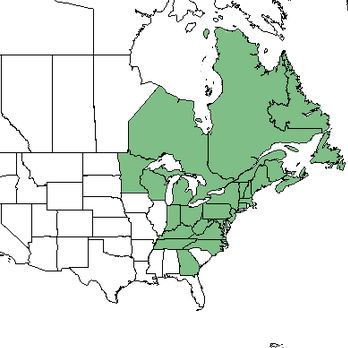 |
| Distribution of mountain woodsorrel. Map courtesy of USDA, NRCS. 2018. The PLANTS Database.
National Plant Data Team, Greensboro, NC [2018, June 1] [40]. |
ECOSYSTEMS:
   FRES11  Spruce - fir
   FRES14  Oak - pine
   FRES15  Oak - hickory
   FRES18  Maple - beech - birch
   FRES19  Aspen - birch
   FRES23  Fir - spruce


STATES:
     CT  DE  IL  IN  KY  ME  MD  MA  MI  MN
     NH  NJ  NY  NC  OH  PA  RI  TN  VA  WV
     WI  MB  NF  NS  ON


BLM PHYSIOGRAPHIC REGIONS:
NO-ENTRY


KUCHLER PLANT ASSOCIATIONS:
   K096  Northeastern spruce - fir forest
   K097  Southeastern spruce - fir forest
   K102  Beech - maple forest
   K104  Appalachian oak forest
   K106  Northern hardwoods
   K107  Northern hardwoods - fir forest
   K108  Northern hardwoods - spruce forest


SAF COVER TYPES:
     1  Jack pine
     5  Balsam fir
    12  Black spruce
    13  Black spruce - tamarack
    15  Red pine
    16  Aspen
    17  Pin cherry
    18  Paper birch
    19  Gray birch - red maple
    21  Eastern white pine
    22  White pine - hemlock
    23  Eastern hemlock
    24  Hemlock - yellow birch
    25  Sugar maple - beech - yellow birch
    28  Black cherry - maple
    30  Red spruce - yellow birch
    31  Red spruce - sugar maple - beech
    32  Red spruce
    33  Red spruce - balsam fir
    34  Red spruce - Fraser fir
    35  Paper birch - red spruce - balsam fir
    37  Northern white-cedar
    60  Beech - sugar maple
   107  White spruce


SRM (RANGELAND) COVER TYPES:
NO-ENTRY


HABITAT TYPES AND PLANT COMMUNITIES:
Mountain woodsorrel  is a dominant understory species in red spruce (Picea
rubens) and balsam or Fraser fir (Abies balsamea or A. fraseri) forests
of the Appalachian Mountains, which are part of the boreal forest
formation [29,34].  Mountain woodsorrel  is an indicator for several forest
habitat types or site types in the balsam and Fraser fir phases
[3,5,11,15].

Mountain woodsorrel  is dominant in the northern hardwoods forest, red or
sugar maple-yellow birch-American beech (Acer rubrum or A.
saccharum-Betula lutea-Fagus grandifolia) [7,24].  It is also a dominant
species in the transition plant associations between the boreal forest
and the northern hardwoods [19,37].  It is a minor component of the
riparian communities in the northern hardwood forests [6].

Mountain woodsorrel  is subdominant in seral communities of black cherry
(Prunus serotina)-red maple [36].  In northern Wisconsin, mountain
woodsorrel is a dominant forb in the association of eastern
hemlock-false lily-of-the-valley-goldthread (Tsuga
canadensis-Maianthemum canadense-Coptis groenlandica) [13,20].  In white
cedar (Thuja occidentalis) communities, mountain woodsorrel  is a minor
component with a corresponding low importance value of 0.4 [28].

Frequent herbaceous codominants are false lily-of-the-valley,
goldthread, starflower (Trientalis borealis), and woodferns (Dryopteris
spp.) [8,29,31,37,41].

Publications that list mountain woodsorrel  as a dominant herb are:
(1)  Field Guide: Habitat classification system for Upper Peninsula of
       Michigan and northeast Wisconsin [4]
(2)  Ground vegetation patterns of the spruce-fir area of the Great Smoky
       Mountains National Park [5]
(3)  The principal plant associations of the Saint Lawrence Valley [7]
(4)  Field guide to forest habitat types of northern Wisconsin [20]
(5)  Habitat classification system for northern Wisconsin [21]
(6)  Soil-vegetation relationships in northern hardwoods of Quebec [24]
(7)  A comparison of virgin spruce-fir forest in the northern and southern
       Appalachian system [29]
(8)  Vegetation, soil, and climate on the Green Mountains of Vermont [34]
(9)  Communities and tree seedling distribution in Quercus rubra- and Prunus
       serotina- dominated forests in southwestern Pennsylvania [36].
MANAGEMENT CONSIDERATIONS
SPECIES: Oxalis montana
IMPORTANCE TO LIVESTOCK AND WILDLIFE:
While mountain woodsorrel  has not been investigated, other members of the
woodsorrel family (Oxalis pes-capre and O. corniculata) form
concentrations of soluble oxalates lethal to livestock under specific
grazing conditions [18].


PALATABILITY:
No information was available on this topic.


NUTRITIONAL VALUE:
No information was available on this topic.


COVER VALUE:
No information was available on this topic.


VALUE FOR REHABILITATION OF DISTURBED SITES:
Mountain woodsorrel  is a soil stabilizer; it has extensive clonal growth
and the ability to grow on steep ground, poor soil, and in deep shade
[5,27,38,39].

In a Canadian northern hardwood-boreal transition forest, disturbed
ground was mulched to suppress red raspberry (Rubus idaeus) growth [16].
Mountain woodsorrel  appeared during the second growing season, despite the
oat (Avena sativa) mulch.  Because only plants with 10 percent or
greater cover were recorded, it is likely that mountain woodsorrel  was
present the first year in low amounts [16].


OTHER USES AND VALUES:
No information was available on this topic.


OTHER MANAGEMENT CONSIDERATIONS:
No information was available on this topic.
BOTANICAL AND ECOLOGICAL CHARACTERISTICS
SPECIES: Oxalis montana
GENERAL BOTANICAL CHARACTERISTICS:
Mountain woodsorrel  is a native woodland perennial with well-developed
clonal growth [1].  It is a small evergreen plant (less than 4 inches
[10 cm] high) that has scaley rhizomes [23].  Mountain woodsorrel  does not
have a main stem.  Leaves, with three cloverlike leaflets, are basal.
The fruit is a round capsule [10,32].


RAUNKIAER LIFE FORM:
Geophyte


REGENERATION PROCESSES:
Reproduction usually involves episodes of seedling recruitment as a
result of disturbance, such as fire and logging, followed by long
periods of vegetative clonal growth [1].  Mountain woodsorrel  forms
extensive colonies in boreal spruce-fir forests; however, its colonies
rarely exceed several feet in diameter in the northern hardwood forests
[35].

Mountain woodsorrel  reproduces both sexually and asexually.  Asexual
flowers (cleistogamous) produce greater amounts of seed compared to
sexual flowers [14].  Total fruit set per plant is low because there is
only one flower per stalk, with a recorded maximum of 34 flowers per
plant [1].  Mature capsules dehisce seeds forcefully, flinging them
outward from the plant [14].


SITE CHARACTERISTICS:
Mountain woodsorrel  has wide ecologic amplitude and occurs commonly
throughout the northern hardwood and spruce-fir (Picea rubens-Abies
balsamea) forests of the Appalachian Mountains [35].  Some authors have
stated that mountain woodsorrel  occurrence is not correlated with any
particular suite of site features [27,35].

Mountain woodsorrel  is on the glaciated uplands of the Canadian shield
[24].  The shallow soils are sandy loams to loamy tills [20].  Saturated
soils may be poor to moderately well-drained [6,7].  However, soils are
generally poorly developed and often consist only of an organic mat on
top of bedrock [27,31].  Soil pH is strongly to moderately acidic
[15,34,38].  Mountain woodsorrel  occurs on level to steep slopes and any
aspect [5].  Plants occur at 500 feet (152 m) in Maine coastal forests
to 5,000 feet (1,524 m) in the Smoky Mountains of Tennessee [24,34,37].

The growing season throughout its range is from 110 to 140 days and is
cool with ample moisture [8].  Snowpack in the subalpine zones can
extend from November to May [31].  The average annual temperatures are
less than 60 degrees Fahrenheit (16 deg C) [41].  Average annual
precipitation is 90 to 140 inches (2,286-3,556 mm) per year [5].  The
moisture regime is perhumid to humid [31].  Rainfall is equitable in all
summer months.  Fog drip from evergreen needles increases precipitation
amounts [34].

Moss coverage can be low to high, and very high fern coverage reduces
mountain woodsorrel  populations [5].  Associated understory species
include lowbush blueberry (Vaccinium angustifolium), witherod (Viburnum
cassinoides), hobblebush (Viburnum alnifolium), and bunchberry (Cornus
canadensis) [5,8,15].  Overstory species also include white ash
(Fraxinus americana) and paper birch (Betula papyrifera) [31].


SUCCESSIONAL STATUS:
Mountain woodsorrel  is a climax understory species.  It is a tolerant
species under mature fir canopy [38,39].  Mountain woodsorrel  is present
in, although not characteristic of, early or mid- seral stages in New
England's northern hardwood or spruce-fir boreal forests [35].
Disturbance occurs as severe winds, hurricanes, and fire [31].


SEASONAL DEVELOPMENT:
Plant growth mainly occurs before flowers are out [14].  Sexual flowers
on mountain woodsorrel  bloom from late May to August throughout its range
[10,23].  In a population, the flowering period lasts approximately 30
days with individual flowers open for about five days [14].  Fruits
mature in about 12 days, requiring warm days before dehiscence [14].
Seed is shed from June to September throughout its range [14].
FIRE ECOLOGY
SPECIES: Oxalis montana
FIRE ECOLOGY OR ADAPTATIONS:
Burning conditions are usually poor in the spruce-fir boreal forests in
which mountain woodsorrel  grows due to the presence of water throughout
the year [17].  Droughts can make the areas more susceptible to fire.
Fires may occur in the southern boreal forests every 50 to 150 years,
and in the northern boreal forests, fire frequencies are every 100 to
300 years [17].

Mountain woodsorrel  fire survival strategy is that of a perennial with
underground rhizomes; surviving rhizomes sprout.  However, it often
grows in humus on bedrock in spruce-fir forests [27,31].  The organic
layer does not give much protection from fire.  No information was found
about mountain woodsorrel  seed surviving fire.

FIRE REGIMES:
Find fire regime information for the plant communities in which this
species may occur by entering the species name in the FEIS home page under
"Find Fire Regimes".

POSTFIRE REGENERATION STRATEGY:
   Rhizomatous herb, rhizome in soil
   Secondary colonizer - off-site seed
FIRE EFFECTS
SPECIES: Oxalis montana
IMMEDIATE FIRE EFFECT ON PLANT:
No fire studies have been done on mountain woodsorrel .  Fire would
top-kill this plant.  Growing in mainly organic or shallow soils, its
rhizomes probably would not survive a fire of moderate severity.


DISCUSSION AND QUALIFICATION OF FIRE EFFECT:
NO-ENTRY


PLANT RESPONSE TO FIRE:
Surviving rhizomes will sprout.  Existing patches can expand to colonize
open areas.  Vegetative reproduction allows the population flexibility
in initiating or stopping plant development.  Since mountain woodsorrel
can reproduce by asexual flowers, seed set is highly probable, despite a
possible low initial population size.  Dissemination by explosive
dehiscence provides the ability to colonize open disturbed areas.  When
open ground has closed with vegetation, mountain woodsorrel  colonies will
continue to expand by rhizome growth (see SUCCESSIONAL STATUS).


DISCUSSION AND QUALIFICATION OF PLANT RESPONSE:
The Research Project Summary Effects of surface fires in a mixed red and
eastern white pine stand in Michigan provides information on prescribed
fire and postfire response of plant community species, including mountain
woodsorrel, that was not available when this species review was written.


FIRE MANAGEMENT CONSIDERATIONS:
No information was available on this topic.
REFERENCES
SPECIES: Oxalis montana
REFERENCES:

 1.  Raphael, Martin G.; White, Marshall. 1984. Use of snags by
       cavity-nesting birds in the Sierra Nevada. Wildlife Monographs No. 86.
       Washington, DC: The Wildlife Society. 66 p.  [15592]

 2.  Bernard, Stephen R.; Brown, Kenneth F. 1977. Distribution of mammals,
       reptiles, and amphibians by BLM physiographic regions and A.W. Kuchler's
       associations for the eleven western states. Tech. Note 301. Denver, CO:
       U.S. Department of the Interior, Bureau of Land Management. 169 p.
       [434]

 3.  Blum, Barton M. 1990. Picea rubens Sarg.  red spruce. In: Burns, Russell
       M.; Honkala, Barbara H., technical coordinators. Silvics of North
       America. Volume 1. Conifers. Agric. Handb. 654. Washington, DC: U.S.
       Department of Agriculture, Forest Service: 250-259.  [13388]

 4.  Coffman, Michael S.; Alyanak, Edward; Resovsky, Richard. 1980. Field
       guide habitat classification system: For Upper Peninsula of Michigan and
       northeast Wisconsin. [Place of publication unknown]: Cooperative
       Research on Forest Soils. 112 p.  [8997]

 5.  Crandall, Dorothy L. 1958. Ground vegetation patterns of the spruce-fir
       area of the Great Smoky Mountains National Park. Ecological Monographs.
       28(4): 337-360.  [11226]

 6.  Cronan, Christopher S.; DesMeules, Marc R. 1985. A comparison of
       vegetative cover and tree community structure in three forested
       Adirondack watersheds. Canadian Journal of Forest Research. 15: 881-889.
       [7296]

 7.  Dansereau, Pierre. 1959. The principal plant associations of the Saint
       Lawrence Valley. No. 75. Montreal, Canada: Contrib. Inst. Bot. Univ.
       Montreal. 147 p.  [8925]

 8.  Davis, Ronald B. 1966. Spruce-fir forests of the coast of Maine.
       Ecological Monographs. 36(2): 79-94.  [8228]

 9.  Eyre, F. H., ed. 1980. Forest cover types of the United States and
       Canada. Washington, DC: Society of American Foresters. 148 p.  [905]

10.  Fernald, Merritt Lyndon. 1950. Gray's manual of botany. [Corrections
       supplied by R. C. Rollins]. Portland, OR: Dioscorides Press. 1632 p.
       (Dudley, Theodore R., gen. ed.; Biosystematics, Floristic & Phylogeny
       Series; vol. 2).  [14935]

11.  Frank, Robert M. 1990. Abies balsamea (L.) Mill.  balsam fir. In: Burns,
       Russell M.; Honkala, Barbara H., technical coordinators. Silvics of
       North America. Volume 1. Conifers. Agric. Handb. 654. Washington, DC:
       U.S. Department of Agriculture, Forest Service: 26-35.  [13365]

12.  Garrison, George A.; Bjugstad, Ardell J.; Duncan, Don A.; [and others].
       1977. Vegetation and environmental features of forest and range
       ecosystems. Agric. Handb. 475. Washington, DC: U.S. Department of
       Agriculture, Forest Service. 68 p.  [998]

13.  Godman, R. M.; Lancaster, Kenneth. 1990. Tsuga canadensis (L.) Carr.
       eastern hemlock. In: Burns, Russell M.; Honkala, Barbara H., technical
       coordinators. Silvics of North America. Volume 1. Conifers. Agric.
       Handb. 654. Washington, DC: U.S. Department of Agriculture, Forest
       Service: 604-612.  [13421]

14.  Helenurm, Kaius; Barrett, Spencer C. H. 1987. The reproductive biology
       of boreal forest herbs. II. Phenology of flowering and fruiting.
       Canadian Journal of Botany. 65: 2047-2056.  [6623]

15.  Hughes, Jeffrey W.; Fahey, Timothy J. 1991. Colonization dynamics of
       herbs and shrubs in disturbed northern hardwood forest. Journal of
       Ecology. 79: 605-616.  [17724]

16.  Jobidon, R.; Thibault, J. R.; Fortin, J. A. 1989. Phytotoxic effect of
       barley, oat, and wheat-straw mulches in eastern Quebec forest
       plantations  1. Effects on red raspberry (Rubus idaeus). Forest Ecology
       and Management. 29: 277-294.  [9899]

17.  Keeley, Jon E. 1981. Reproductive cycles and fire regimes. In: Mooney,
       H. A.; Bonnicksen, T. M.; Christensen, N. L.; [and others], technical
       coordinators. Fire regimes and ecosystem properties: Proceedings of the
       conference; 1978 December 11-15; Honolulu, HI. Gen. Tech. Rep. WO-26.
       Washington, DC: U.S. Department of Agriculture, Forest Service: 231-277.
       [4395]

18.  Kingsbury, John M. 1964. Poisonous plants of the United States and
       Canada. Englewood Cliffs, NJ: Prentice-Hall, Inc. 626 p.  [122]

19.  Kirkland, Gordon L., Jr. 1977. Responses of small mammals to the
       clearcutting of northern Appalachian forests. Journal of Mammalogy.
       58(4): 600-609.  [14455]

20.  Kotar, John; Kovach, Joseph A.; Locey, Craig T. 1988. Field guide to
       forest habitat types of northern Wisconsin. Madison, WI: University of
       Wisconsin, Department of Forestry; Wisconsin Department of Natural
       Resources. 217 p.  [11510]

21.  Kotar, John; Kovack, Joseph; Locey, Craig. 1989. Habitat classification
       system for northern Wisconsin. In: Ferguson, Dennis E.; Morgan,
       Penelope; Johnson, Frederic D., eds. Proceedings--Land classifications
       based on vegetation applications for resource management; 1987 November
       17-19; Moscow, ID. Gen. Tech. Rep. INT-257. Ogden, UT: U.S. Department
       of Agriculture, Forest Service, Intermountain Research Station: 304-306.
       [6962]

22.  Kuchler, A. W. 1964. Manual to accompany the map of potential vegetation
       of the conterminous United States. Special Publication No. 36. New York:
       American Geographical Society. 77 p.  [1384]

23.  Lakela, O. 1965. A flora of northeastern Minnesota. Minneapolis, MN:
       University of Minnesota Press. 541 p.  [18142]

24.  Lemieux, G. J. 1963. Soil-vegetation relationships in northern hardwoods
       of Quebec. In: Forest-soil relationships in North America. Corvallis,
       OR: Oregon State University Press: 163-176.  [8874]

25.  Lyon, L. Jack; Stickney, Peter F. 1976. Early vegetal succession
       following large northern Rocky Mountain wildfires. In: Proceedings, Tall
       Timbers fire ecology conference and Intermountain Fire Research Council
       fire and land management symposium; 1974 October 8-10; Missoula, MT. No.
       14. Tallahassee, FL: Tall Timbers Research Station: 355-373.  [1496]

26.  Maguire, D. A.; Forman, R. T. 1983. Herb cover effects on tree seedling
       patterns in a mature hemlock-hardwood forest. Ecology. 64(6): 1367-1380.
       [9620]

27.  McIntosh, R. P.; Hurley, R. T. 1964. The spruce-fir forest of the
       Catskill Mountains. Ecology. 45(2): 314-326.  [14886]

28.  Ohmann, Lewis F.; Ream, Robert R. 1971. Wilderness ecology: virgin plant
       communities of the Boundary Waters Canoe Area. Res. Pap. NC-63. St.
       Paul, MN: U.S. Department of Agriculture, Forest Service, North Central
       Forest Experiment Station. 55 p.  [9271]

29.  Oosting, H. J.; Billings, W. D. 1951. A comparison of virgin spruce-fir
       forest in the northern and southern Appalachian system. Ecology. 32(1):
       84-103.  [11236]

30.  Raunkiaer, C. 1934. The life forms of plants and statistical plant
       geography. Oxford: Clarendon Press. 632 p.  [2843]

31.  Reiners, William A,; Lang, Gerald E. 1979. Vegetational patterns and
       processes in the balsam fir zone, White Mountains, New Hampshire.
       Ecology. 60(2): 403-417.  [14869]

32.  Roland, A. E.; Smith, E. C. 1969. The flora of Nova Scotia. Halifax, NS:
       Nova Scotia Museum. 746 p.  [13158]

33.  Scoggan, H. J. 1978. The flora of Canada. Ottawa, Canada: National
       Museums of Canada. (4 volumes).  [18143]

34.  Siccama, T. G. 1974. Vegetation, soil, and climate on the Green
       Mountains of Vermont. Ecological Monographs. 44: 325-249.  [6859]

35.  Siccama, T. G.; Bormann, F. H.; Likens, G. E. 1970. The Hubbard Brook
       ecosystem study: productivity, nutrients and phytosociology of the
       herbaceous layer. Ecological Monographs. 40(4): 389-402.  [8875]

36.  Smith, Lisa L.; Vankat, John L. 1991. Communities and tree seedling
       distribution in Quercus rubra- and Prunus serotina-dominated forests in
       southwestern Pennsylvania. American Midland Naturalist. 126(2): 294-307.
       [16876]

37.  Spear, Ray W. 1989. Late-Quaternary history of high-elevation vegetation
       in the White Mountains of New Hampshire. Ecological Monographs. 59(2):
       125-151.  [9662]

38.  Sprugel, Douglas G. 1976. Dynamic structure of wave-regenerated Abies
       balsamea forests in the north-eastern United States. Journal of Ecology.
       64: 889-911.  [14866]

39.  Sprugel, Douglas G. 1981. Natural disturbance and the steady state in
       high-altitude balsam fir forest. Science. 211: 390-393.  [14870]

40.  USDA Natural Resources Conservation Service. 2018. PLANTS Database, [Online].
       U.S. Department of Agriculture, Natural Resources Conservation Service
       (Producer). Available: https://plants.usda.gov/.  [34262]

41.  Webb, William L.; Behrend, Donald F.; Saisorn, Boonruang. 1977. The
       effect of logging on songbird populations in a northern hardwood forest.
       Wildlife Monographs No. 55. Washington, DC: The Wildlife Society. 35 p.
       [13745]

42.  Stickney, Peter F. 1989. Seral origin of species originating in northern
       Rocky Mountain forests. Unpublished draft on file at: U.S. Department of
       Agriculture, Forest Service, Intermountain Research Station, Fire
       Sciences Laboratory, Missoula, MT; RWU 4403 files. 7 p.  [20090]
FEIS Home Page

