|
|
FEIS Home Page |
|
|
 |
|
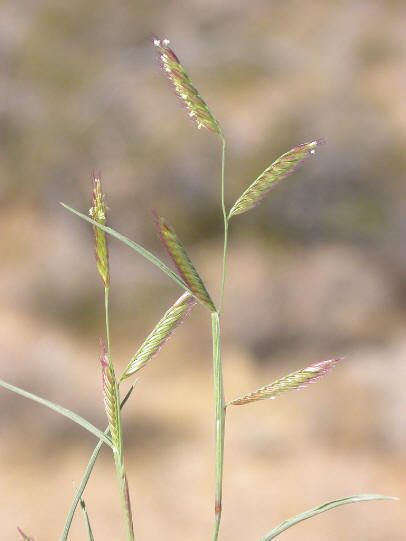
©2004, James M. Andre. |
©2002, Thomas M. Elder, M.D. |
AUTHORSHIP AND CITATION:
Hauser, A. Scott 2005. Bouteloua barbata.
In: Fire Effects Information System, [Online].
U.S. Department of Agriculture, Forest Service,
Rocky Mountain Research Station, Fire Sciences Laboratory (Producer).
Available: https://www.fs.usda.gov
/database/feis/plants/graminoid/boubar/all.html [].
FEIS ABBREVIATION:
BOUBAR
SYNONYMS:
None
NRCS PLANT CODE [73]:
BOBA2
COMMON NAMES:
sixweeks grama
six-weeks grama
six weeks grama
TAXONOMY:
The scientific name of sixweeks grama is Bouteloua barbata Lag. (Poaceae)
[16,32,40,48,80]. A single variety is recognized by some authorities
[32,80]:
Bouteloua barbata var. barbata Cienc.
Sonoran grama, formerly recognized as Bouteloua barbata var. sonorae (Griffiths) Gould, and Rothrock's grama, formerly recognized as Bouteloua barbata var. rothrockii (Vasey) Gould, are currently recognized as the distinct species Bouteloua sonorae Griffiths and Bouteloua rothrockii Vasey, respectively [40].
LIFE FORM:| AZ | CA | CO | KS | MT | NV | NM | OK | TX | UT |
| Ags. | B.C.N. | B.C.S. | Chih. | Coah. | Dgo. | Gto. | Gro. | Hgo. | N.L. |
| Oax. | Pue. | Qro. | S.L.P. | Sin. | Son. | Zac. |
Arizona: Warren and others [77] describe sixweeks grama as common and widespread in Arizona, although not a dominant species. In the Sonoran Desert, sixweeks grama is found in desert chaparral, pinyon-juniper (Pinus-Juniperus spp.) woodland [4,10,61], creosotebush (Larrea tridentata) [4,36,61], and mesquite (Prosopis spp.) bosque [48,61,84] communities. Sixweeks grama grows alongside needle grama (Bouteloua aristidoides) and the dominant grass species Rothrock's grama in the yellow palo verde-white bursage-saguaro (Parkinsonia microphylla-Ambrosia dumosa-Carnegiea gigantea) vegetation type in the eastern Sonoran Desert [39,61]. In the Santa Teresa Mountains, sixweeks grama occurs in the understory of the Madrean evergreen woodlands. This xeric part of the range has coarse soils and is composed mainly of Emory oak (Quercus emoryi), gray oak (Q. grisea), and alligator juniper (Juniperus deppeana) [10]. In ponderosa pine/pointleaf manzanita (Pinus ponderosa/Arctostaphylos pungens) forests in southern Arizona and portions of the Colorado plateau, sixweeks grama is found at <1% density/cover. The understory is dominated by alligator juniper and Colorado pinyon (Pinus edulis) [57].
California: Sixweeks grama grows from creosotebush scrub up to pinyon-juniper woodland [58] in the Colorado and east Mojave deserts [37]. Below 3,900 feet (1,200 m) in Joshua Tree National Monument, California, sixweeks grama is found with the dominant shrubs creosotebush and desertholly (Atriplex hymenelytra). At approximately 5,000 feet (1,500 m), it grows with singleleaf pinyon (P. monophylla) and junipers; and between 3,300 and 5,000 feet (1,000-1,500 m), it occurs in Joshua tree (Yucca brevifolia) woodland [38,80,81].
Nevada: Sixweeks grama is found in the creosotebush belt of southern Nevada, primarily with croton (Croton spp.), blackbrush (Coleogyne ramosissima), desert-thorn (Lycium spp.), saltbush (Atriplex) spp., and hopsage (Grayia) spp. [41]. Literature on sixweeks grama occurrence in Nevada is limited.
New Mexico: Sixweeks grama occurs in the Chihuahuan Desert within creosotebush and desert grassland communities. Other species common in the creosotebush and grassland communities include desertholly, broom snakeweed (Gutierrezia sarothrae), honey mesquite (Prosopis glandulosa), tarbush (Flourensia cernua), silver leaf nightshade (Solanum eleagnifolium), bush muhly (Muhlenbergia porteri), burro grass (Scleropogon brevifolius), black grama (Bouteloua eriopoda), poverty threeawn (Aristida divaricata), tobosa (Pleuraphis mutica), and low woolly grass (Erioneuron pulchellum) [25,44,59,78]. In the Fort Bayard area of southwestern New Mexico, sixweeks grama grows in 3 plant communities: 1) oneseed juniper (Juniperus monosperma)-Colorado pinyon with 0.1% density and 14% constancy; 2) Colorado pinyon-alligator juniper with trace density and 4% constancy; and 3) gray oak with 0.1% density and 11% constancy [53]. Nelson [60] lists sixweeks grama as a prominent annual grass in black grama communities of the Jornada Experimental Range, located in the southern part of the state.
Texas: Sixweeks grama is found in Cross Timbers, prairie, rolling plains, and other dry grassland communities [15,16]. Denyes [15] describes sixweeks grama as a codominant grass in the shortgrass association in the plains grasslands of Brewster County. Other dominant shortgrasses include blue grama (Bouteloua gracilis), hairy grama (B. hirsuta), black grama, purple threeawn (Aristida purpurea), Wright's threeawn (A. p. var. wrightii), blue threeawn (A. glauca), and Wooton's threeawn (A. pansa). Oneseed juniper is a common tree, and honey mesquite and javelin bush (Microrhamnus ericoides) are common shrubs in the shortgrass association.Utah: Sixweeks grama grows within desert shrub and creosote bush communities [79]. Literature on sixweeks grama occurrence in Utah is limited.
Sixweeks grama is a short-lived, warm season, native annual bunchgrass. It grows to an approximate height of 1 foot (0.3 m) [28,41,76]. The culms are tufted prostrate or spreading, 4 to 12 inches (10-30 cm) long. Leaves are 0.4 to 2.4 inches (1-6 cm) long and 1-1.5 mm wide, occurring sparingly along the culms [28,58]. The fruit is an awned caryopsis. Awns range from minute to as long as the fruit body. The fruit measures 4.0 to 6.5 mm long and weighs approximately 0.03 mg [33,82]. The inflorescence consists of 2 to 9 persistent branches that are 0.4 to 1.2 inches (1-3 cm) long, with 7 to 40 closely placed spikelets measuring 2.5 to 4 mm long [32,83].
In southern New Mexico and southern Arizona, sixweeks grama and Rothrock's grama, a perennial, often grow together and are mistaken as the same species. Sixweeks grama can be differentiated by its branched stems and shorter awns [14,28]. Keys for identification presented above will aid in proper identification of sixweeks grama.
RAUNKIAER [63] LIFE FORM:Breeding system: No information is available on this topic.
Pollination: Sixweeks grama is probably wind pollinated.
Seed production: In Joshua Tree National Monument, California, sixweeks grama produced seeds within 4 weeks of germination at elevations below 1,000 feet (300 m) and within 6 weeks above 1,000 feet (300 m) elevation [80]. In the Chihuahuan Desert of southeastern Arizona, seed production was observed 6 to 8 weeks after germination at an elevation of 5,000 feet (1,500 m) [73].
Seed dispersal: Given sixweeks grama's small seed weight (0.03 mg), dispersal by wind is likely. Seeds are also dispersed by birds, small mammals, and ungulates when awns attach to fur and feathers [49]. A controlled study of the chisel-toothed kangaroo rat on plots of Chihuahuan Desert shrub habitat in southeastern Arizona found that sixweeks grama was significantly (p<0.05) less abundant in areas where the chisel-toothed kangaroo rat had been removed. This was attributed to both seed dispersal mechanisms and soil disturbance [9]. A study of cactus wren in Arizona found transported seeds of sixweeks grama surrounding the wrens' nests [54].
Seed banking: Little information pertaining to sixweeks grama seed banking exists. A study was conducted north of Las Cruces, New Mexico, to determine plant emergence from soils collected on 3 desert grassland sites representing 3 rangeland conditions (poor, fair, and good). The researchers noted that needle grama and sixweeks grama could not be differentiated in the seedling stage. On good-condition range sites dominated by black grama, 26.1 sixweeks grama/needle grama seedlings emerged per m2. Sixweeks grama comprised 17.5% of total plant species composition based on coverage of the poor-condition range. On fair-condition range dominated by mesa dropseed (Sporobolus flexuosus), 11.0 grama seedlings emerged per m2 (6.8% of total plant species composition). On poor-condition range dominated by fluffgrass (Erioneuron pulchellum), 10.2 grama seedlings emerged per m2 (6.4% of total plant species composition) [54]. A study conducted by Went and others [38] (see Germination below) seems to indicate that a large bank of sixweeks grama seeds are held in the soil.
Seed dormancy: To date (2005), the literature does not describe how long seeds remain viable in the soil. However, several studies have found that sixweeks grama does not germinate when precipitation is inadequate [6,12,17,25,26,31,37,38], so it seems likely that soil-stored seeds remain viable for several years.
Germination: Sixweeks grama germination is dependent upon warm soil temperatures and heavy summer precipitation associated with thundershowers and monsoon rains in desert ecosystems [12,37,37,61]. Studies conducted in Joshua Tree National Monument [80] and the Chihuahuan Desert of New Mexico [44] found that a single rainfall of 0.6 to 1 inch (15-25 mm) was required for germination to begin. In gullies or collection areas, germination has occurred with as little as 0.4 inch (10 mm) of rain [80]. In laboratory experiments conducted by Went [80], sixweeks grama showed good germination under a temperature regime of warm days (8 hours at 80 °F (27 °C)) and warm nights (16 hours at 78 °F (26 °C)), but poor germination under a temperature regime of warm days and cool nights (16 hours at 55 °F (13 °C)). In another experiment by Went and others [38], between 50 and 100 cm³ of soil was collected from Joshua Tree National Monument and subjected to 3 different temperature regimes. Eighty sixweeks grama and needle grama seeds germinated with warm daytime soil temperatures of 86 °F (30 °C); 29 grama seeds germinated in moderate daytime soil temperatures ranging from 62 °F (17 °C) to 73 °F (23 °C); and no seeds germinated with cool daytime soil temperatures of 50 °F (10 °C) [38].
Seedling establishment/growth: Upon seedling establishment, sixweeks grama's life cycle can be "measured in terms of weeks rather than months" [4]. Growth occurs rapidly, with the plant reaching its maximum size and setting seed within 4 to 6 weeks following germination [44,61,80].
In Joshua Tree National Monument, sixweeks grama was observed producing new growth from its root crown toward the end of its life cycle. The new growth occurred following "substantial" rainfall when daytime temperatures were between 90 ºF and 105 ºF (32-41 ºC ). Sixweeks grama does not sprout from the root crown following autumn rains due to cool temperatures [84].
SITE CHARACTERISTICS:Soils: Loamy to sandy and gravelly soils composed of lithic sandstone and granite are most often associated with sixweeks grama [7,16,29,41,57,58].
Climate: The natural habitat of sixweeks grama is normally one of low rainfall, hot summer temperatures, high evaporation, and high winds typical of desert ecosystems. In the deserts of the southwestern United States, maximum summer temperatures can exceed 110 °F (43 °C) and winter lows can drop to 10 °F (-12 °C) [10,11,52,82,82,84]. Precipitation is commonly distributed in a bimodal pattern, with heavy rains falling in spring and summer and gentler rains in winter. In these arid environments, average yearly precipitation can range from 8.5 to 10 inches (216-254 mm) with extremes of 0.74 to 22.9 inches (19-581 mm) recorded [10,11,52,82,84]. Where sixweeks grama grows on the grasslands of Texas, average yearly precipitation is 7.0 inches (178 mm) with an extreme temperature range of 11 °F to 114 °F (-12 °C to 456 °C) [15].
Elevation: The range of elevations for sixweeks grama in several states is presented below:
| Arizona | 1,000 to 5,500 feet (300-1,700 m) overall [10,42,51,61] |
| <3,200 feet (1,000 m) in the Rincon Mts.[7] | |
| 1,640 to 1,750 feet (500-530 m) in the Sawtooth Mts. [51] | |
| 2,165 to 3,907 feet (660-1,191 m) on Ragged Top Peak [84] | |
| California | <5,000 feet (1,500 m) overall [32,58] |
| 2,500 to 5,000 feet (800-1,500 m) in Joshua Tree National Monument [80] | |
| Colorado | 4,250 to 7,100 feet (1,295-2,160 m) overall [30,50,57] |
| Nevada | 1,000 to 5,600 feet (300-1,700 m) overall [41] |
| New Mexico | <7,000 feet (2,100 m) overall [24] |
| Fort Bayard Range, 1,800 to 2,560 feet (550-780 m) [53] | |
| Texas | <4,000 feet (1,219 m) in Brewster County [15] |
| Utah | 2,800 to 6,000 feet (850-1,800 m) overall [80] |
In Joshua Tree National Monument, sixweeks grama was observed producing new growth from root crowns toward the end of its life cycle (see Seedling establishment/growth) [84]. The period of flowering for sixweeks grama is presented in the table below:
| Location | Beginning of Flowering | End of Flowering |
| Arizona | July | September [61,73] |
| California | June | October [4,58] |
| Colorado | July | October [30,37,58] |
| Kansas/Oklahoma | August | October [29] |
| New Mexico | July | October [11,50] |
| Nevada | July | August [41,83] |
| Texas | July | October [15,83] |
| Utah | July | September [26] |
| Baja California | July | October [83] |
The phenology of sixweeks grama in the northern Chihuahuan Desert of southern New Mexico is presented in the table below [44]:
| Phenological event | Period of event |
| Seeds germinate | Late August to early September |
| Flowering | September |
| Seeds mature | Late September to early October |
| Seeds dispersed/plant death | Late October |
Fire regimes: Sixweeks grama predominantly occurs in desert scrub/thorn scrub and desert grassland communities. Historic fire regimes for these communities widely differed, with desert scrub/thorn scrub communities rarely burning and grassland communities burning often [62]. European-American settlement and subsequent land use changes has altered fire regimes greatly [10,62,74].
Desert scrub and thorn scrub communities: Historically, fire was not an important ecological process in desert scrub and thorn scrub communities where sixweeks grama occurs. The annual grasses either did not accumulate enough fine fuel on the ground to facilitate fire or thrived during summer monsoon rains. Dominant tree, shrub, and cactus species were widely spaced and open branched, so there were usually not enough fuels to carry fire. However, this has dramatically changed since the 1970s with the spread of several nonnative species including red brome (Bromus madritensis spp. rubens), cheatgrass (B. tectorum), mediterranean grasses (Schismus spp.), and buffel grass (Pennisetum ciliare). Nonnative grasses have increased the risk and severity of fires in these communities [1,74]. Late spring and summer fires (from mid-May to July), fueled primarily by red brome, have dramatically increased in recent years. When fires occur before late summer, when sixweeks grama typically germinates, they often kill dominant plants including the columnar cacti species saguaro, senita (Lophocereus schottii), and organpipe (Stenocereus thurberi), the trees species bursera (Bursera spp.) and desert ironwood (Olneya tesota), and the shrub species bursage (Ambrosia spp.), paloverde (Parkinsonia spp.), brittle bush (Encelia farinosa), and creosotebush [74].
Desert grassland communities: Prior to land use changes, grassland communities where sixweeks grama occur burned frequently [52,85]. While there are relatively few fire frequency data available prior to the 1880s, it is estimated that fire occurred every 7 to 10 years [52]. Grassland fires played an important role in thwarting the invasion of woody vegetation [64]. However, grazing pressures and fire exclusion have promoted the conversion of desert grassland communities to shrub-dominated communities [62]. The establishment of shrubs in desert grasslands has decreased available fuels and subsequently, fire frequencies [10,62,74].
The following table provides fire return intervals for plant communities and ecosystems where sixweeks grama is important. For further information, see the FEIS review of the dominant species listed below.
| Community or Ecosystem | Dominant Species | Fire Return Interval Range (years) |
| saltbush-greasewood | Atriplex confertifolia-Sarcobatus vermiculatus | <35 to <100 [62] |
| desert grasslands | Bouteloua eriopoda and/or Pleuraphis mutica | <35 to <100 [52,62] |
| plains grasslands | Bouteloua spp. | <35 [62,86] |
| blue grama-needle-and-thread grass-western wheatgrass | B. gracilis-Hesperostipa comata-Pascopyrum smithii | <35 [62,65,86] |
| grama-galleta steppe | B. g.-Pleuraphis jamesii | <35 to <100 |
| blue grama-tobosa prairie | B. g.-P. mutica | <35 to <100 |
| California montane chaparral | Ceanothus and/or Arctostaphylos spp. | 50-100 |
| blackbrush | Coleogyne ramosissima | <35 to <100 [62] |
| California steppe | Festuca-Danthonia spp. | <35 [62,70] |
| paloverde-cactus shrub | Parkinsonia spp./Opuntia spp. | <35 to <100 |
| creosotebush | Larrea tridentata | <35 to <100 |
| Ceniza shrub | L. t.-Leucophyllum frutescens-Prosopis glandulosa | <35 |
| pinyon-juniper | Pinus-Juniperus spp. | <35 [62] |
| Colorado pinyon | P. edulis | 10-400+ [22,27,43,62] |
| interior ponderosa pine* | P. ponderosa var. scopulorum | 2-30 [2,3,47] |
| Arizona pine | P. ponderosa var. arizonica | 2-15 [3,13,67] |
| galleta-threeawn shrubsteppe | Pleuraphis jamesii-Aristida purpurea | <35 to <100 [62] |
| mesquite | Prosopis glandulosa | <35 to <100 [52,62] |
| mesquite-buffalo grass | P. g.-Buchloe dactyloides | <35 |
| Texas savanna | P. g. var. glandulosa | <10 |
| oak-juniper woodland (Southwest) | Quercus-Juniperus spp. | <35 to <200 [62] |
FIRE REGIMES: Find fire regime information for the plant communities in which this species may occur by entering the species name in the FEIS home page under "Find Fire Regimes"
Sixweeks grama seeds survive burning, and surviving seeds germinate when favorable conditions occur (hot temperatures and sufficient rainfall) [80,81].
DISCUSSION AND QUALIFICATION OF PLANT RESPONSE:| -G -B | -G +B | +G -B | +G +B |
| 0.73 | 1.97 | 0.65 | 0.68 |
| Fall | Winter | Spring | Summer | ||||
| H | SG | H | SG | H | SG | H | SG |
| 1.7 | 3.3 | 7.1 | 1.9 | -- | -- | -- | 9.4 |
Wildlife: A variety of upland game birds (e.g. wild turkey), songbirds (e.g. brown-capped rosy-finch, chestnut-collared longspur, McCown's longspur, and Brewer's sparrow), and small mammals (e.g. prairie pocket mouse, black-tailed and Gunnison prairie dogs, desert kangaroo and banner-tailed rats) eat the seeds and seedheads of grama grasses (Bouteloua spp.) [49]. Harvester ants in Sonoran Desert lowlands of Arizona also eat sixweeks grama seeds [36]. The seeds of sixweeks grama have been found in the surrounds of cactus wren nests [54]. Caches of sixweeks grama seeds have been identified in the dens of the banner-tailed kangaroo rat, Merriam's kangaroo rat, and white-throated woodrat [56]. Jackrabbits (antelope and white-sided), prairie pocket mice, prairie dogs (black-tailed and Gunnison), and ungulates (pronghorn, American bison, mule and white-tailed deer, elk, and bighorn sheep) eat grama grasses [49].
Palatability/nutritional value: When young, sixweeks grama is palatable to livestock and is actively grazed [41,66]. Sixweeks grama is moderately nutritious when green [31,34,35]. But, since the green period is short, little forage is produced and nutritional value rapidly decreases upon maturity rendering the plant "practically worthless" [24]. A 1962 winter nutritional analysis of sixweeks grama (% of dry weight) taken in the Jornada Experimental Range, New Mexico, is presented below [59]:
| Date | Protein (%) |
Ether extract (%) |
Acid-detergent fiber
(%) |
Ash (%) |
Ca (%) |
P (%) |
| February (overripe) | 4.1 | 1.4 | 51.3 | 6.2 | 0.30 | 0.05 |
| March (dormant) | 5.0 | 1.5 | 53.2 | 1.7 | 0.63 | 0.05 |
Cover value: Given its small mass, sixweeks grama likely provides cover for only small animals.
VALUE FOR REHABILITATION OF DISTURBED SITES:1. Alford, Eddie J.; Brock, John H. 2002. The effects of fire on Sonoran Desert plant communities. Final Report: RMRS-99164-RJVA. Fort Collins, CO: U.S. Department of Agriculture, Forest Service, Rocky Mountain Research Station. 111 p. [Alford's Dissertation]. On file with: U.S. Department of Agriculture, Forest Service, Rocky Mountain Research Station, Fire Sciences Laboratory, Missoula, MT. [47514]
2. Arno, Stephen F. 1976. The historical role of fire on the Bitterroot National Forest. Res. Pap. INT-187. Ogden, UT: U.S. Department of Agriculture, Forest Service, Intermountain Forest and Range Experiment Station. 29 p. [15225]
3. Baisan, Christopher H.; Swetnam, Thomas W. 1990. Fire history on a desert mountain range: Rincon Mountain Wilderness, Arizona, U.S.A. Canadian Journal of Forest Research. 20: 1559-1569. [14986]
4. Barbour, Michael G.; Burk, Jack H.; Pitts, Wanna D. 1980. Major vegetation types of North America. In: Barbour, Michael G.; Burk, Jack H.; Pitts, Wanna D. Terrestrial plant ecology. Menlo Park, CA: The Benjamin/Cummings Publishing Company, Inc: 486-583. [45729]
5. Bernard, Stephen R.; Brown, Kenneth F. 1977. Distribution of mammals, reptiles, and amphibians by BLM physiographic regions and A.W. Kuchler's associations for the eleven western states. Tech. Note 301. Denver, CO: U.S. Department of the Interior, Bureau of Land Management. 169 p. [434]
6. Booth, W. E. 1950. Flora of Montana. Part I: Conifers and monocots. Bozeman, MT: The Research Foundation at Montana State College. 232 p. [48662]
7. Bowers, Janice E.; McLaughlin, Steven P. 1987. Flora and vegetation of the Rincon Mountains, Pima County, Arizona. Desert Plants. 8(2): 50-94. [495]
8. Brown, David E. 1982. Sonoran savanna grassland. In: Brown, David E., ed. Biotic communities of the American Southwest--United States and Mexico. Desert Plants. 4(1-4): 137-141. [8897]
9. Brown, James H.; Heske, Edward J. 1990. Control of a desert-grassland transition by a keystone rodent guild. Science. 250(4988): 1705-1707. [54673]
10. Buegge, J. Jeremy. 2001. Flora of the Santa Teresa Mountains in Graham County, Arizona. Journal of the Arizona-Nevada Academy of Science. 33(2): 132-149. [45078]
11. Campbell, R. S.; Bomberger, E. H. 1934. The occurrence of Gutierrezia sarothrae on Bouteloua eriopoda ranges in southern New Mexico. Ecology. 15(1): 49-61. [596]
12. Carmichael, R. S.; Knipe, O. D.; Pase, C. P.; Brady, W. W. 1978. Arizona chaparral: plant associations and ecology. Res. Pap. RM-202. Fort Collins, CO: U.S. Department of Agriculture, Forest Service, Rocky Mountain Forest and Range Experiment Station. 16 p. [3038]
13. Cooper, Charles F. 1961. Pattern in ponderosa pine forests. Ecology. 42(3): 493-499. [5780]
14. Cronquist, Arthur; Holmgren, Arthur H.; Holmgren, Noel H.; [and others]. 1977. Intermountain flora: Vascular plants of the Intermountain West, U.S.A. Vol. 6. The Monocotyledons. New York: Columbia University Press. 584 p. [719]
15. Denyes, H. Arliss. 1956. Natural terrestrial communities of Brewster County, Texas. The American Midland Naturalist. 55(2): 289-320. [26765]
16. Diggs, George M., Jr.; Lipscomb, Barney L.; O'Kennon, Robert J. 1999. Illustrated flora of north-central Texas. Sida Botanical Miscellany No. 16. Fort Worth, TX: Botanical Research Institute of Texas. 1626 p. [35698]
17. Dorn, Robert D. 1984. Vascular plants of Montana. Cheyenne, WY: Mountain West Publishing. 276 p. [819]
18. Dwyer, Don D.; Aguirre V., Edmundo. 1978. Plants emerging from soils under three range condition classes of desert grassland. Journal of Range Management. 31(3): 209-212. [54684]
19. Esque, Todd C.; Schwalbe, Cecil R. 2002. Alien annual grasses and their relationships to fire and biotic change in Sonoran desertscrub. In: Tellman, Barbara, ed. Invasive exotic species in the Sonoran region. Arizona-Sonora Desert Museum Studies in Natural History. Tucson, AZ: The University of Arizona Press; The Arizona-Sonora Desert Museum: 165-194. [48660]
20. Eyre, F. H., ed. 1980. Forest cover types of the United States and Canada. Washington, DC: Society of American Foresters. 148 p. [905]
21. Flora of North America Association. 2004. Flora of North America: The flora. [Online]. Flora of North America Association (Producer). Available: http://www.fna.org/FNA. [36990]
22. Floyd, M. Lisa; Romme, William H.; Hanna, David D. 2000. Fire history and vegetation pattern in Mesa Verde National Park, Colorado, USA. Ecological Applications. 10(6): 1666-1680. [37590]
23. Garrison, George A.; Bjugstad, Ardell J.; Duncan, Don A.; Lewis, Mont E.; Smith, Dixie R. 1977. Vegetation and environmental features of forest and range ecosystems. Agric. Handb. 475. Washington, DC: U.S. Department of Agriculture, Forest Service. 68 p. [998]
24. Gay, Charles W., Jr.; Dwyer, Don D. 1965. New Mexico range plants. Circular 374. Las Cruces, NM: New Mexico State University, Cooperative Extension Service. 85 p. [4039]
25. Gibbens, Robert P.; Beck, Reldon F. 1988. Changes in grass basal area and forb densities over a 64-year period on grassland types of the Jornada Experimental Range. Journal of Range Management. 41(3): 186-192. [5227]
26. Goodrich, Sherel. 1986. Vascular plants of the Desert Experimental Range, Millard County, Utah. Gen. Tech. Rep. INT-209. Ogden, UT: U.S. Department of Agriculture, Forest Service, Intermountain Research Station. 72 p. [1033]
27. Gottfried, Gerald J.; Swetnam, Thomas W.; Allen, Craig D.; [and others]. 1995. Pinyon-juniper woodlands. In: Finch, Deborah M.; Tainter, Joseph A., eds. Ecology, diversity, and sustainability of the Middle Rio Grande Basin. Gen. Tech. Rep. RM-GTR-268. Fort Collins, CO: U.S. Department of Agriculture, Forest Service, Rocky Mountain Forest and Range Experiment Station: 95-132. [26188]
28. Gould, Frank W. 1979. The genus Bouteloua (Poaceae). Annals of the Missouri Botanical Garden. 66: 348-416. [5758]
29. Great Plains Flora Association. 1986. Flora of the Great Plains. Lawrence, KS: University Press of Kansas. 1392 p. [1603]
30. Harrington, H. D. 1964. Manual of the plants of Colorado. 2d ed. Chicago: The Swallow Press, Inc. 666 p. [6851]
31. Herbel, Carlton H.; Nelson, Arnold B. 1966. Species preference of Hereford and Santa Gertrudis cattle on a southern New Mexico range. Journal of Range Management. 19: 177-181. [5313]
32. Hickman, James C., ed. 1993. The Jepson manual: Higher plants of California. Berkeley, CA: University of California Press. 1400 p. [21992]
33. Hitchcock, A. S. 1951. Manual of the grasses of the United States. Misc. Publ. No. 200. Washington, DC: U.S. Department of Agriculture, Agricultural Research Administration. 1051 p. [2nd edition revised by Agnes Chase in two volumes. New York: Dover Publications, Inc.]. [1165]
34. Humphrey, Robert R. 1960. Arizona range grasses: Description--forage value--management. Bulletin 298. Tucson, AZ: University of Arizona, Agricultural Experiment Station. 104 p. [5004]
35. Humphrey, Robert R.; Brown, Albert L.; Everson, A. C. 1952. Common Arizona range grasses: Their description, forage value and management. Bulletin 243. Tucson, AZ: University of Arizona, Agricultural Experiment Station. 102 p. [4442]
36. Jackson, Laura L.; McAuliffe, Joseph R.; Roundy, Bruce A. 1991. Desert restoration. Restoration & Management Notes. 9(2): 71-79. [22746]
37. Johnson, Hyrum B. 1976. Vegetation and plant communities of southern California deserts--a functional view. In: Latting, June, ed. Symposium proceedings: plant communities of southern California; 1974 May 4; Fullerton, CA. Special Publication No. 2. Berkeley, CA: California Native Plant Society: 125-164. [1278]
38. Juhren, Marcella; Went, F. W.; Phillips, Edwin. 1956. Ecology of desert plants. IV. Combined field and laboratory work on germination of annuals in the Joshua Tree National Monument, California. Ecology. 37(2): 318-330. [12975]
39. Karpiscak, Martin M. 1980. Secondary succession of abandoned field vegetation in southern Arizona. Tucson, AZ: University of Arizona. 219 p. Dissertation. [53608]
40. Kartesz, John T.; Meacham, Christopher A. 1999. Synthesis of the North American flora (Windows Version 1.0), [CD-ROM]. Available: North Carolina Botanical Garden. In cooperation with the Nature Conservancy, Natural Resources Conservation Service, and U.S. Fish and Wildlife Service [2001, January 16]. [36715]
41. Kartesz, John Thomas. 1988. A flora of Nevada. Reno, NV: University of Nevada. 1729 p. [In 3 volumes]. Dissertation. [42426]
42. Kearney, Thomas H.; Peebles, Robert H.; Howell, John Thomas; McClintock, Elizabeth. 1960. Arizona flora. 2d ed. Berkeley, CA: University of California Press. 1085 p. [6563]
43. Keeley, Jon E. 1981. Reproductive cycles and fire regimes. In: Mooney, H. A.; Bonnicksen, T. M.; Christensen, N. L.; Lotan, J. E.; Reiners, W. A., technical coordinators. Fire regimes and ecosystem properties: Proceedings of the conference; 1978 December 11-15; Honolulu, HI. Gen. Tech. Rep. WO-26. Washington, DC: U.S. Department of Agriculture, Forest Service: 231-277. [4395]
44. Kemp, Paul R. 1983. Phenological patterns of Chihuahuan Desert plants in relation to the timing of water availability. Journal of Ecology. 71: 427-436. [5054]
45. Kucera, Clair L. 1981. Grasslands and fire. In: Mooney, H. A.; Bonnicksen, T. M.; Christensen, N. L.; Lotan, J. E.; Reiners, W. A., technical coordinators. Fire regimes and ecosystem properties: Proceedings of the conference; 1978 December 11-15; Honolulu, HI. Gen. Tech. Rep. WO-26. Washington, DC: U.S. Department of Agriculture, Forest Service: 90-111. [4389]
46. Kuchler, A. W. 1964. United States [Potential natural vegetation of the conterminous United States]. Special Publication No. 36. New York: American Geographical Society. 1:3,168,000; colored. [3455]
47. Laven, R. D.; Omi, P. N.; Wyant, J. G.; Pinkerton, A. S. 1980. Interpretation of fire scar data from a ponderosa pine ecosystem in the central Rocky Mountains, Colorado. In: Stokes, Marvin A.; Dieterich, John H., technical coordinators. Proceedings of the fire history workshop; 1980 October 20-24; Tucson, AZ. Gen. Tech. Rep. RM-81. Fort Collins, CO: U.S. Department of Agriculture, Forest Service, Rocky Mountain Forest and Range Experiment Station: 46-49. [7183]
48. Mares, M. A.; Enders, F. A.; Kingsolver, J. M.; [and others]. 1977. Prosopis as a niche component. In: Simpson, B. B., ed. Mesquite: Its biology in two desert ecosystems. US/IBP Synthesis Series 4. Stroudsburg, PA: Dowden, Hutchinson & Ross, Inc: 123-149. [5194]
49. Martin, Alexander C.; Zim, Herbert S.; Nelson, Arnold L. 1951. American wildlife and plants. New York: McGraw-Hill Book Company, Inc. 500 p. [4021]
50. Martin, William C.; Hutchins, Charles R. 1981. A flora of New Mexico. Volume 2. Germany: J. Cramer. 2589 p. [37175]
51. Mauz, Kathryn. 1999. Flora of the Sawtooth Mountains, Pinal County, Arizona. Desert Plants. 15(2): 3-27. [38731]
52. McPherson, Guy R. 1995. The role of fire in the desert grasslands. In: McClaran, Mitchel P.; Van Devender, Thomas R., eds. The desert grassland. Tucson, AZ: The University of Arizona Press: 130-151. [26576]
53. Medina, Alvin L. 1987. Woodland communities and soils of Fort Bayard, southwestern New Mexico. Journal of the Arizona-Nevada Academy of Science. 21: 99-112. [3978]
54. Milton, Suzanne J.; Dean, W. R. J.; Kerley, G. I. H.; [and others]. 1998. Dispersal of seeds as nest material by the cactus wren. The Southwestern Naturalist. 43(4): 449-452. [29454]
55. Moir, William H. 1982. A fire history of the High Chisos, Big Bend National Park, Texas. The Southwestern Naturalist. 27(1): 87-98. [5916]
56. Monson, Gale; Kessler, Wayne. 1940. Life history notes on the banner-tailed kangaroo rat, Merriam's kangaroo rat, and white-throated wood rat in Arizona and New Mexico. Journal of Wildlife Management. 4(1): 37-43. [12166]
57. Muldavin, Esteban H.; De Velice, Robert L.; Ronco, Frank, Jr. 1996. A classification of forest habitat types: southern Arizona and portions of the Colorado Plateau. RM-GTR-287. Fort Collins, CO: U.S. Department of Agriculture, Forest Service, Rocky Mountain Forest and Range Experiment Station. 130. [27968]
58. Munz, Philip A. 1974. A flora of southern California. Berkeley, CA: University of California Press. 1086 p. [4924]
59. Nelson, A. B.; Herbel, H. M.; Jackson, H. M. 1970. Chemical composition of forage species grazed by cattle on an arid New Mexico range. Bulletin 561. Las Cruces, NM: New Mexico State University, Agricultural Experiment Station. 33 p. [4034]
60. Nelson, Enoch W. 1934. The influence of precipitation and grazing upon black grama grass range. Technical Bulletin No. 409. Washington, DC: U.S. Department of Agriculture. 32 p. [4175]
61. Nichol, A. A. [revisions by Phillips, W. S.]. 1952. The natural vegetation of Arizona. Tech. Bull. 68 [Revised]. Tucson, AZ: University of Arizona, Agricultural Experiment Station: 189-230. [3928]
62. Paysen, Timothy E.; Ansley, R. James; Brown, James K.; [and others]. 2000. Fire in western shrubland, woodland, and grassland ecosystems. In: Brown, James K.; Smith, Jane Kapler, eds. Wildland fire in ecosystems: Effects of fire on flora. Gen. Tech. Rep. RMRS-GTR-42-volume 2. Ogden, UT: U.S. Department of Agriculture, Forest Service, Rocky Mountain Research Station: 121-159. [36978]
63. Raunkiaer, C. 1934. The life forms of plants and statistical plant geography. Oxford: Clarendon Press. 632 p. [2843]
64. Robinett, Dan. 1995. Prescribed burning on upper Sonoran rangelands. In: Roundy, Burce A.; McArthur, E. Durant; Haley, Jennifer A.; Mann, David K., compilers. Proceedings: wildland shrub and arid land restoration symposium; 1993 October 19-21; Las Vegas. Gen. Tech. Rep. INT-GRT-315. Ogden, UT: U.S. Department of Agriculture, Forest Service, Intermountain Research Station: 361-363. [27500]
65. Rowe, J. S. 1969. Lightning fires in Saskatchewan grassland. Canadian Field-Naturalist. 83: 317-324. [6266]
66. Sampson, Arthur W.; Chase, Agnes; Hedrick, Donald W. 1951. California grasslands and range forage grasses. Bull. 724. Berkeley, CA: University of California College of Agriculture, California Agricultural Experiment Station. 125 p. [2052]
67. Seklecki, Mariette T.; Grissino-Mayer, Henri D.; Swetnam, Thomas W. 1996. Fire history and the possible role of Apache-set fires in the Chiricahua Mountains of southeastern Arizona. In: Ffolliott, Peter F.; DeBano, Leonard F.; Baker, Malchus, B., Jr.; [and others], tech. coords. Effects of fire on Madrean Province ecosystems: a symposium proceedings; 1996 March 11-15; Tucson, AZ. Gen. Tech. Rep. RM-GTR-289. Fort Collins, CO: U.S. Department of Agriculture, Forest Service, Rocky Mountain Forest and Range Experiment Station: 238-246. [28082]
68. Shiflet, Thomas N., ed. 1994. Rangeland cover types of the United States. Denver, CO: Society for Range Management. 152 p. [23362]
69. Stickney, Peter F. 1989. FEIS postfire regeneration workshop--April 12: Seral origin of species comprising secondary plant succession in Northern Rocky Mountain forests. 10 p. Unpublished draft on file at: U.S. Department of Agriculture, Forest Service, Intermountain Research Station, Fire Sciences Laboratory, Missoula, MT. [20090]
70. Stomberg, Mark R.; Kephart, Paul; Yadon, Vern. 2001. Composition, invasibility, and diversity in coastal California grasslands. Madrono. 48(4): 236-252. [41371]
71. Swetnam, Thomas W.; Baisan, Christopher H.; Caprio, Anthony C.; Brown, Peter M. 1992. Fire history in a Mexican oak-pine woodland and adjacent montane conifer gallery forest in southeastern Arizona. In: Ffolliott, Peter F.; Gottfried, Gerald J.; Bennett, Duane A.; [and others], technical coordinators. Ecology and management of oak and associated woodlands: perspectives in the southwestern United States and northern Mexico: Proceedings; 1992 April 27-30; Sierra Vista, AZ. Gen. Tech. Rep. RM-218. Fort Collins, CO: U.S. Department of Agriculture, Forest Service, Rocky Mountain Forest and Range Experiment Station: 165-173. [19759]
72. U.S. Department of Agriculture, Natural Resources Conservation Service. 2005. PLANTS database (2005), [Online]. Available: https://plants.usda.gov /. [34262]
73. Valone, Thomas J. 2003. Examination of interaction effects of multiple disturbances on an arid plant community. The Southwestern Naturalist. 48(4): 481-490. [47270]
74. Van Devender, Thomas R.; Felger, Richard S.; Burquez M., Alberto. 1997. Exotic plants in the Sonoran Desert region, Arizona and Sonora. In: Kelly, M.; Wagner, E.; Warner, P., eds. Proceedings, California Exotic Pest Plant Council symposium; 1997 October 2-4; Concord, CA. Volume 3. Berkeley, CA: California Exotic Pest Plant Council: 10-15. [44103]
75. Van Devender, Thomas R.; Mead, Jim I.; Rea, Amadeo M. 1991. Late Quaternary plants and vertebrates from Picacho Peak, Arizona. The Southwestern Naturalist. 36(3): 302-314. [17089]
76. Van Dyne, George M. 1958. Ranges and range plants. Unpublished manuscript on file at: U.S. Department of Agriculture, Forest Service, Rocky Mountain Research Station, Fire Sciences Laboratory, Missoula, MT. 290 p. [7310]
77. Warren, Peter L.; Hoy, Marina S.; Hoy, Wilton E. 1992. Vegetation and flora of Fort Bowie National Historic Site, Arizona. Tech. Rep. NPS/WRUA/NRTR-92/43. Tucson, AZ: The University of Arizona, School of Renewable Natural Resources, Cooperative National Park Resources Studies Unit. 78 p. [19871]
78. Welsh, Richard G.; Beck, Reldon F. 1976. Some ecological relationships between creosotebush and bush muhly. Journal of Range Management. 29(6): 472-475. [3970]
79. Welsh, Stanley L.; Atwood, N. Duane; Goodrich, Sherel; Higgins, Larry C., eds. 1987. A Utah flora. The Great Basin Naturalist Memoir No. 9. Provo, UT: Brigham Young University. 894 p. [2944]
80. Went, F. W. 1948. Ecology of desert plants. I. Observations on germination in the Joshua Tree National Monument, California. Ecology. 29(3): 242-253. [12915]
81. Went, F. W.; Westergaard, M. 1949. Ecology of desert plants. III. Development of plants in the Death Valley National Monument, California. Ecology. 30(1): 26-38. [11102]
82. Wiens, John F. 2000. Vegetation and flora of Ragged Top, Pima County, Arizona. Desert Plants. 16(2): 3-31. [39488]
83. Wiggins, Ira L. 1980. Flora of Baja California. Stanford, CA: Stanford University Press. 1025 p. [21993]
84. Wolden, Lynn; Stromberg, Julie; Patten, Duncan; Richter, Holly. 1990. Understory restoration in three riparian forest types. Restoration & Management Notes. 8(2): 116-117. [13790]
85. Wright, Henry A. 1980. The role and use of fire in the semidesert grass-shrub type. Gen. Tech. Rep. INT-85. Ogden, UT: U.S. Department of Agriculture, Forest Service, Intermountain Forest and Range Experiment Station. 24 p. [2616]
86. Wright, Henry A.; Bailey, Arthur W. 1982. Fire ecology: United States and southern Canada. New York: John Wiley & Sons. 501 p. [2620]