




Modeling Sheds Light on the Next 50 Years of Forest Management in the Eastern Region of the United States
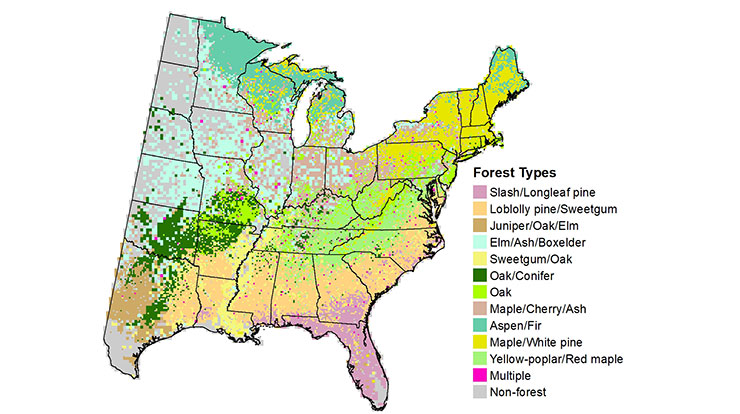
The landscape level information habitat models deliver is only part of the bigger picture needed by land managers. A team of Northern Research Station scientists used text-mining to develop landscape level forest type classifications that better represent the habitat models. The scientists demonstrated the utility of the text-mining approach by mapping forest types of the eastern United States to evaluate potential changes in vegetation under future climate scenarios.
A team of Northern Research Station scientists used a text-mining approach to define forest types from species distribution models for 125 tree species in the eastern United States. Advances in machine learning algorithms and novel techniques provide insights to make better use of information gleaned from habitat suitability modeling efforts. The application of a text-mining algorithm to define forest types from modeled suitable habitats and developing scores to assess potential future changes is a novel addition to the important quest for understanding future forest community structures. The information will assist forest managers planning for the next half of the century by identifying areas with greater change from recent vegetation patterns resulting from not only climatic changes, but also species’ suitability.
The forest type and potential vegetation change maps offer additional information to users of the Climate Change Atlas (www.fs.usda.gov/nrs/atlas) to help interpret current forest communities and consider where changes could occur in the future, or where forest communities might be relatively unchanged. By combing changes in suitable habitat and climate separately, scientists hope to tease out the potential impacts each could have in the future.
Contacts
- Matthew Peters, Ecologist
- Stephen Matthews, Ecologist
- Anantha Prasad, Research Ecologist
- Louis Iverson, Landscape Ecologist, Emeritus
Publications and Resources
- Defining landscape-level forest types: application of latent Dirichlet allocation to species distribution models.
- Utilizing the density of inventory samples to define a hybrid lattice for species distribution models: DISTRIB‐II for 135 eastern U.S. trees.
- Analysis of Climate Change Impacts on Tree Species of the Eastern US: Results of DISTRIB-II Modeling.