

US Department of Agriculture, USDA Forest Service, Technology and Development Program Banner with Logos.
Images from various aspects of the T&D Program.
HomeAbout T&DT&D PubsT&D NewsProgram AreasHelpContact Us
Search T&D
   Go
  Search all USDA
Program Areas
Left Nav Bottom
T&D > Programs Areas > Forest Management > Chip Trailers > Curve Calculators Program Areas
Chip Trailers

Curve Calculator

This is a curve calculator for calculating the curve widening needed to allow the passage of trucks and trailers. The first step is to determine the central angle of the curve. This is done by measuring the azimuth of the roads coming into the curve. Measure these angles from the point of tangent with the curve.

Click on this link to download a desktop version of this calculator, Curve Widening. This is a zip file that contains three files. Put the files into one folder on your computer. For the sake of simplicity create a shortcut to the .exe file on you Desktop and run it from the shortcut. Otherwise, you can just double click the .exe file to run the program. All three files must be in the same folder for the help to work.

The first azimuth must be the smaller of the two measurements or the calculator will return a wrong central angle.
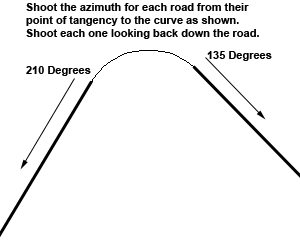
Enter the first azimuth

Enter the second azimuth

Hit the calculate button to calculate the central angle

Central Angle, I in degrees

The next step is to calculate the radius of the curve. This is done by measuring the arc length of the curve at the center line. The radius is then calculated from the central angle and the arc length.

Enter the arc length

Hit the calculate button to calculate the radius

Radius, in feet

The final step is to put this all together to calculate the width of curve required to pass a tractor-trailer. At the right are the fields required for input.

  1. Truck type is the type of tractor-trailer combo being analyzed. 1 is a standard lowboy or tractor-trailer. 2 is a stinger type log truck
  2. L1 is the wheel base of the tractor, in feet
  3. For a standard tractor-trailer, L2 is the distance from the fifth wheel to the middle of the rear duals of the first trailer. For a stinger log truck, L2 is the length of the stinger.
  4. For a standard tractor-trailer, L3 is the distance from the fifth wheel to the middle of the rear duals of the second trailer. For a stinger log truck, L3 is the bunk to bunk distance minus the stinger length.

The calculator gives three numbers:

  1. The effective length is the effective length of the tractor-trailer combo, in feet.
  2. Curve Widening is the extra width needed at the inside of the curve.
  3. Minimum land width is the overall lane width required to pass the tractor-trailer. Standard lane width is 12 feet, so this number is just 12 plus the curve widening.

Truck Type

L1

L2

L3


Effective Length

Curve Widening

Minimum Lane Width


