|
Evaluation of Stress Detection Glasses
Entire Report
"Detect stress in your plants before it's too late". This is the type of statement used to market
plant stress detection glasses. Do they work? How well do they work? Do they
have applications in Forestry?
The glasses are available through
several commercial outlets. They are marketed through these outlets by Dr.
Robert Brock of Beaverton, OR. The glasses are marketed to producers of crops.
They are advertised to spot, from a distance, stressed turf or field crops
due to insect, disease or moisture stress. They would be an "early warning
system" that can be used by field work crews. More recently they have
been offered in forestry supply catalogues.
The glasses were developed by a
NASA scientist in an attempt to identify camouflaged objects in forests, grass
or jungle environments. The glasses filter out green color, while enhancing
yellow and red wavelengths. Dr Brock's paper "Stress Detection
Glasses, History and Additional Information", September 2002, details
how the glasses function.
A search for information evaluating
these glasses showed there has been little formal evaluation. Most information
is anecdotal. A formal paper "Efficacy of NASA Plant Stress Detection
Glasses for Pine Beetle Detection" by Rankin, Heath and Murtha details
the use of the glasses during aerial surveys to locate bark beetle infestations.
A comparison of mapping with and without the glasses indicated that significantly
more beetle infestations were recorded when the glasses were worn.
The glasses are designed to block
the color green and enhance other colors. They would possibly amplify changes
(reductions) of green in the plant foliage brought about by a change in the
chlorophyll when the plant is under stress. The glasses could feasibly make
it possible to detect color changes in green that would not be visible to
the unaided eye. This would have application for determining when vegetation
is under stress and providing advanced warning so that action can be taken
to relieve that stress by watering, fertilizing, removing insects or disease,
whatever is causing the stress. It may also provide application during designation
of trees to be removed for salvage because of fire, disease or insect attack.
It may be possible with the glasses to determine, at an earlier stage, when
a tree is starting to fade. This could be very useful in the spring or early
summer when trees start to come under moisture stress and fading of crown
begins.

The stress detection glasses are available from several
suppliers and come in regular and clip-on styles.
Viewing
Examples of what vegetation looks like through the stress detection glasses. With actual observations
using the glasses the contrast of vegetation changes seems to be more intense than it does through the camera lenses.

Normal view of tree showing
live and dead foliage.

View of same tree through stress
detection glasses. Dead/dying
foliage shows bright red.
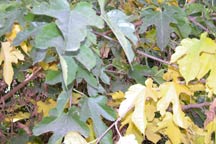
Above and below - Normal view
of fading leaves.
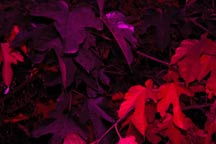
Above and below - Same view with
glasses. Green leaves appear gray
violet.

Normal view of tree showing
live and dead foliage.

View of same tree through stress
detection glasses. Dead/dying
foliage shows bright red.
Evaluation of Glasses
The glasses were tested
at the San Dimas Technology and Development Center. The purpose of the testing
was to determine if plant stress could be detected with the glasses before
it could be detected with the unaided eye.
Preliminary Evaluation
A preliminary evaluation
was started in January, 2003 at the SDTDC. Herbicide (Roundup) was applied
to 4 patches (approximately 18x18 inches) of naturally occurring weeds (2
grass and 2 broadleaf). Application of herbicide was at 10:00 am on January
22, 2003. Weather - Approximately 60 degrees, 50% relative humidity, and hazy.
Most changes to the plants occurred within the first two or three days. Observations
were made over several more days to take advantage of changing light conditions
(hazy and sunny days).
Test areas were checked approximately
every 2 hours during daylight/work day. After 24 hours evidence of stress
started to show up in the grass but this was only evident upon close inspection
with the glasses and probably would not have been noticed if the test areas
were not identified. At about 28.5 hours the stress to the grass was becoming
very noticeable with the glasses. Without the glasses the changes could be
seen but were not as obvious at a glance. The glasses appeared to amplify
the differences. The broadleaf weeds had some leaf curling at 28.5 hours.
However the herbicide effects at this time were not very pronounced and would
not have been observed at a glance, with or without the glasses.
Early morning and late afternoon
observations seemed less effective than when the sun was higher in the sky
(approximately 10am to 3pm for this time of year). On sunny days, during the
midday hours, the glasses seemed to make fading in leaves much more evident.
During overcast days the differences were similar throughout the day—probably
a little easier to discern in the morning and evening hours but less pronounced
at midday.
The preliminary evaluation showed
that the glasses should be tested to consider sun angle (time of day) and
sun position relative to the observer.
Formal Evaluation
The evaluation of the glasses
was undertaken starting July 14th, 2003. High temperatures were in the 90
to 100 degree range. Humidity varied but was high for this period of time
in southern California. It was mostly sunny but there were periods of hazy
weather. Eight species of plants native to California were used in the test.
These were manzanita, sedge, bush anemone, grass, ponderosa pine, toyon, monkeyflower,
and ceanothus. Individuals of each type were stressed by withholding water
(drought stress) or by applying a light dose of herbicide. The plants were
evaluated by six people, several times a day, over a period of four days.
Persons evaluating the plants had forestry field experience ranging from none
to over 30 years. The plants were viewed from four angles (north, east, south,
and west). The plants were evaluated each time and at each angle with and
without the glasses.
Method
Most plants were in five-gallon
containers, except the grass and sedge which were in one-gallon containers.
Each plant species was assigned a group (A through H). Each plant was assigned
a number within the group. One or two plants of each species were lightly
treated with pre-mixed Roundup and one or two plants of each species had water
withheld to simulate drought. The plants had not been watered over the previous
weekend. Starting on July 14th the plants not being tested for drought stress
were watered daily. The evaluators did not know which plants were being stressed.
Evaluation was based on a comparison
of other plants within the same group but not between groups. Each plant was
recorded as having no change, minor/slight change, or obvious changes (assigned
values of 0, 1, or 2, respectively). There were some initial observable differences
due to the natural variation in plants and the fact that there were dead or
dying leaves or branches on some plants. The test was started immediately
after initial treatment at a time when none of the treatment effects would
be showing up. This allowed for natural variation to be recorded and changes
evaluated from these base observations. The testing was terminated after four
days because the effects of the herbicide treatments were fully evident. The
effects of drought stress were evident in the least drought resistant plants
in the larger containers and in the small plant containers (dry out more quickly).
The most drought resistant plants did not show much evidence of stress but
it was felt that there was enough data for purposes of the test.
Results
The results of the evaluation were
tabulated and comparisons made of the results with and without the glasses.
Each day was broken into five time periods to evaluate for sun angle. Data
was also separated by direction of viewing (north, east, south, or west) and
further segregated by the location of the sun to the observer.
Observations by time period
The data represented in Figure
1 (next page) indicates that in the first two days there were more changes
observed with the glasses than without them. This appears to reverse for the
last two days where changes observed without the glasses exceeded changes
observed with the glasses. This indicates that the glasses do aid initially
in the detection of stressed plants and are better than the naked eye. Of
the 10 time periods in the first two days the changes detected with the glasses
exceeded those without the glasses 8 out of 10 times. In the last two days
the changes detected with the glasses exceeded those without the glasses only
1 out of 9 times.
The differences in the first two
days compared to the last two days can be explained by how the glasses work.
The glasses make green vegetation appear gray or black but make yellows and
orange brighter. This would make the vegetation with diminished chlorophyll
appear bright orange. Brown or gray vegetation is not enhanced by the glasses.
Therefore, over a period of time, the vegetation that initially appeared bright
when it is stressed later blends in with the darker colors that the glasses
turn the green vegetation.
Change observed by time period.
| Date/Time |
Without
glasses |
With
glasses |
| 7/14 to 0900 |
2 |
6 |
| to 110 |
19 |
21 |
| to 1400 |
41 |
55 |
| to 1530 |
25 |
36 |
| to 1700 |
65 |
58 |
| 7/15 to 0900 |
83 |
75 |
| to 1100 |
90 |
103 |
| to 1400 |
201 |
224 |
| to 1530 |
26 |
30 |
| to 1700 |
71 |
92 |
| 7/17 to 0900 |
170 |
170 |
| to 1100 |
256 |
252 |
| to 1400 |
293 |
236 |
| to 1530 |
127 |
113 |
| to 1700 |
65 |
80 |
| |
129 |
106 |
| |
318 |
279 |
| |
341 |
313 |
| |
245 |
223 |
| |
0 |
0 |
| Figure 1. Each day was divided into 5 periods. Due to work schedules of the participants it was not feasible to get the same number of samplings in each time period. Though the data with and without glasses is directly comparable within a time period on a given day, no comparison should be made to data between time periods. Numbers represent the total tally of assigned values (0, 1, or 2) related to observed changes in a time period. |
Sun angle in relation to observer
The data represented in Figure 2 (next page) indicates that when wearing the
glasses there is little difference between facing the sun and having the sun
at your back. However, discussion with the samplers indicates that the brightness
of the color difference is more intense when the sun is at your back.
Sun angle in relation to observer.
| Date |
Glasses |
Facing
the sun |
Sun
behind |
Sun
over-head
** |
Sun
to
side
(left
or
right)
* |
E
AM |
W
PM |
W
AM |
E
PM |
NESW Midday |
S/N AM |
S/N PM |
| 7/14/2003
| Without |
5 |
19 |
4 |
19 |
10.25 |
6 |
26 |
| With |
5 |
21 |
8 |
20 |
13.75 |
7 |
26.5 |
| 7/15/2003 |
Without |
36 |
25 |
46 |
19 |
50.25 |
45.5 |
26.5 |
| With |
41 |
28 |
44 |
28 |
56 |
46.5 |
33 |
| 7/16/2003 |
Without |
99 |
46 |
109 |
48 |
73.25 |
109 |
49 |
| With |
91 |
44 |
114 |
43 |
59 |
108.5 |
53 |
| 7/17/2003 |
Without |
109 |
60 |
112 |
63 |
85.25 |
113 |
61 |
| With |
94 |
54 |
94 |
54 |
78.25 |
98.5 |
57.5 |
* Total divided by 2 because of 2 directions.
** Total divided by 4 because of 4 directions.
Figure 2. The data was segregated by time periods of daylight hours with samplings up to 11 o’clock representing AM and samplings after 2 o’clock representing PM. From 11 to 2 o’clock is considered midday where the sun is overhead. Since the stress in the treated plants increased as time passed each day, the data between AM, midday, and PM are not comparable. What can be compared are the data within the same time period by direction and the data with and without glasses within the same time period and direction.
|
Because the stressed plants changed over time it is not reasonable to compare
the midday readings with other data taken at different times. What this information
shows is that during the initial stages of plant stress (first two days) there
is a better chance of detecting stress with the glasses.
The data indicates that having the sun at the side increases the chances
of observing plant stress compared to either facing the sun or having the
sun at your back. This does not appear consistent with the verbal opinions
of the observers. This difference is probably attributable to layout of the
plants being sampled. The east/west axis of the layout was approximately twice
as long as the north/south axis. This probably caused screening of some plants
by others in front of them. The layout of the plant groups is indicated below.
| North |
| West |
Group A |
Group B |
Group C |
Group D |
East |
| Group E |
Group F |
Group G |
Group H |
| South |
Follow-up field evaluation
The SDTDC testing of stress detection glasses was on small plants.
In essence all observations were looking straight ahead or down. What differences
would there be when looking up into a tree canopy? The San Bernardino National
Forest was visited and the glasses were evaluated on trees affected by drought/bark
beetles.
Small tree at eye level
Stress detection glasses increase the color contrast of dead/dying foliage.
Looking toward the sun reduces the contrast. Viewing with the sun to your
back makes the color contrast of dead/dying vegetation the brightest.
Large trees looking up
Looking up into crowns at a 30 to 45 degree angle is similar to the results
at eye level. However, when the sun is higher in the sky the contrast is reduced
if looking at the tops of the trees. This is probably because you are again
looking toward the sun.
Landscape scale viewing
On a landscape scale, dead/dying trees really stand out compared to the naked
eye. When the glasses are removed the trees can still be picked out, but not
as easily. The stress detection glasses could be very useful when trying to
estimate mortality at long distances, such as from ridge to ridge.
General observation
The stress detection glasses will help pick up changes to the color of the foliage. As needles or leaves
start to fade before normal cast-off they become very evident when using the
glasses. Insect damage such as needle miners becomes a lot more evident. Trees
exhibiting chlorotic foliage from mineral deficiency or disease will appear
brighter through the stress detection glasses.
Just because there is an observable
effect does not necessarily mean that a tree is dying. The stress detection
glasses could be useful in helping detect possible mortality during the early
stages of bark beetle or other insect attack. However, they should only be
used to draw your attention to the possibility of a problem. The tree should
not be designated for removal based on the stress detection glasses alone.
Closer inspection should be used to determine what is causing the color change.
Opinions of Samplers and Others
The people doing the sampling provided
verbal and written observations and opinions of the stress detection glasses.
Other persons that have tried the stress detection glasses provided some additional
input/opinions. These are summarized below.
Sampler's Comments
It became evident that the dead or dying plants had a more orange
or red appearance.
The signs of mortality were
more evident without glasses than with the use of the glasses.
On the first day of the experiment
I was able to detect stress in two plants that I could not see with the naked
eye. As the test went on, many of the plants showed noticeable signs of stress
with the glasses, and no signs without the glasses.
Group D showed plants having
signs of mortality but this was also detected without the glasses.
....when the sun was at your
back and directed on to the plants it enhanced the colors more.
The glasses did enhance the
mortality but the mortality could be detected without the glasses.
The usefulness of the glasses
for detecting stress varied by type of plant, time of day, direction, and
cloud cover.
Group F showed more yellowing
but showed better without the glasses.
The colors were more enhanced
with the glasses.
There were certain times of
the day that the glasses seemed most effective. During the early afternoon
and late evening the glasses worked better than they did in the mid-afternoon.
The light colors were more apparent in the early morning and late afternoon.
There was not this distinct difference when it was the middle of the day.
Overall the glasses helped
me detect stress in the plants that I was not able to see with the naked eye.
Although the plant stress could
be observed at about the same time with and without the UV glasses, the stress
was more apparent with the glasses for some plant types.
My observation is that a user may find these glasses helpful in detecting
mortality. However, there will be a learning curve in seeing these differences.
These glasses may only be good
for specific species.
The glasses tended to conceal
stress in plants with yellow-green leaves.
I would only use these glasses
in conjunction with other science.
I think the glasses are a useful
tool for some types of plants, not necessarily to detect stress sooner, but
to see it easier.
Others
Bill Radtke, Michigan Department of Natural Resources. Surveying
a variety of causal agents in both hardwood and conifer forests.
They did seem to be useful. After
a period of acclimation and comparison I did learn to interpret the information
garnered via the glasses.
Our application requires the constant
transfer of information to a quad map and soon to a computer tablet. The stress
detection glasses are so dark that constant removal or lifting of the clip-on
lenses is required. This problem could be eliminated by leaving
the bottom half or "bifocal" area of the lenses clear.
Bill Befort, Minnesota Department
of Natural Resources. Sketch-mapping during aerial surveys.
Entire landscapes viewed from
the air are far from uniform; there is a very wide range of perfectly normal
variation and contrast, unrelated to plant damage, that must be instantly
and continuously recognized and factored out by the observer as he flies along.
The symptoms of vegetation damage are not the strongest contrasts in the general
landscape, but some of the subtlest, and they are also far from uniform. Because
stress detection glasses substantially alter the visual appearance of the
landscape, they add a great deal to the baseline mental interpretation workload
that the observer must handle merely to stay oriented and factor out inessentials,
while any enhancement they provide to vegetation stress symptoms is likely
to be lost in the clutter. In brief, they create more problem than they solve.
I've settled on amber
(not yellow) "blue-blocker" sunglasses for sketch-mapping.
Keith Windell, Missoula Technology
and Development Center. Evaluating fire damaged trees.
In the very short period of
time I had them on (about 5 or 10 minutes per session) my eyes never did totally
adjust to the color scheme (rose) you see through the glasses. I started to
feel disoriented (and even sick) so discontinued using them.
The dead needles in the tree
crowns stood out but at 50 to 100 feet I didn't feel like I could make
a decent call on whether the trees were mortally stressed or not.
Although an experienced user
of these glasses would no doubt be more confident with their decisions (leave
vs. cut) I think there will always be a high degree of subjectivity in this
approach....
Conclusions
The value of the stress detection
glasses appears to be in the way they amplify a person's color perceptions.
Determining what the observations mean will take some experience by comparisons
with known plant stresses. Comparing different types of vegetation may be
difficult. Changes in vegetation that is naturally a yellowish color may be
difficult to detect. The glasses amplify color changes but give no indication
of what is causing the change. As an example, natural color changes in leaves
at the beginning of fall are significantly enhanced but the vegetation is
probably healthy.
Some users find the glasses somewhat
disorienting or upsetting. Others seem to have no problems, at least using
them for short periods of time.
The ability of the eye to detect
plant stress problems seems to increase with experience. A novice may not
notice minute changes that the seasoned veteran may think are obvious. For
this study, testing was of short duration. The ability to detect changes with
the glasses may increase with more experience.
The glasses do appear to have utility
for forestry work. Some experience with the glasses appears to help when evaluating
what one sees. They may not provide magic answers as to whether vegetation
is about to die but they do amplify a person's perceptions. They are
a relatively inexpensive, small, and lightweight tool. They can easily be
carried to the field and can aid in quickly picking out vegetation changes.
Comparison of Stress Detection with Other Sunglasses
Though not part of the original
project, the NASA stress detection glasses were compared to other readily
available sunglasses. It has been noted that amber lenses can detect stress
related changes in plants. Are these detectable changes comparable to the
NASA glasses? Do other colors work?
Four pair of sunglasses were compared
to the NASA glasses where the changes in the plant were already apparent.
Colors evaluated were blue, green, amber and brown.
The colored glasses appear to enhance
color differences that are the same color as the lenses. The blue and the
green did not seem to do much to enhance visibility of changes in plants due
to stress/mortality. The amber glasses did the best job of the sunglasses
particularly where the foliage turned orange or brown. The brown glasses did
amplify some changes but not to the degree of the amber glasses. Wade (1997)
found that among the most effective glasses were those that block the blue
and haze that comes from the scattering of blue light under hazy conditions.
He also found that the inexpensive variety of blue-blocking glasses was as
effective as the expensive one.
However, compared to the NASA stress
detection glasses, none of the sunglasses detected as wide a variety of change
nor did they adequately detect early changes like the NASA glasses did.
Schultz (2001) tested 19 lenses
of various colors, including the stress detection glasses evaluated in the
paper. His test used ponderosa pine. He found that the stress detection glasses
showed no particular advantage at detecting off-color ponderosa pine. He also
found that the stress detection glasses were too dark to conveniently or safely
wear while driving or walking under forested conditions.
References
- Brock, R., 2002, Stress Detection Glasses, History and Additional Information
- Rankin, L., Heath, J., and Murtha, P., 2000 Proceedings 22nd Canadian Symposium Remote Sensing
- Schultz, D., 2001, Evaluation of Lenses to Detect Stress (FHP Eval. No. N01-06 Letter of USDA Forest Service
- Wade, G., 1997, Amber Sunglasses Enhance Foliage Color Discrimination USDA Forest Service paper, NE-INF-131-97, from the Northeast Forest Experiment Station
|












