
Contact
|
MTDC Home Contact |
|---|
 |
Physical Security Basics |
Threat & Vulnerability Assessment |
Facility Planning |
Deterrents | Alarm Systems & Sensors |
Video
&
Access Control Systems |
|
 |
|||||
Video Camera EquipmentAll video cameras use an optical lens to capture and focus light reflected from the scene onto an electronic chip. The chip converts the reflected light into electrical impulses. An electronic scanning system creates a time-sensitive voltage signal that is a replica of optical information captured by the lens and focused on the chip. This voltage signal is transmitted to a location where it is viewed and possibly recorded as a coherent video image. The sensitivity of a video camera describes how much light is required to produce a video image. The more sensitive the camera, the less light required.  Video cameras can be color or black and white (monochromatic). Color cameras should be equipped with an infrared cut filter that allows the camera to respond effectively when infrared light is used for scene illumination. Color cameras need to be properly adjusted to present colors faithfully. The image size and field of view are determined primarily by the len’s focal length in relation to the size of the camera’s image sensor. Zoom lenses are variable focal-length lenses that can be manipulated to increase or decrease the image size. Zooming in to increase the image size decreases the field of view. This makes it more difficult to follow a rapidly moving target. Zooming out increases the field of view, which decreases the image size, but makes it easier to keep a rapidly moving target in the video frame. The mount for a video camera is extremely important. A fixed mount keeps the camera pointed in one direction. The camera’s orientation can be changed only at the mount. The lens can still be zoomed for crude and limited target tracking. A remotely controllable mounting that allows the camera to be panned (moved side to side) and tilted (moved up and down) is highly desirable when it is important to track a moving or movable target. Cameras that need to track moving or movable targets probably should be placed on a pan-and-tilt mounting and equipped with a zoom lens. Often, those functions are abbreviated as PTZ (pan, tilt, zoom) by video system designers. Lenses have an aperture control that adjusts the image brightness based on the amount of light reaching the lens. The aperture control can be manually operated. Lenses that automatically adjust the aperture for different light levels are preferred when the scene’s light level is expected to change (from day to night to day again).  Some highly specialized cameras called thermal imagers are sensitive to specific wavelengths of light. Every object at temperatures above absolute zero absorbs heat energy and emits it as infrared energy. Thermal imagers look for the emitted infrared energy and display the difference in energy emitted between different objects as a thermal image. A thermal image of a human body retains the general outline of a human body, but features that are recognizable in visible light video (the video we’re all familiar with) are less recognizable in thermal imagery. 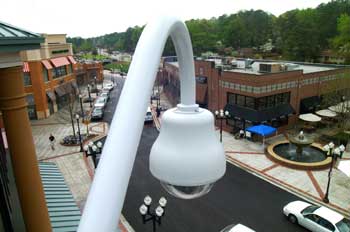 A thermal imager can “see in the dark” because it does not rely on visible light. How well it sees in the dark depends on the physical properties of the target and surrounding objects. Thermal imagers are often touted as being able to “penetrate fog.” That characterization is incorrect. Thermal imagers may be able to sense or detect energy emitted by a warm body that is otherwise obscured by fog, but the image may lack enough form and detail to allow an observer to distinguish the body’s characteristics. 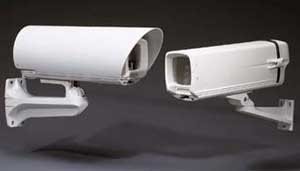 Normally, the camera and lens are enclosed in a housing that protects them from weather and vandals. Housings can be equipped with accessories that control the camera’s temperature. Most types of electronic equipment, including CCTV cameras and electronic lenses, perform erratically or fail in extreme temperatures. Particularly in high-temperature environments, the temperature inside the housing will exceed the air temperature. Camera housings can be equipped with wipers and defrosters to keep the transparent element in front of the camera’s lens clear of water, frost, steam, insects, and so forth. Camera housings can be mounted on a remotely controllable pan-tilt mount. If the camera inside is equipped with a zoom lens, the housing must be large enough for the lens to be extended fully.  Another type of camera housing is fully transparent. The housing remains stationary, but it includes a small CCTV camera and lens, a rapidly changeable pan-tilt mount, and an electronic processor. This type of assembly is becoming popular because it is small in size and can be adapted for many uses. The camera’s position (the direction that it’s pointed) and the focal length of the zoom lens can be changed quickly and precisely by a human operator or in response to programmed instructions that redirect the camera’s position and zoom the lens to respond to preset alarm system conditions. In simple terms, the alarm system automatically tells the CCTV where to look and the size of image to present. Because the changes can be made in a second or less, the target image is presented quickly to the human console operator. The operator has longer to assess the video image. The operator can retain all pan, tilt, and zoom controls, overriding the preset parameters, if necessary. In more complex systems, an array of these cameras can be positioned and programmed to track a moving target handing off the target from one camera to the next. The human console operator will be able to follow a target continuously (as long as the system designer covered all areas with video). This capability may let the operator to guide security responders to the moving target more quickly. It also lets the operator provide security responders with more information about the target. |
Top Back | Next Physical Security Toolbox Home T&D Home |
