|
| Search all USDA |
 |
|---|


|
Aerial Vegetation Survey
Ryan Becker, Project Leader
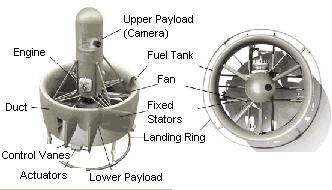
Other UAVs Of Interest The high-resolution images collected by the Bat are not necessarily the ideal product to meet the needs of invasive species professionals. Alternative aircraft and technologies were continually evaluated throughout the project, but none that were located could deliver a product immediately. While the Bat is presently the ideal platform for satisfying the identified demand, the systems described here may soon find their own application. Rotor-Wing Aircraft The ideal product for this application, figuratively speaking, is a set of remote "eyes" that can be commanded to go anywhere and examine objects in unlimited detail. This also happens to be an ideal product for combat. Not surprisingly, a wide variety of unpiloted aircraft capable of hovering in a given spot and relaying live video to a remote location have been developed by the Defense Department, and some of these systems have been advertised for commercial applications. On the other end of the spectrum, hobbyist aircraft that are not presently capable of autonomous flight were also investigated. Those identified show no immediate potential for this application. Rotor-wing aircraft concede some major flight advantages to fixed-wing in exchange for the ability to launch without a runway and hover. The primary concession is in fuel efficiency. The static lift developed by fixed wings takes far less energy to maintain than the dynamic lift of rotor wings. This drawback is most notable when comparing flight durations for similar payloads between fixed-wing and rotor-wing aircraft. Despite limited range, this type of aircraft will see wide use in applications where high-resolution imaging is required, and especially where the imaging targets are not visible from directly overhead. iSTAR UAV: Ducted Fan Manufacturer: Allied Aerospace As of July 2009, the iStar UAV project management team has changed several times and could no longer be located for status information. To the authors knowledge, the project never reached production. The iSTAR line of UAVs incorporate live video fed to a base station with fully autonomous takeoff, flight and landing capabilities. Three sizes are planned, up to the 29-inch diameter version at right, which has completed several test flights. This version has achieved autonomous startup, takeoff, hover, transitions to and from forward flight, and landing. The aircraft will carry about an hour's worth of fuel and will have a flight ceiling of sixteen thousand feet, which is considerably higher than many rotor-wing platforms. The communications link will be capable of a ten-kilometer range. While the developers are targeting a maximum level cruise speed of sixty to one hundred knots, the modest flight duration - a byproduct of the relative inefficiency of rotor-wing aircraft, in comparison to fixed-wing - limits the aircraft's potential to image large swaths in a short time. Payload is also weight-limited, reducing the variety of candidate imaging equipment. The engines currently used produce a considerable amount of medium-frequency noise, which could be an issue for some applications. Purchase and service costs have not been finalized, although the development team has been conducting flight tests for the past eighteen months. The base station is currently housed in a van, which places some limitations on the iSTAR's portability. Natural resource professionals may find use for the iSTAR once it is commercially available. Unlike fixed-wing aircraft, the iSTAR and other rotor-wing aircraft have more potential for very high-resolution imagery at close target range. The iSTAR will be able to operate much closer to aerial hazards, and possibly even below some tree canopies, without extreme risk of crashing. An ideal application could be as a follow-up inspection tool for inaccessible areas that show inconclusive signs of invasive species intrusion in satellite imagery. Another ducted fan UAV very similar to the iSTAR, named HeliSpy, was recently purchased by an unidentified company that has ceased publicizing the aircraft. The previous developer, Micro Autonomous Systems, had planned to sell the aircraft for between $12,000 and $25,000. WB 65/80: Rotor and Tail Boom Manufacturer: RC Whirly Bird RC Whirly Bird counts the reality TV show Fear Factor as a regular customer. The aircraft used for such work have been modified to provide long flight durations with payloads as heavy as 45 pounds and standard ranges up to 500 miles with an autonomous flight control system. Camera pods developed for high-quality video applications include gyroscopic control and stabilization with two-axis rotation (720-degree horizontal by 200-degree vertical). As with all rotor-wing systems, maximum altitude decreases rapidly as payload increases, but the two autonomous systems, named the WB 65 and WB 80, both have a normal service ceiling of 13,000 feet, which is as good as can be expected from any such aircraft. The WB 65 and 80 are the largest of the aircraft investigated closely for this application, and may be too large for use in many situations. The WB 80's rotor diameter of over eight feet foreshadows issues associated with rotor downwash and clearance of aerial hazards that are less severe with smaller aircraft. From a positive standpoint, the large payload and sophisticated camera pod hold promise for allowing higher-quality imaging from high altitudes. Unlike many autonomous systems, the WB 65 and 80 use an airframe with thousands of commercial flight hours in non-autonomous operation. Users can expect both lower acquisition costs given the higher airframe production volume and greater reliability resulting from an extensive flight history. Blimp Hawk/Sky Ship: Airship Manufacturer: Remote Aerial Tripod Specialists (Rats Inc) The complete line of airships offered by Rats Inc span lengths from twenty to fifty feet with payloads in the ten to twenty pound range. These are not autonomous aircraft, and thus do not have immediate invasive species application under most circumstances. They do, however, offer the benefits of slow-cruise imaging without the high fuel consumption of rotor-wing aircraft. The large profile of airships make them much less fit for windy conditions. The 32-foot Sky Ship 500 (pictured below) sells for around $25,000. The airship is partially deflated for transport, but still requires a large enclosed trailer. Shipping may be accomplished through total deflation and disassembly, but this is impractical on a repeated basis. Airships can be very quiet platforms. Various issues, such as Threatened and Endangered avian harassment or visitor complaints, can cause operations to be restricted based on noise concerns. The larger fuselage of an airship, compared to other aircraft with comparable payloads, allows greater physical isolation of imaging equipment from engine-induced vibration. The rise of satellite communications has led to renewed interest in airships over the past decade, as various companies seek low-cost "satellite alternatives", aircraft capable of flying at high altitude for very long periods and relaying signals. Airships may see long-sought investment capital if the concept proves viable with any aircraft. Solong UAV: Powered Glider Manufacturer: AC Propulsion Batteries and solar cells power this 14-foot-wingspan, 20-pound aircraft in a quest to remain airborne for 24 hours straight. This aircraft chases a loftier goal than the much larger Helios, a well-publicized aircraft in development by AeroVironment to relay communications signals from high in the atmosphere for months at a time. The Solong is intended to improve upon the concept by flying purely on battery power during the night and fully recharging its batteries during the day, thus enabling perpetual flight. The aircraft is fully autonomous and has taken digital photos in flight. Its electric motor makes it virtually noise-free. Several factors limit the practicality of the Solong in its current state for this application. The FAA issue is the primary factor, as the aircraft is intended for high-altitude cruising, which is not possible under current regulations. The aircraft has not been developed for a specific customer or application, and would require significant investment to optimize for invasive species monitoring. Still, if the Solong does realize its potential to become essentially a low-cost, low-altitude satellite, high-resolution imagery could be collected virtually anywhere in the country for a fraction of the cost of conventional satellite imagery. |
 
|