

Accident Investigation Guide: 2005 Edition
Chapter 2—Investigation Overview
2.1 Introduction
The four basic components of the accident investigation process are:
- The accident sequence.
- Human factors accident and incident analysis.
- Equipment factors analysis.
- Environmental factors analysis.
The nature and complexity of the accident determines the extent to which these components are evaluated. Exhibit 2–1 shows the accident investigation process.
Exhibit 2-1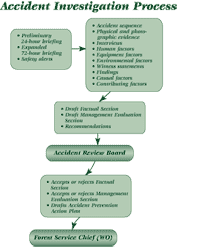

Click image for larger view
2.2 Accident Sequence
The accident sequence consists of five components and is established based only on the facts determined during the investigation. The five components are:
- Events occurring before the accident. Establish the sequence
of events leading to the accident to answer the questions:
who, what, when, where, and how. Identify any contributing
factors such as urgency, weather, equipment condition, or
terrain. If a fire was involved, establish when, where, and
how the fire was started. Determine flame propagation and
whether attempts were made to extinguish the fire.
- The accident sequence. Start with the initiating event
(examples are the truck tire blew out or the helicopter tail
rotor struck a snag) and continue until the sequence
reaches a logical endpoint.
- Events occurring after the accident. Identify the sequence
of events that occurred after the accident (such as search
and rescue or medical efforts), how the accident was first
reported, and the locations of personnel and equipment
after the accident. Note any disturbance to the accident
site and security or preservation measures taken, as well
as any injury and causal or contributing factors due to
events that occurred after the accident, such as rescue
and medical response.
- Injuries. Record all injuries. Identify all medical facilities
that provided treatment, document the condition of the
patients, and summarize autopsy reports, if applicable.
- Damage. Estimate the cost of the equipment or property damage and define the damage as minor, major, destroyed, or repairable.
2.3 Human Factors Accident and Incident Analysis
Human factors play a large role in most accidents. Investigators need to be able to identify the human factors that contribute to an accident. Thorough analysis can result in effective intervention and prevention strategies and recommendations. The Human Factors Accident and Incident Analysis checklist (exhibit 2–2) can be used to help the investigation team in identifying human factors associated with the accident. For aviation, use exhibit 9–2.
- Qualifications and Training. Determine the qualifications
and training of individuals directly involved in the accident (the
vehicle operator, passengers, and supervisor). Identify any
contributing factors such as the lack of operator certifications
or insufficient training.
- Duties. Identify the duties of individuals directly involved in
the accident, such as primary and additional duties, and work
and rest schedules. Note any contributing factors, such as
employee fatigue. Conduct a work/rest analysis covering at
least 72 hours before accident. Include an examination of time
and attendance records as well as input from appropriate
supervisors on tasks completed and actual time worked (may
not necessarily match recorded time), offduty activities, and
sleep duration cycles.
- Management. Determine the organization, supervision, and
external control of individuals directly involved in the accident.
Identify any contributing factors, such as a failure to emphasize
safety by the supervisor or organization.
- Compliance. Note deviations from policies, procedures,
practices, and contract specifications. Review the JHA, safety
equipment, and other items pertinent to the accident investigation.
- Documents. Identify whether directives, operating guides,
and contracts were current, readily available, and properly
used by individuals associated with the accident. Review
records specific to the accident, such as inspections, dispatch
and equipment logs, time and attendance records, safety
plans, and incident command system forms, if applicable.
- Communications. Identify the type of communications used
before, during, and after the accident. Identify any contributing
factors related to communications, such as radio coverage or
faulty equipment.
- Services. Determine whether contractual services, such as
road guards, traffic signs, or dispatch procedures contributed
to the accident.
- Risk Management. Determine whether a JHA or other workplace risk analysis was developed. Establish the role that the risk analysis played in the performance of the work project or activity. Determine whether a tailgate safety session was held and documented before work began.
2.4 Equipment Factors Analysis
- Systems. Determine what equipment was involved in the
accident and its suitability to perform the work project or
activity. Include any pertinent operator manuals, maintenance
records, inspections, and approvals of maintenance personnel.
- Survivability. Evaluate the ability and suitability of the vehicle,
system, or equipment to perform the work project or activity,
and the structural integrity of the occupant compartment.
- Impact conditions and crash (dynamic) forces.
- Restraint and rollover protection systems. Were such systems installed? Were they used?
- Personal protective clothing and equipment, and safety equipment.
- Backup and emergency systems.
- Safety design.
- Laboratory or Teardown Analysis. Review the results of any equipment component analyses. Special studies or tests should be conducted by another agency or private laboratory.
2.5 Environmental Factors Analysis
- Weather. Verify the weather conditions before, during, and
after the accident. Identify any contributing factors, such as
precipitation, temperature, lighting, and visibility.
- Physical Environment. Fully describe the accident scene. Determine whether the scene was preserved. Note the terrain at the accident site. Provide a general area map, a site-specific location map, profiles of terrain features, diagrams and sketches of the accident site, and diagrams of any other relevant objects. Take all measurements from a control point that has some permanency. Measurements can be made from the control point during return trips to the site. Identify any contributing factors, such as altitude, vegetation, slope, accessibility, dust, and smoke.
 E-mail: