

Accident Investigation Guide: 2005 Edition
Chapter 1—Accident Investigation
1.1 Introduction
A Forest Service serious accident is one that involves:
- A death
- Three or more persons hospitalized after treatment for reasons other than observation
- Wildland fire shelter deployments or entrapments
- Property damage, other than to aircraft, that exceeds $250,000
- Damage to aircraft that exceeds $1,000,000 or results in total destruction of the aircraft
- Supervisors and managers at all organizational levels are responsible for
identifying and abating hazards, incorporating safe operating procedures
into each of our daily tasks, and refusing to accept unnecessary risk. The
causes of most accidents or incidents are a result of failures to observe
established policies, procedures, and controls. All too often, accident investigations
reveal existing hazards that were not adequately addressed.
- The accident investigation gathers and interprets information to help managers
understand how and why an accident or incident occurred. Recommendations
can then be developed for corrective actions that will mitigate hazards and
prevent future injuries and property damage.
- An investigation must be done promptly to assure that important information
is not lost, misplaced, or contaminated. The agency’s first priority
is to aid the injured and to ensure prompt emergency medical attention. As
soon as the emergency situation is over, the accident investigation begins.
- An accident is an unplanned event involving Forest Service employees, volunteers,
cooperators, contractors, emergency firefighters, special program enrollees,
property, or the environment that results in an injury, illness, or material
loss (chapter 6732.1 of FSM 6700).
- An aviation accident is an occurrence associated with the operation of an aircraft that takes place between the time any person boards an aircraft with the intention of flight until all such persons have disembarked or before equipment has been unloaded.
1.2 Authority
The authority for the investigation of accidents is established in:
- Public Law 107–203
- Title 5, USC 7902
- 29 CFR 1904.2
- 41 CFR 101-37
- 49 CFR 830 NTSB
- Executive Order 12196
- FSM 5700, Aviation Management, Chapter 5720
- FSM 6700, Safety and Health Program, Chapter 6732.1
1.3 Purpose
The purpose of accident investigations is to provide management with information for accident prevention. The Accident Investigation Guide details information on the investigative process and associated tasks, such as gathering and maintaining custody of physical and photographic evidence, documenting witness statements, interviewing witnesses, managing records, preparing the investigation report (factual and management evaluation sections), and conducting accident review boards. The guide also includes the investigation protocol for wildland fire shelter entrapments, deployments, and fatalities, and aviation accidents and incidents with potential. Because the guide is revised as needed, it is important to use the most current version.
A compact disk (CD) also is included with the guide. All exhibits that may be necessary for accident investigation teams and accident review boards are provided as Microsoft Word documents.
1.4 Scope
- The Accident Investigation Guide is designed for Washington Office Forest
Service Chief’s investigation teams, but region and station investigations
should also follow the guide for consistency. A Chief’s investigation
team may also be mobilized anytime the Designated Agency Safety and Health
Official (DASHO) believes an investigation is warranted, for example, an “incident
with potential.”
The DASHO may also delegate responsibility to conduct the investigation to the regional forester or station director in the region where the accident occurred. In these cases, the DASHO will provide a letter of delegation of authority assigning the responsibility. In these situations, the DASHO may appoint at least one member to the investigation team. The procedures outlined in this guide will be used to conduct delegated investigations.
The process in the guide should also be used—entirely or in part—for all accident and incident investigations conducted at any unit level by individuals working under the direction and authority of the Forest Service. For example, while specific required procedures for motor vehicle accident investigations are outlined in the Manual on Uniform Traffic Control Devices, applicable information on conducting witness interviews and collecting evidence is available in this guide.
- Multi-agency/Interagency Investigations. With the advent of All-Hazards
Incident Management, Forest Service employees, equipment, and contract resources
are now working in unfamiliar environments, such as hurricanes, floods, and
biological hazard areas, in addition to wildland firefighting. National emergencies
may be longlasting events that may require rotation of personnel and other
resources. Many of these incidents also involve other Federal, State, county
and municipal agencies. When accidents occur during these activities, it
will be necessary to conduct multi-agency investigations where cooperation
between agencies is paramount.
The team leader should establish cooperative relationships with the other agencies involved in the investigation to ensure that the Forest Service meets its responsibilities while recognizing each agency’s need to fulfill theirs. This may involve negotiations, cooperative agreements, and coordination with the agency official who signed the delegation of authority, for example, a Memorandum of Understanding between the U.S. Department of the Interior (USDI) and the U.S. Department of Agriculture (USDA), to establish the basis for interagency investigations of serious fire-related accidents (exhibit 8–3).
During these types of investigations, a broader range of technical specialists than is typically used in Forest Service activities may be needed to assess risks to involved personnel or to provide the skill level needed to conduct the investigations.
- A Forest Service firefighter fatality as a result of a burnover or entrapment
requires the USDA Office of Inspector General to conduct an independent investigation.
That investigation shall be independent of the Forest Service investigation
(Public Law 107–203).
- Aviation accidents and incidents with potential (mishaps) are investigated
in accordance with chapter 9 and FSM 5700, chapter 5720.
Smokejumping and helicopter rappelling are considered Forest Service aviation
accidents if they occur before the employee has safely disembarked from the
aircraft or before equipment has been unloaded.
- The National Transportation Safety Board (NTSB) has the responsibility
to investigate all Forest Service aviation accidents and certain incidents
with potential (mishaps). This results in special interagency working relationships,
policies, and procedures when conducting aviation accident investigations.
The NTSB will appoint an investigator in charge (IIC) to perform the NTSB factual investigation. The investigation process and direction is under the authority of the IIC. The IIC will conduct the NTSB investigation in one of the following ways:
- The IIC conducts the onsite investigation. When the IIC conducts the
onsite investigation, the Qualified Technical Investigator (QTI) assists
the IIC as requested in the collection of data to support the NTSB factual
investigation.
- The IIC delegates the onsite investigation to the Federal Aviation Administration
(FAA). When the FAA conducts the onsite investigation, they do so with
the full authority of the NTSB. The QTI will be the liaison with the FAA
onsite investigator and the Forest Service.
- The IIC delegates the onsite investigation to the Forest Service. When
neither the NTSB nor the FAA conduct the onsite investigation, the QTI
will conduct the onsite investigation and provide all data collected to
the IIC.
In addition, the Forest Service investigation team will conduct their investigation of Forest Service management and policy issues following this investigation guide concurrent with the NTSB investigation.
- Collateral Investigations. Collateral investigations are conducted independently of the accident or incident investigation and record the facts for litigation, claims, and other administrative or disciplinary actions.
1.5 Investigation Team Selection
For Washington Office-level accident investigations, the deputy chief for business operations, who serves as the DASHO, shall notify the appropriate regional forester or station director that a Chief’s level investigation has been authorized and whether it will be conducted by a national level team or delegated to the region, station, or area.
1.6 Composition of the Investigation Team
The investigation team normally includes: a team leader, chief investigator, safety manager, technical specialist(s), a documentation specialist, a union representative, and a law enforcement representative. For aviation investigations, a qualified technical investigator (QTI) has the same duties as a chief investigator. Other team members may be added as needed (exhibit 1–1). The team leader, chief investigator or QTI, and all team members should be recruited from outside of the unit experiencing the accident. For fire-related investigations, investigators and technical specialists may need certification that addresses red-card requirements for unescorted investigation site visits. A delegation of authority memorandum documents the official appointment of the team leader (exhibit 1–2).
Exhibit 1-1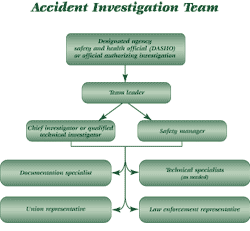

Click image for larger view
Duties and responsibilities of team members:
- Team Leader. The team leader is normally a line officer or higher-level
agency official and is selected based on the severity of the accident and
the level of management representation needed. The team leader must be knowledgeable
of Forest Service policy and should be appointed from outside of the region,
forest, or unit that incurred the accident.
- Qualifications. Senior management official (senior executive
service level) for Washington Office investigations; Regional
Office director or forest supervisor for regional office investigations.
- Duties and Responsibilities.
- Organizes, conducts, and controls the Forest Service
investigation effort and provides support to team activities
with the assistance of the chief investigator or QTI.
- Establishes cooperative working relationships with other
Federal, State, county, and municipal agencies involved
in the investigation.
- Contacts the unit that had the accident to determine
the status of the local investigation in progress and to
obtain other pertinent information.
- Coordinates Critical Incident Stress Management/Critical
Incident Stress Debriefing (CISM/CISD) activities planned
by the unit to ensure investigation integrity is maintained
while meeting the needs of affected individuals.
- Provides briefings for affected personnel, agency officials,
and the public.
- Conducts investigation team meetings and coordinates
information exchange between team members.
- Maintains liaison with regions, stations, areas, labs,
forests, units, and the Washington Office.
- Approves requests for resources from the chief investigator
and approves team members for the investigation or for
release from the investigation. A team leader investigation
checklist (exhibit 1–3) is provided
at the end of chapter 1. It is designed to help the team
leader identify other individuals who are key to the investigation.
- Forwards the expanded briefing to the safety manager
at the organizational level that authorized the investigation.
This briefing is prepared by the investigation team within
72 hours of the team’s arrival (exhibit
1–5). The preliminary briefing is prepared by
the home unit (unit where the accident occurs) within 24
hours after the accident has occurred (exhibit
1–4). The unit is responsible for forwarding
it to the safety manager at the organizational level that
authorized the investigation.
- Arranges local transportation, obtains a suitable local
workplace, provides for the safety of the team, and ensures
the security of the meeting place and the information gathered
during the investigation.
- Arranges critical incident stress debriefing for investigation
team members as needed.
- Coordinates with the unit information officer for all
media releases. For aviation, the team leader coordinates
with the NTSB before the release of information to the
public.
- Forwards the draft factual and management evaluation
sections of the investigation report to the safety manager
at the organizational level that authorized the investigation.
- With the assistance of the chief investigator or QTI,
conducts the closeout meeting for the agency administrator
(the authorized official on the unit where the accident
occurred) to provide information on the status of the investigation
(exhibit 1–6).
- Helps prepare and presents the draft factual and management
evaluation sections of the investigation report to the
authority authorizing the investigation and to the Accident
Review Board.
- Coordinates with the appropriate Forest Service human
resources office to address death benefits, occupational
workers’ compensation program issues, and requirements
of the public safety officers’ benefit program for
survivors of firefighters or law enforcement officers killed
in the line of duty. Firefighter and law enforcement beneficiaries
will receive a death benefit only if an autopsy is completed.
The team leader should ensure that the medical examiner
has a copy of FA-156 Firefighter Autopsy Protocol.
- The team leader should always attempt to have autopsies
conducted. If an autopsy is not planned, determine whether
the family would agree to one if the information gained
would benefit the investigation.
- If information is discovered that suggests an administrative
or criminal review is needed, the team leader will advise
the DASHO, who will determine what further actions are
required.
- Organizes, conducts, and controls the Forest Service
investigation effort and provides support to team activities
with the assistance of the chief investigator or QTI.
- Qualifications. Senior management official (senior executive
service level) for Washington Office investigations; Regional
Office director or forest supervisor for regional office investigations.
- Chief Investigator. The chief investigator is responsible for the direct
management of the technical investigation activities other than those associated
with aviation accidents.
- Qualifications. Satisfactorily completed a serious accident
investigation course and served as a team member on an accident
investigation team. For Washington Office ground investigations,
the chief investigator shall be selected and assigned to the
investigation by the DASHO.
- Duties and Responsibilities.
- Directs investigations by providing information and guidance
to the team leader.
- Requests, manages, and supervises the technical specialists
and documentation specialist based on the technical complexity
of the investigation.
- Ensures that the investigation addresses pertinent safety
issues and concerns.
- Ensures security and control of the accident site.
- Recommends that the team leader release technical specialists
assigned to the investigation when their services are no
longer required.
- Drafts the expanded briefing, and factual and management
evaluation sections of the investigation report.
- Completes the Human Factors Accident and Incident Analysis
(exhibit 2–2).
- Ensures coordination with local law enforcement, the
coroner’s office, CISD/CISM team leader, and others,
as required.
- Requests that drug testing, autopsies, medical reports,
and other appropriate tests are conducted when required.
- Assists the team leader in presenting the factual section
of the investigation report to the authority authorizing
the investigation.
- Takes possession of and maintains all relevant Forest
Service and contractor records for the case file.
- Serves as spokesperson in conjunction with the team leader
and unit information officer for all media releases.
- Directs investigations by providing information and guidance
to the team leader.
- Qualifications. Satisfactorily completed a serious accident
investigation course and served as a team member on an accident
investigation team. For Washington Office ground investigations,
the chief investigator shall be selected and assigned to the
investigation by the DASHO.
- Qualified Technical Investigator (QTI). The qualified technical investigator
is responsible for the direct management of the technical investigation activities
for aviation accidents.
- Qualifications.
- Must meet the requirements in 41 CFR 101–37.
- Completion of a Washington Office-approved aviation accident
investigation related course within the previous 5 years.
- Participation in an investigation of an aviation accident
or incident with potential within the previous 5 years.
- Attendance at a Washington Office-sponsored accident
investigation workshop within the previous 2 years.
- Proven ability to communicate effectively and work in
a team environment.
- Must have experience in at least one of the following
areas:
- Aviation program management
- Aviation safety management
- Aviation operations, fixed-wing or rotor-craft
- Aircraft maintenance
- Must meet the requirements in 41 CFR 101–37.
- Duties and Responsibilities.
- By formal designation from the NTSB, serves as the Forest
Service representative as a member in the factual investigation
conducted by the NTSB. Ensures that a NTSB transmittal
letter is completed (exhibit 9–1).
- Serves as the liaison between the NTSB investigator in
charge and Forest Service team leader.
- Provides technical expertise, knowledge of procedures,
operating practices, qualifications, and policies of aviation
management.
- Ensures that a SAFECOM (safety communiqué) is
prepared and forwarded through established channels.
- Coordinates issuing safety alerts through the national
aviation safety and training manager.
- Completes the NTSB form 6120.½, Pilot/Operator Aircraft
Accident Report within 10 days, or within 7 days after
an aircraft is overdue and still missing.
- Obtains the pilot’s agency issued qualification
card and submits it to the Regional Aviation Officer, as
appropriate.
- Completes the Aviation Human Factors Analysis (exhibit
9–2).
- Assigns tasks, organizes, and directs technical team
members.
- Coordinates release of wreckage with the NTSB through
the appropriate contract officer.
- By formal designation from the NTSB, serves as the Forest
Service representative as a member in the factual investigation
conducted by the NTSB. Ensures that a NTSB transmittal
letter is completed (exhibit 9–1).
- Qualifications.
- Safety Manager. The safety manager is a safety and occupational health
professional responsible for advising the team on safety issues pertinent
to the investigation in accordance with the U.S. Department of Labor Occupational
Safety and Health Administration (OSHA) and Forest Service policies.
- Qualifications. Safety and occupational health professional
skilled in accident investigation. Has satisfactorily completed
an accident investigation course.
- Duties and Responsibilities.
- Advises the team on the conduct of the investigation
to ensure compliance with OSHA and Forest Service requirements.
- Ensures a job hazard analysis (JHA) is completed for
the investigation team’s operations and activities
(exhibit 1–7).
- Ensures team members have the necessary training (such
as L-180, Human Factors) for any activity they will be
performing.
- Ensures team members use the required personal protective
clothing (PPE) and equipment as prescribed by the JHA.
- Advises the team on the conduct of the investigation
to ensure compliance with OSHA and Forest Service requirements.
- Qualifications. Safety and occupational health professional
skilled in accident investigation. Has satisfactorily completed
an accident investigation course.
- Technical Specialists (as needed). Technical specialists, such as fire
equipment specialists, contracting officers, and human factors specialists,
have skills needed to support the accident investigation.
- Qualifications. Possess technical skills in the specialty required
to support the investigation effort.
- Duties and Responsibilities. Works directly for the chief investigator
or QTI providing technical support for the investigation until
released by the team leader.
- Qualifications. Possess technical skills in the specialty required
to support the investigation effort.
- Documentation Specialist. The documentation specialist provides document
management support.
- Qualifications. Skilled in word processing and records management.
- Duties and Responsibilities.
- Works directly for the chief investigator or QTI to provide
document management support to the investigation until
released by the team leader.
- Maintains the original case file.
- Prepares the draft/final factual section and the draft
management evaluation section.
- Works directly for the chief investigator or QTI to provide
document management support to the investigation until
released by the team leader.
- Qualifications. Skilled in word processing and records management.
- National Federation of Federal Employees (NFFE) representative. A Forest
Service employee who has been designated by the appropriate NFFE official
as the union representative to serve as an investigation team member, in
compliance with article 27 of the master agreement between the Forest Service
and NFFE.
- Qualifications. Serves as NFFE representative as defined in
the master agreement between the Forest Service and NFFE.
- Duties and Responsibilities. Works for the chief investigator
or QTI and provides technical support until released by the team
leader.
- Qualifications. Serves as NFFE representative as defined in
the master agreement between the Forest Service and NFFE.
- Law enforcement and investigation representative (LEI). A Forest Service
law enforcement official who is selected by the Washington Office Director
of Law Enforcement.
- Qualifications. A Forest Service employee who has the specialized
technical investigative expertise and skills to perform investigations.
- Duties and Responsibilities.
- Works with the team leader to provide law enforcement
assistance and support as appropriate.
- Provides appropriate local law enforcement notifications;
secures sites, physical evidence, and property; establishes
the evidence log and chain-of-custody log; secures the
likely point of origin in fire fatality investigation;
and requests toxicology reports and autopsies, requested
by the chief investigator or QTI.
- Ensures all evidence collected by the investigation
team is safeguarded and the chain-of-custody is maintained.
- Works with the team leader to provide law enforcement
assistance and support as appropriate.
- Qualifications. A Forest Service employee who has the specialized
technical investigative expertise and skills to perform investigations.
- Writer/editor. During more complex investigations it may be necessary to have a writer/editor to assist in the drafting and completion of the factual and management evaluation sections of the investigation report. The team leader can request this assistance from the authorizing official.
1.7 Investigation Sequence
- Before team arrival. Many activities should occur at the unit experiencing
the accident while the team is traveling. The team leader should ensure,
with the unit line officer, that the following actions are underway while
the team is being formed and traveling to the site.
- Initiating rescue and medical assistance.
- Securing the site.
- Requesting an autopsy.
- Identifying witnesses.
- Setting up administrative support for the team.
- Collecting and preserving evidence.
Exhibit 1–8 provides more detail on these actions and should be faxed or e-mailed to the unit as soon as possible.
- Initial briefing with the agency administrator. Soon after the team arrives
at the accident location, the group should hold a formal inbriefing with
the agency administrator to get an overview of the activities that have occurred
before their arrival, such as CISD/CISM activities. All records and information
that have been gathered should be transferred to the team at this time. Compile
a list of all personnel involved and their telephone numbers. Establish a
team workplace, assign a forest/station liaison, obtain clerical support,
determine transportation needs, and whether a public information officer
is available. NOTE: Ensure that the agency administrator understands the
role of the investigation team and the need to maintain the confidentiality
of the team’s actions and findings.
- Initial team meeting. The team leader and chief investigator (or QTI) need
to meet with the team soon after arrival to establish the structure of the
team:
- Who are designated members, and who are designated support personnel?
- What skills and expertise does each member possess?
- Is additional technical or administrative assistance needed?
The chief investigator will explain investigation procedures, and make team assignments based on information needed and the expertise of the team members.
- Accident site visit. Once the team reaches the accident location, going
to the accident site is recommended, but not a priority if the accident site
has been secured and protected by law enforcement. The chief investigator
or QTI should coordinate all accident site visits with any other agencies
assigned to investigate the accident and those who have jurisdictional responsibilities
for the accident site.
At the site, the chief investigator or QTI will establish:- What main tasks need to be completed?
- Order in which tasks should be done.
- Who will complete the tasks?
- Whether the team has the right PPE.
- The extent of the site.
- Whether the site is secure.
- Initial description and mapping of the site.
- Photographs of everything before it is touched.
- Collection of evidence.
- Logging of evidence and photographs.
- Interviews and evidence collection. After the onsite visit, the chief investigator
will determine which individuals need to be interviewed and what human, material,
and environmental evidence needs to be collected. Chapter 3 and 4 discuss
these tasks in more detail.
- Daily team meetings. The team leader and the chief investigator (or QTI)
will schedule daily team meetings, usually one in the morning and one in
the evening. Items to cover include:
- Priorities
- Specific team assignments
- Review of daily findings:
- Compare notes, establish facts, and the chronology of events as evidence is gathered. Discuss preliminary findings (list) and highlight areas of concern.
- Identify and document additional items needed and prioritize
assignments.
- Develop findings and recommendations.
- Develop a findings list based on the chronology of events and factual
data gathered during the investigation. Findings are based on facts
or conditions that are material to the accident.
- Determine which findings support causal factors and which findings
support contributing factors to the accident.
- Develop preliminary recommendations. Team participation in this process is important. Each item should be discussed thoroughly.
- Develop a findings list based on the chronology of events and factual
data gathered during the investigation. Findings are based on facts
or conditions that are material to the accident.
1.8 Investigation Briefings and Report
- Preliminary (24-Hour) Briefing. This document, prepared by the unit where
the accident occurs, contains the first details of the accident. Within 24
hours of the accident, the briefing is transmitted by the unit to the safety
manager, at the organizational level that authorized the investigation and
to the Washington Office, Office of Safety and Occupational Health (exhibit
1–4). It has preliminary factual information about the accident and
may contain preventive measures or recommendations of an emergency nature.
This information does not necessarily become part of the factual section,
but is retained as part of the case file.
- Expanded (72-Hour) Briefing. This document contains a brief narrative of
the accident based on factual information gathered at the accident site.
The chief investigator or QTI drafts it within 72 hours after the team arrives
at the site and the document is released under the signature of the team
leader (exhibit 1–5). The team leader sends the expanded
briefing to the safety manager at the organizational level that authorized
the investigation and to the Washington Office, Office of Safety and Occupational
Health. This information does not necessarily become part of the factual
section, but is retained as part of the case file.
- Safety Alert. A safety alert is needed when the investigation has identified
a failure in a piece of equipment or a faulty policy or procedure that could
lead to an accident before the investigation report is complete (exhibit
1–9). Proposed safety alerts will be submitted to the Washington
Office, Office of Safety and Occupational Health for distribution. For aviation
accidents, an aviation safety alert (exhibit 1–10)
will be issued through the national aviation safety and training manager.
For fire operations accidents, a National Wildfire Coordinating Group (NWCG)
safety warning will be issued through the Forest Service National Fire Operations
safety officer.
- Accident Investigation Report.
- Factual Section. This section of the investigation report contains
the facts involving the accident. The team leader will forward the
draft factual section under signature of the chairperson by a letter
of transmittal (exhibit 6–1) within 45 calendar
days of the accident to the safety manager at the organizational level
authorizing the investigation (the approving official). Extensions
beyond this deadline need to be requested by the team leader and approved
by the official authorizing the investigation. The section cover will
be labeled DRAFT—FOR OFFICIAL USE ONLY, and will remain a draft
until accepted by the organizational level authorizing the investigation
(the approving official) as outlined in chapters 7 and 9.
For additional information on the factual and the management evaluation
sections, refer to chapter 6. The accident investigation
report format is in chapter 6.1 General, C., Formatting Guidelines.
For aviation, also refer to the accident investigation template (exhibit
9–3).
- Management Evaluation Section. This section of the investigation
report contains an executive summary and recommendations to prevent
similar accidents. The team leader will forward the draft management
evaluation section under signature of the chairperson by a letter of
transmittal (exhibit 6–1) within 45 days of the
accident to the safety manager at the organizational level authorizing
the investigation (the approving official). Extensions beyond this
deadline need to be requested by the team leader and approved by the
official authorizing the investigation. The section will be labeled
DRAFT—FOR OFFICIAL USE ONLY, and will remain a draft until it
is approved by the organizational level authorizing the investigation
(the approving official) as outlined in chapter 7.
- Factual Section. This section of the investigation report contains
the facts involving the accident. The team leader will forward the
draft factual section under signature of the chairperson by a letter
of transmittal (exhibit 6–1) within 45 calendar
days of the accident to the safety manager at the organizational level
authorizing the investigation (the approving official). Extensions
beyond this deadline need to be requested by the team leader and approved
by the official authorizing the investigation. The section cover will
be labeled DRAFT—FOR OFFICIAL USE ONLY, and will remain a draft
until accepted by the organizational level authorizing the investigation
(the approving official) as outlined in chapters 7 and 9.
For additional information on the factual and the management evaluation
sections, refer to chapter 6. The accident investigation
report format is in chapter 6.1 General, C., Formatting Guidelines.
For aviation, also refer to the accident investigation template (exhibit
9–3).
- Closeout briefing with Agency Administrator. This briefing, conducted by the team leader with the assistance of the chief investigator or QTI, provides information on the status of the investigation (including the timelines) to the agency administrator (exhibit 1–6).
1.9 Report Use
Information collected and developed during the course of an accident investigation is for accident prevention purposes.
Except for factual data, this information is not intended to be used for purposes such as:
- Evidence (or to obtain evidence) to determine civil/criminal misconduct of agency personnel
- Evidence to determine the disciplinary responsibility of agency personnel
- Evidence to assert affirmative claims on behalf of the Government
- Evidence to determine the liability of the Government
- Evidence before administrative bodies
- Punitive or administrative action taken by agencies of the United States
 E-mail: