




Safety and Outdoor Ethics
It's everyone’s responsibility to be good stewards of your public lands and to take steps to minimize the chances of becoming lost or injured. Learn how to help protect the natural environment, ensure your health and safety, and to promote a pleasant and rewarding outdoor recreation experience for all.
Check out the Forest Service's Know Before You Go page for more information.
Keep Yourself Safe
The outdoors can help us relieve our stress, exercise our weary minds and muscles, and connect us to not just nature but our family, friends, and ourselves. With an outdoors adventure comes a sense of responsibility, especially when it comes to safety. Please remember, you are responsible for the safety of yourself and for those around you
- Visit the forest or grassland web pages for safety rules and alerts, including those that warn you of road closings, trail conditions, wildland fires and known animal dangers. If you need more information, call the forest of grassland of your destination.
- Check the weather then wear and/or bring the appropriate clothing.
- Make sure you have a full tank of gas, plenty of drinking water and food to last throughout your trip – or even beyond in case you decide to say longer. Know where to find gas near your forest or grassland destination.
- Pack a first aid kit and know how to use it.
- Make sure someone knows where you’re going and when you’ll be back. Then stick to the plan.
- Know whether you need a permit for the activity you plan and be sure you carry your permit with you at all times.
- Appropriate footwear: Make sure you are wearing sturdy footwear that can withstand the terrain and the length of your trip.
- Map: Bring a printed map. Don't rely on your phone for navigation in emergencies. You can't count on cell phone coverage in remote areas.
- Extra Food: Carry more than the minimum requirement of food. Such as: Power bars, jerky or chocolate.
- Extra Water: Bring extra water! It's often helpful to carry water purification tablets or a water filter.
- Extra Clothing: Bring layers of clothing that are not cotton. This way you can regulate your temperature if the weather shifts.
- Emergency Items: Bring a flashlight & extra batteries, whistle, matches.
- First Aid Kit: including foot care and insect repellent (as needed)
- Multi-tool or Knife: plus a gear repair kit
- Backpack: Bring a backpack that can fit your essentials and any extra gear you need.
- Sun protection: Hat, sunglasses & sunscreen.
The best tool needed for survival in the event you get lost outdoors is your skill of advanced planning. You must expect the unexpected and plan accordingly. Even if you are going out for just a few hours, pack enough essentials that you can stay hydrated, fueled and prepared for any type of weather. Review the 10 Essentials in the tab above for an idea of what to bring.
It’s also important that once you have planned your outing, tell someone. Give them exact details of where you are going, the trail you plan to follow, when you will return, the vehicle you are driving (and where you plan to park) and how many people will go with you – do not go alone.
If you do become lost your most important tool is keeping a positive mental attitude.
Stop:
- As soon as you realize you may be lost: stop, stay calm, stay put. Panic is your greatest enemy.
Think:
- Go over in your mind how you got to where you are. What landmarks should you be able to see? Do not move at all until you have a specific reason to take a step.
Observe:
- Get out your compass and determine the directions based on where you are standing. Do not walk aimlessly.
- If you are on a trail, stay on it. All trails are marked with signs (where intersections meet) and with diamond blazers or markers. However, signs are sometimes vandalized or stolen.
- As a very last resort, follow a drainage or stream downhill. This is often a difficult path but could lead to a trail or road. Again, this could be very dangerous.
Plan:
- Based on your thinking and observations, come up with some possible plans, think them through then act on one of them.
- If you are not very, very confident in the route, then it’s always better to stay put.
- If it’s nightfall, you are injured or you are near exhaustion, stay in place.
Self-rescue tips:
If after careful planning and consideration you decide that you should try to rescue yourself, here are some tips to remember:
- Stop and rest when you start to feel tired. Don’t wait until you are exhausted.
- Your body can’t hike hard and digest food at the same time. Rest in the shade for at least 30 minutes when you stop to eat. If you are still tired after 30 minutes, continue to rest.
- Make sure to drink enough water to avoid dehydration. Symptoms of dehydration could include thirst; dry/sticky mouth; not urinating very much or dark yellow urine; dry, cool skin; headache; muscle cramps.
- Stop and fix small problems while they are still small. If you ignore your body and keep pushing, the pain or illness will only get worse and make recovery more difficult.
- Avoid hiking between 10 a.m. and 4 p.m. on hot days. If you are on a trail between those hours, find a shady spot and stay there until the temperature cools down. Adjust your hiking pace to one you can comfortably maintain and rest when you feel the need.
Practice Good Ethics
While National forests and grasslands are ours to enjoy now, we also want future generations to enjoy our public land. It's up to all of us to take care of these natural resources to allow present and future generations to benefit.
Do you know the seven principles of Leave No Trace? Leave No Trace provides an easily understood framework of minimum impact practices for anyone visiting the outdoors.
- Plan ahead and prepare
- Travel and camp on durable surfaces
- Dispose of waste properly
- Leave what you find
- Minimize campfire impacts
- Respect wildlife
- Be considerate of other visitors
Learn more at lnt.org.
- Keep fires small and bring firewood purchased in the local area. Firewood brought from another area could also bring invasive pests.
- If you have to collect firewood at your campsite, collect dead and down wood only.
- Check at the local ranger station for current fire restrictions, which can change on a daily, sometimes hourly, basis.
- Use existing fire rings. Scrape away litter and any other burnable material within a 10-foot-diameter surrounding the ring.
- Make sure all wood fits inside the fire ring. Do not feed a large log into the fire ring.
- Have a shovel, axe, and bucket of water available before lighting your campfire.
- Never leave a campfire unattended, even for a few minutes or even if there are no flames present. Many wildfires start because of abandoned fires or because someone thought a fire was out.
- Put out a campfire by slowly pouring water onto the fire and stirring with a shovel. Continue adding and stirring until all material is cool to touch.
- Do not bury your fire. The coals can smolder and re-ignite.
- Creating new campsites kills vegetation and leads to soil erosion. If possible, use an existing site, or pick a site where vegetation is absent.
- Keep campsites small.
- Never dig a trench or build a tent platform.
- Respect living trees. By carving or chopping into the trunks of trees, people unknowingly damage the tree by slitting veins right below the bark. These veins transport nutrients and water throughout the tree. If the damage becomes severe, it will deprive the tree of nutrients and food, and the tree slowly starves to death.
- When choosing your campsite location, camp, park, and wash at least 200 feet from rivers, streams, lakes or wetlands.
- Camp at least 1/4 mile from natural water holes or man-made watering facilities containing water; your presence may prevent them from accessing water! (ARS 17-308)
- Use biodegradable soap or plain water when washing.
Respect Wildlife
We share the outdoors with a variety of animals who make the forest home. Remember, these are not pets. Keep a safe distance from them and be careful not to disturb their habitat. Never approach, touch, or feed wild animals.
The black bear is the only bear species still found in Arizona. It is the smallest and most widely distributed North American bear.
Their breeding period is in July and cubs generally are born the following January in winter dens. Black bears normally hibernate from November through March.
Within the state, black bears live in most forest, woodland and chaparral habitats, and desert riparian areas, primarily at elevations from 4,000 to 10,000 feet. They generally roam an area of 7 to 50 square miles.
Hikers and other members of the public recreating at higher elevations may come in contact with black bears, which are most active at dawn and dusk. To minimize bear encounters, people should adhere to the following precautions:
- Do not feed bears
- Do not store food in sleeping areas
- Secure human food, pet food, scented toiletries, and trash in animal proof dumpsters, food storage containers, and/or trashcans provided in some developed recreation sites
- Travel in groups
- Keep kids close and pets leashed
- Make noise
- Carry an easily accessible, Environmental Protection Agency-registered bear pepper spray that you know how to use
However, being outdoors means that people may encounter a bear. The following tips may help discourage an approaching bear.
- Alter your route to avoid a bear in the distance
- If the bear continues approaching…
- Make yourself as large and imposing as possible
- Stand upright and wave your arms, jacket or other items
- Make loud noises, such as yelling, whistles, and banging pots and pans
- Do not run and never play dead
- Give the bear a chance to leave the area
- If the bear does not leave, stay calm, continue facing it, and slowly back away
Black bears usually avoid people yet if they start associating people with food, they may become aggressive. If a black bear attacks, do the following:
- Fight back with everything in your power – fists, sticks, rocks and EPA-registered bear pepper spray
People can call 911 to report a situation with a bear or contact the Arizona Game and Fish Department at (623) 236-7201. Department personnel remove bears that present an imminent threat to human safety. The department also offers a Living with Wildlife page on the Arizona Game & Fish webpage that has more information regarding wildlife safety tips.
The Tonto National Forest contains a significant portion of the core breeding areas for the bald eagle in Arizona along portions of the Salt and Verde rivers within the Forest. Through management and protection of these bald eagle nesting areas, the Tonto National Forest has contributed to the recovery of the bald eagle since the species was listed in 1967. The Forest has promoted protection and enhancement of the species and its habitat by restricting land management activities, maintaining "No Entry" areas around bald eagle nests, initiating and supporting the "Bald Eagle Nestwatch". In 1978, the Tonto National Forest and Maricopa Audubon Society began the Nestwatch Program by stationing observers at bald eagle nests on the Salt River to protect bald eagles from recreationists, aircraft overflights, and other activities that were affecting bald eagle reproduction. This program has since been directed by the US Fish and Wildlife Service and later the Arizona Game and Fish Department and is considered critical to the recovery of the species.
"No Entry" areas around bald eagles' nests are found on the Cave Creek, Mesa, and Tonto Basin Ranger Districts to protect three breeding areas: The Lower Verde, Lower Salt River, and Roosevelt Lake breeding areas. These breeding areas are generally closed from December 1 to June 30 each year. For the most recent closure orders please see our Alerts Page.
The Tonto National Forest serves on the Southwest Bald Eagle Management Committee (SWBEMC), a committee comprised of federal, state, private and tribal agencies dedicated to coordination and cooperation of funding and activities designed to protect and recover the bald eagle. Efforts by these land management agencies have been successful in increasing the number of eagles fledged from a low of 4 in 1974 to 43 in 2014.
The SWBEMC continues of coordinate activities, such as the Nestwatch Program, public education, and research needs, across multiple agencies. The committee's website is found at the following link and contains extensive information of Arizona bald eagles, protection and other activities.
For more information, visit the Southwest Bald Eagle Management Committee web site.
Your chances of encountering a mountain lion are small. However, mountain lion attacks have been on the rise as humans increasingly enter these cats’ territory. If at any time you spot a mountain lion, report the sighting or encounter to your local forest ranger station or visitor center as soon as possible.
Hikers and other members of the public recreating at higher elevations may come in contact with mountain lions, which are most active at dawn and dusk. To minimize mountain lion encounters, people should adhere to the following precautions:
- Do not hike alone. Go in groups, with adults supervising children.
- Avoid dawn and dusk excursions.
- Keep children close to you. Animals seem especially drawn to children.
- Pick up small children. The mountain lion will see small children as easier prey.
- Do not approach a lion. Most mountain lions will try to avoid confrontation, so give them a way to escape.
- Do not run from a lion. Running may stimulate a mountain lion's instinct to chase.
- Do not crouch down or bend over. A human standing does not resemble a mountain lion's natural prey.
- Do all you can to appear larger. Raise your arms. Open your jacket if you are wearing one. Wave your arms slowly and speak firmly in a loud voice.
- Fight back if attacked. Mountain lions usually try to bite the head or neck; try to remain standing and face the attacking animal.
More information on Mountain Lions and safety can be found on the Arizona Game and Fish page on Mountain Lions.
More Safety and Ethic Resources
More safety and ethics resources on a variety of recreational activities are available:
Hiking is a wonderful way to see and experience the many wonders of our nation’s forests. Please follow these safety tips to ensure a safe journey:
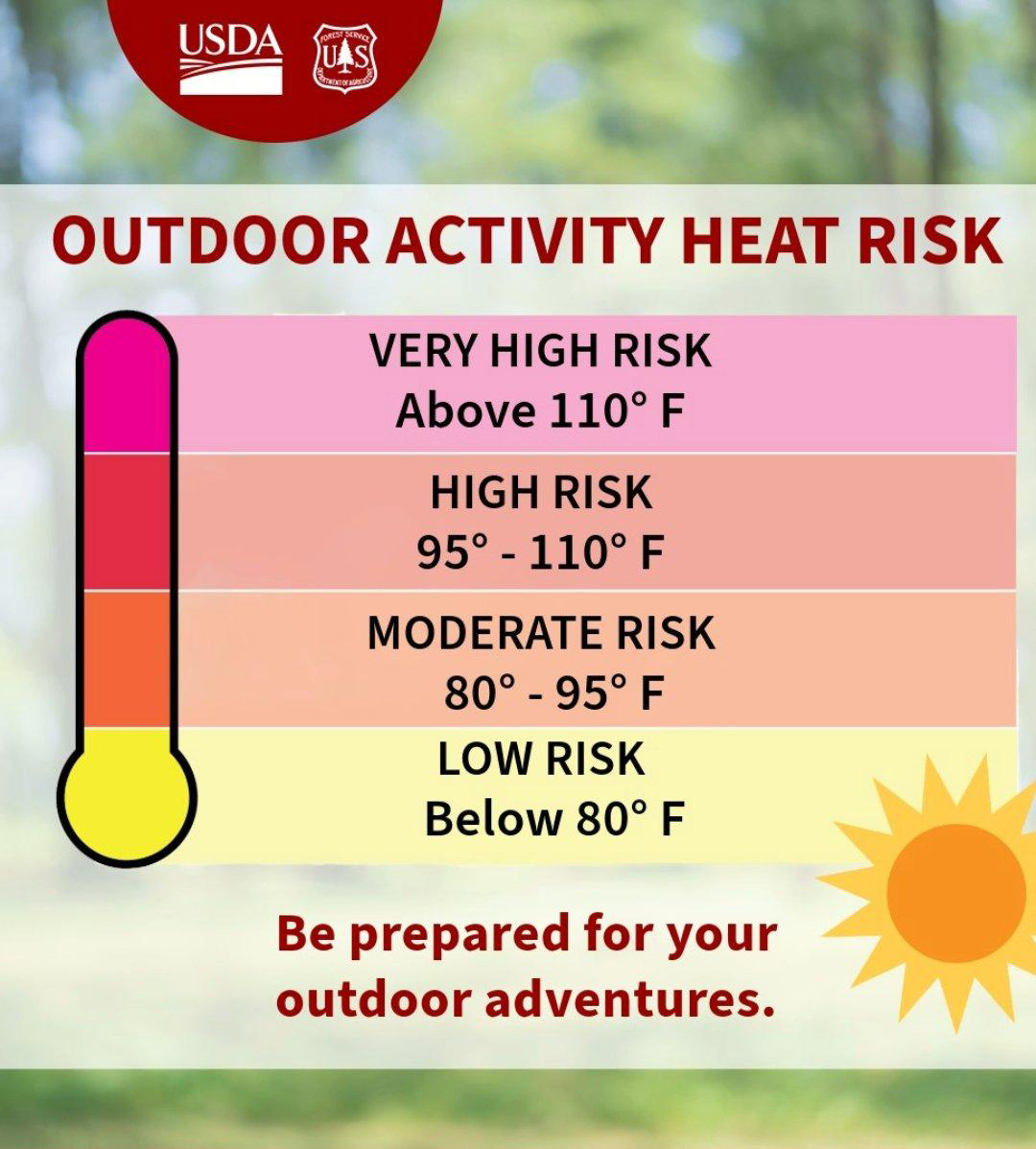
- Hiking in the heat.
- Know the signs of Heat-related Illness.
- Start early in the day, or late in the day. Avoid hiking or other strenuous recreation during the hottest times of the day.
- Bring plenty of water (more than you think you need!) and turn back to the trailhead before half your water is gone.
- Wear sun protection including hats and sunscreen.
- Wear sturdy shoes, moisture wicking clothing, and bring layers as temperatures can drop rapidly in the desert after nightfall.
- Know your limits and listen to your body. Rest when needed and remember that it’s ok to cut your hike short.
- Responsible Recreation. Being prepared includes knowing how to be a responsible hiker. Learn more on our Responsible Recreation page.
- Stay on marked trails.
- Don’t hike alone. Let the slowest person in your party set the pace. This is especially important when children are a part of your group.
- Leave your itinerary with a friend or family member and check in with them upon your return.
- Develop an emergency plan before you start your trip. Make sure everyone knows what to do if they become lost or a medical emergency arises. Give children whistles with the instructions to "stop and blow" if they become lost.
- Take frequent rests or vary your pace to maintain your energy level.
- Drink plenty of water, even on cool, wet days. Never drink your entire supply between refills.
- Wear appropriate clothing, including sturdy boots that are broken in and are comfortable.
- Consider using a hiking pole or walking stick to help maintain your balance in unlevel or hazardous areas.
- Be aware of your surroundings, and pre-plan your approach before hiking through more hazardous areas. Wet surfaces can be a hazard and even more so if it's on a slope.
- Consider what you'll do if you start to slide or fall so that you are prepared.
- If falling, do not try to catch yourself; try to avoid landing on your hands, elbows or knees. Landing on the side of your body is much safer.
- If the slope is such where you know you are going to slide, lowering your center of gravity, by sitting down and sliding on your feet or bottom, is safer.
- If sliding while standing up, keep your weight over your feet and bend your knees—do not lean back or forward while sliding.
- If on a day hike, extra weight wears you down and reduces your agility over uneven terrain. Pack as light as possible. Leave the extras behind, but consider bringing these essentials:
- Map
- Sunglasses and a hat
- Sunscreen
- Flashlight
- Waterproof matches
- First aid kit
- Water and water-purifying tablets
- High-energy bars, granola, candy, or fruit
- Extra clothing. Temperatures can change dramatically, particularly if there is an elevation change. For every 1,000 feet of elevation gain, the temperature often drops three to five degrees.
Stay on open forest roads
Some roads could be closed temporarily or permanently to protect against further damage to wetland and aquatic resources and halt damage to soil, water and vegetation resources. The intent of road closures is to balance popular public use with the sustainability of natural resources.
- Closed roads will be posted. Not all bicycle trails are open to off-highway vehicle use.
- Wilderness areas are off-limits to all vehicles, including bicycles.
- Comply with signs and barriers and leave gates as you found them.
- Some trails cross private property and are subject to deed restrictions, which prohibit vehicular travel of any kind.
- Respect public and private property by practicing minimum impact cycling.
Protect the environment
- Stay on trails and roads designated for use. Cutting switchbacks, creating hill climbs and riding in undesignated areas cause erosion, loss of wildlife habitat and other natural resource damage. Repairs cost tax dollars, and citations cost you dollars.
- Minimize erosion by staying on trails and not cutting switchbacks.
- Avoid wet, muddy areas as they are more susceptible to erosion. Meadows, lake shores, stream banks and vegetation are easily damaged.
- Do not ride on snow-covered roads!
- Do not disturb wildlife or livestock.
- Teach new riders trail etiquette—lead by example.
- Don’t litter. Pack out more than your share.
Ride safely, stay in control
- The forest is for everyone. Be considerate of hikers and equestrians
- Yield right-of-way to other trail users. Horses spook when they see an unfamiliar object, especially one that moves quickly and quietly.
- Slow down and use caution when passing others. If necessary, dismount your vehicle or bicycle on the downhill side and wait for horses and hikers to pass.
- Always wear a protective helmet and other gear.
- Ride single file in the middle of the trail to avoid widening the trail.
- Control your speed at all times and approach turns in anticipation of someone around the bend. Reckless riding and high downhill speeds are not appropriate.
Be prepared
- Be prepared for sudden changes in weather.
- Don’t ride alone. Tell someone where you plan to ride and then stick to your plans.
- Don’t take unnecessary chances—help for emergencies may be miles away.
- Make sure you have a first aid kit and other safety gear with you when riding in the forest.
Stay on open forest roads
- Travel only on off-highway vehicle designated routes. Cross-country travel is prohibited. Obtain a Motor Vehicle Use Map for specific information on your forest.
- Comply with signs and barriers and leave gates as you found them.
- Wilderness areas are off-limits to all motorized vehicles.
Protect the environment
- Minimize erosion by staying on trails and not cutting switchbacks.
- Avoid wet, muddy areas as they are more susceptible to erosion. Meadows, lake shores, stream banks and vegetation are easily damaged.
- Do not ride on snow-covered roads!
- Teach new riders trail etiquette—lead by example.
- Don’t litter. Pack out more than your share.
Ride safely, stay in control
- The forest is for everyone. Be considerate of hikers and equestrians.
- Yield right-of-way to other trail users. Horses spook when they see an unfamiliar object, especially one which moves quickly and quietly.
- Control your speed at all times and approach turns in anticipation of someone around the bend. Reckless riding and high downhill speeds are not appropriate.
- Wear your helmet and protective gear.
Plan your trip
- Be prepared for sudden changes in weather.
- Don’t ride alone. Tell someone where you plan to go and then stick to your plans.
- Don’t take unnecessary chances—help for emergencies may be miles away.
- Make sure you have a first aid kit and other safety gear with you when riding in the forest.
Follow vehicle regulations
- Children under 8 years of age may not operate all-terrain vehicles or motorcycles. An operator under 16 must have constant supervision by an adult over the age of 18.
- No passengers are allowed on all-terrain vehicles, unless vehicles are designed to carry passengers.
- All vehicles must be registered and licensed. Non-street legal "red sticker" vehicles have a limited operating period on the forest.
- Obey all traffic signs. State traffic laws apply to all national forest roads; violations are reported to the state department of motor vehicles.
- Within campgrounds and other recreation sites, use cars, motorbikes, motorcycles, or other motor vehicles only for entering or leaving, unless directed otherwise.
- Park only in designated parking areas.
- Do not block, restrict, or interfere with the use of roads, trails and gates.
- Spark arresters, mufflers, and brakes are required for motorized vehicles.
- Don’t drink and ride. Alcoholic beverages are prohibited on all trail systems or in recreation areas.
OHV Permit Zones
The new Off-Highway Vehicle Special Recreation Permit (OHV Permit) is required for motorized vehicle access in the Bulldog Canyon, The Rolls, St. Clair, and Desert Vista OHV Permit Zones. The date for the Lower Sycamore OHV Permit Zone is to be determined. OHV Permit Frequently Asked Questions
Travel Management Plan & MVUM
The Tonto National Forest released the Final Record of Decision (ROD) for the Forest’s Travel Management Plan on October 5, 2021. The Tonto is currently drafting a Motor Vehicle Use Map (MVUM) as required by the 2005 Travel Management Rule to display the designated roads, trails, and areas for motor vehicle use. These maps will be available for free for the public to download onto their devices or pickup at a District Office; at this time a MVUM is not yet available.
For more information about the Travel Management Plan, see Travel Management.
In the meantime, some Adobe PDF maps are available for popular OHV areas by clicking on the links above. Or you can purchase a Tonto Visitor Map from a District Office. Visit the Maps page for more information.
More OHV Resources
Whether you're camping in a tent or planning a family picnic, there are many ways to make sure that your experience is fun and safe. Consider the following basic tips:
Be prepared
- Pack a first aid kit. Your kit can prove invaluable if you or a member of your group suffers a cut, bee sting or allergic reaction. Pack antiseptics for cuts and scrapes, tweezers, insect repellent, a snake bite kit, pain relievers, and sunscreen. Tailor your kit to your family's special needs.
- Learn ABC - Airway, Breathing, & Circulation. Know how to perform CPR and basic first aid. Recognizing serious injuries will enable you to attend to a victim until medical help arrives.
- Bring emergency supplies. In addition to a first aid kit, you should also have a map of the area, compass, flashlight, knife, waterproof fire starter, personal shelter, whistle, warm clothing, high energy food, water, water-purifying tablets, and insect repellant.
- Responsible Recreation. Being prepared includes knowing how to be a responsible camper. Learn more on our Responsible Recreation page.
Check the elements
- What is in the skies? Check the weather report before you leave home. When you arrive at the site, keep on eye on the skies for changes and, if possible, carry a compact weather radio. In inclement weather, take shelter until the bad weather passes. Stay dry - wet clothes contribute to heat loss. Also, keep sleeping bags and important gear dry at all times.
- Are there forest or grassland alerts? Forest and grassland home pages post alerts you should know before you go. Many of our forests and grasslands also post alerts on Twitter. The latest fire information may be found on InciWeb.
Survey your surroundings
- Arrive early. Plan your trip so that you arrive at your actual campsite with enough daylight to check over the entire site and safely set up camp.
- Check for potential hazards. Be sure to check the site thoroughly for glass, sharp objects, branches, large ant beds, poison ivy, bees, and hazardous terrain.
- Avoid areas of natural hazards. Check the contour of the land and look for potential trouble spots due to rain or snow. Areas that could flood or become extremely muddy can pose a problem.
- Inspect the site. Look for a level site with enough room to spread out all your gear. A site that has trees or shrubs on the side of prevailing winds will help block strong, unexpected gusts.
- Pitch your tent in a safe spot. Make sure your tent is made of flame-retardant fabric, and keep it a safe distance away from campfires. Keep insects out of your tent by closing the entrance quickly when entering or leaving.
- Build fires in a safe area. Your open fires and fuel-burning appliances must be far enough away from the tent to prevent ignition from sparks, flames, and heat. Never use a flame or any other heating device inside a tent. Check to know whether there are fire restrictions in place before starting a campfire. You could be fined if you start a fire in a restricted area.
Outdoor awareness
- Ensure your fires are always attended. Be sure you have an area for a campfire that cannot spread laterally or vertically - a grill or stone surface is ideal. When putting the fire out, drown it with water. Make sure all embers, coals and sticks are wet. Embers buried deep within the pile have a tendency to reignite later.
- Use caution with propane stoves, grills. Read the instructions that come with the stove and propane cylinder. Use the stove as a cooking appliance only - never leave it unattended while it's burning.
- Watch out for bugs. Hornets, bees, wasps, and yellow jackets are a problem at many campsites. Avoid attracting stinging insects by wearing light-colored clothing and avoiding perfumes or colognes. Should such an insect approach, do not wave wildly and swat blindly - instead use a gentle pushing or brushing motion to deter them.
- Dispose of trash properly. Remember to recycle - use the proper recycling bins if available.
- Beware when encountering wildlife. To ward off bears, keep your campsite clean, and do not leave food, garbage, coolers, cooking equipment or utensils out in the open. Remember that bears can be dangerous and unpredictable - never feed or approach a bear. Use a flashlight at night - many animals feed at night and the use of a flashlight may warn them that you are approaching.
- Know which plants are poisonous. Familiarize yourself with any dangerous plants that are common to the area. If you come into contact with a poisonous plant, immediately rinse the affected area with water and apply a soothing lotion such as calamine to the affected area.
- Keep it clean. Wash your hands, particularly after using the toilet and before handling food to prevent the spread of germs and disease. Use biodegradable soap. Keep your campsite clean, too. And don't forget to remove all trash.
Target shooting is allowed on national forest or grassland unless restricted. Contact your local ranger district office for more information about local restriction. It is prohibited to shoot:
- In or within 150 yards from a residence, building, campsite, developed recreation area or occupied area.
- Across or on a national forest or grassland road or body of water.
- In any manner or place where any person or property is exposed to injury or damage as a result of such discharge.
- Into or within a cave.
- Firing tracer bullets or incendiary ammunition.
- Disturbing, injuring, destroying, or in any way damaging any prehistoric, historic, or archaeological resource, structure, site, artifact, property.
- Abandoning any personal property or failing to dispose of all garbage, including targets, paper, cans, bottles, appliances.
In general, you should target shoot only if you:
- Use approved targets. Certain forests may have specific restrictions, such as the type of targets used (i.e. cardboard targets, paper targets, clay pigeons).
- Exploding targets are not recommended and are restricted on many forests or grasslands for safety and fire concerns.
- Use approved targets along with a safe, "bullet-proof" backstop. Do not to attach your targets to vegetation or structures, such as trees, log decks, slash piles, fences, or water tanks.
- Practice safe gun handling by:
- Treating every gun as if it is loaded.
- Never letting the muzzle of a firearm point at anything you do not intend to shoot.
- Keeping your finger off of the trigger until your sights are on the target and you are ready to shoot.
- Making sure of your target and what is beyond.
- Are not in possession of alcoholic beverages while discharging a firearm.
Law Enforcement Information
More resources regarding our law enforcement on the Tonto National Forest.
The Law Enforcement & Investigations staff of the US Forest Service is comprised of professional patrol officers and criminal investigators dedicated to the protection of visitors, employees and enforce Federal laws and regulations governing National Forest System (NFS) lands and resources.
Our uniformed patrol officers are called “LEOs” (Law Enforcement Officers). They patrol national forests by pickup truck, SUV, Off-Highway Vehicles (OHV), watercraft, on horseback, and on foot to provide public safety services, prevent and detect violations, and take appropriate law enforcement action in response to any national forest incident they encounter. They are trained federal law enforcement officers with an emphasis on natural resource protection.
Our plainclothes criminal investigators are called “special agents.” They conduct highly complex investigations of felony crimes such as arson, fraud, archeological resources, and controlled substance offenses, as well as other crimes which require extensive commitment of time and resources.
The Central Arizona Zone serves both the Tonto and Prescott National Forests from its headquarters in Phoenix, Arizona. Our LEOs and special agents are stationed throughout the Zone. The manager and supervisor of the Enforcement division is the Patrol Captain. The Patrol Captain is responsible for all law enforcement activity occurring on National Forest System lands within the Zone. Both the Enforcement and Investigative divisions are supervised by the Special Agent in Charge (SAC), located at the regional office in Albuquerque, New Mexico.
Law enforcement is not new to the Forest Service. Since the establishment of the first Forest Reserve in 1891, the establishment of laws, rules and regulations were necessary to regulate forest uses and protect forest resources from depredation. A ranger service was established, first by the General Land Office (1897), and later by the US Forest Service (1905), to “patrol to prevent fire and trespass... issue minor permits, build cabins and trails, enforce grazing regulations, investigate claims and when necessary, arrest for violation of forest laws.”
Early forest rangers were expected to take their law enforcement duties seriously and were expected to know how to shoot straight and bring in violators to the Territorial or State authorities without regard to their own personal safety. They were not trained as professional police officers as our LEOs are today. However, they were expected to be:
- Thoroughly sound and able-bodied, capable of enduring hardships and of performing severe labor under trying conditions.
- He must be able to take care of himself and his horse in regions remote from settlement and supplies.
- He must be able to build trails and cabins, ride, pack, and deal tactfully with all classes of people.
- He must know something of land surveying, estimating and scaling timber, logging, land laws, mining, and the live-stock business.
- He is authorized to issue permits… and report upon and arrest for the violation of forest laws and regulations.
Preventing Crime in Our National Forests and Grasslands
Visiting your national forests and grasslands can be a wonderful experience. You may enjoy recreating in a developed campground, walking on a trail, fishing a stream, collecting rocks, enjoying off-highway vehicle trails, or appreciating the view from an overlook. Whatever your activity, chances are there may be other people in the area. Although most people are there to enjoy the national forest or grassland, some are not.
This is intended to give you precautionary guidelines to help prevent crimes from occurring while you visit your national forest or grassland. These guidelines should make you less vulnerable to the criminal actions of others.
Applying the "Neighborhood Watch" Concept
One of the most effective ways to prevent crime and reduce fear is to become involved in Neighborhood Watch. You can apply the Neighborhood Watch concept to the forest setting by being vigilant, by protecting yourself and securing your property, and by acting as an extra set of “eyes and ears” for reporting crimes and suspicious activity you may encounter. Remember, when you visit National Forest System lands, it is your neighborhood.
- Know how to contact law enforcement and other emergency services personnel. Keep an eye out for the well-being of your fellow forest visitors and the safety of their property.
- Be observant of others and their activity. Keep an eye out for persons or vehicles that appear out of place or suspicious in or near campgrounds, recreation areas, trailheads, or rest areas.
- Report suspicious persons!
- Report criminal activity immediately.
Preparing To Visit National Forest System lands
Before you visit a national forest or grassland, get information and be prepared in case you have an unplanned overnight trip. Precautions include:
- Obtain a map of the area you are visiting.
- Become familiar with the area; contact the local U.S. Forest Service office for specific information.
- Tell a friend where you are going and when you plan to return.
- Make sure your vehicle is in good running condition and has plenty of fuel.
- Be prepared in case you get stranded; take extra food and warm clothing.
- Be prepared for the night; have a flashlight.
- Obtain the contact numbers for the U.S. Forest Service law enforcement office and the local sheriff’s office.
- Carry identification or your name, phone number, and blood type information on your person.
Parking Your Vehicle
Whether you park your vehicle at the campground where you are staying, at a trailhead, or at another location, it will be left unattended for a few hours or a few days. To help protect your vehicle and your valuables:
- Lock your valuables in the trunk or other location where they cannot be seen.
- Lock your vehicle. Do not hide your keys on or near your vehicle.
- Note other vehicles in the area. Write down license plate numbers and descriptions of vehicles that appear suspicious or out of place in the area where you park.
- Report suspicious activity to local law enforcement or Forest Service personnel as soon as possible.
Protecting Your Property
Precautions to protect your property include:
- Do not carry more cash than you will need.
- Leave unnecessary valuable items at home.
- Do not make yourself a target by dangling your purse or showing your wallet.
- If someone attempts to rob you, give up your property; it is less valuable than your life.
- When leaving a campsite, lock valuables away.
Discovering Illegal Activity
Some people may use National Forest System lands to conduct illegal activity. For example, polyvinyl chloride pipes or hoses may indicate an active marijuana garden, or household chemicals in an unusual combination used in conjunction with glassware and tubing may indicate methamphetamine production. If you come across illegal activity:
- Do not approach or confront the individuals present at the site; do not in any way indicate that you are suspicious of their activities!
- Immediately leave the area along the same route you entered.
- Watch for other people in the area.
- Be aware of your surroundings at all times. In some instances, potentially dangerous devices or harmful materials might be nearby. Make every effort to avoid contact with suspicious packages and/or equipment; they might be highly volatile.
- When you are safely away, write down a detailed description of the activities taking place, the area, the people, and any vehicles.
- Immediately report the activity to local law enforcement or Forest Service personnel.
Protecting Your Children
To keep you children safe in the forest:
- Know where your children are at all times. Make sure your children know the rules about strangers.
- Make sure your children know what to do if they become separated from you.
- Use extra precautions regarding your child's personal safety.
Preventing Personal Assault
While in the forest, most of us relax and leave our worries at home. Unfortunately, criminals may use the fact that you are relaxed against you. To protect yourself:
- Be alert and aware of your surroundings and other people in the area.
- Stand tall and walk confidently. Don’t show fear.
- Trust your instincts. If you feel uncomfortable in a place or situation, leave right away and get help if necessary.
- Be observant of others and use discretion in acknowledging strangers.
- Avoid confrontations.
- Be respectful of your fellow outdoor enthusiasts. Always use good manners when interacting with others.
- Carry a cell phone if coverage is available in the area.
- Know how to contact law enforcement or other assistance.
- Carry a noisemaker, such as a whistle, or other protective device that you have been trained to use.
- Do not pick up hitchhikers.
- Never go anywhere alone! It is safer to be in pairs or a group.
Reacting If You are a Victim
You should be safe and have a wonderful time when you visit your national forests or grasslands. Unfortunately, crimes against persons and property do occur, however rare that may be. After a crime has occurred:
- Try to stay calm.
- Write down as much information on the suspect as possible, including personal and/or vehicle description and the last known direction and method of travel.
- Contact the local Sheriff's Office or USDA Forest Service Law Enforcement office immediately!!
- Preserve, but do not handle, any evidence of the crime.
Contact Numbers
- 911 (Always in an Emergency, where service is provided)
- Apache County Sheriff's Office (800) 352-1850
- Coconino County Sheriff's Office (800) 338-7888
- Gila County Sheriff's Office (928) 425-3231
- Maricopa County Sheriff's Office (800) 352-4553
- Navajo County Sheriff's Office (928) 524-4450
- Pinal County Sheriff's Office (800) 420-8689
- Yavapai County Sheriff's Office (928) 771-3260
- Arizona Game and Fish Operation Game Thief (800) 352-0700
U.S. Forest Service, Law Enforcement & Investigations Phoenix Office: (602) 225-5241
If you are looking to submit a comment, tip or report a crime, please visit our LEI contact page or view the form below.
1. What are the basic rules for my visit to the national forest?
There are numerous rules and regulations governing the occupancy and use of National Forest System lands. They may be found at 36 CFR Part 261 . Additional rules may be enacted under the authority of the Forest Supervisor. These are called ‘forest orders” or sometimes “closure orders.” All state criminal and traffic laws apply to the National Forest System lands as well.
2. What are Closure Orders and Forest Orders?
Forest orders, also referred to as “closure orders” are implemented by the Forest Supervisor when there is a specific need for additional rules or restrictions to protect the public or national forest resources and facilities. These rules differ from forest to forest, are usually site-specific, and must be posted in such a place and manner as to reasonably bring these rules to the attention of the public.
3. Can I carry a firearm on the national forest?
Possession of firearms. The possession and unconcealed carry of a firearm on the national forest is not restricted by federal law or Forest Service regulations with the exception of “prohibited possessors,” such as convicted felons (see 18 USC 922g and ARS 13-3101). State laws regarding the concealed carry of firearms and the carrying of weapons within or on a motor vehicle apply to all National Forest System lands.
Discharge of firearms. National Forest regulations prohibit the discharge of a firearm within 150 yards of a residence, building, campsite, developed recreation site, or any other occupied area; across a road or any body of water adjacent to a road; into or within a cave; or in any negligent manner that could endanger life or property (see 36 CFR 261.10d) . The Tonto National Forest also has areas that are closed to recreational shooting year-round due to proximity to local communities (see Forest Closure Orders). During periods of high fire danger, additional restrictions on the use of firearms may be imposed. None of the temporary or year-round restrictions prohibit the use of a firearm in the lawful taking of game.
4. Why are there fees at certain locations on the national forest?
Because appropriated funds have been and continue to be inadequate to build, maintain, and service our most popular recreation sites and facilities, Congress enacted a law called the Federal Lands Recreation Enhancement Act of 2004 (16 usc 6802) . This law authorizes the Forest Service and other federal land management agencies to charge modest fees for the use of recreation sites that provide certain public amenities. The law further authorizes agencies to retain those fees be used in direct support of those sites.
5. Why does the Forest Service need law enforcement officers?
Although state and county law enforcement personnel have full authority to enforce state law on national forests, only forest officers can enforce the federal laws, rules and regulations that apply to the protection of the national forests.
6. What authority does the Forest Service have to enforce laws and make arrests?
Forest Service law enforcement authority derives directly from the Constitution of the United States and several laws enacted by Congress.
Article IV, Section 3, Clause 2, commonly referred to as the “property clause” of the Constitution, allows the federal government to own and protect certain properties not belonging to the individual states… “The Congress shall have Power to dispose of and make all needful Rules and Regulations respecting the Territory or other Property belonging to the United States …”
The United States Code contains numerous laws pertaining to the National Forests. The principal laws relating the law enforcement authority are—
The Act of June 4, 1897 , as amended; codified at 16 United States Code, section 551, states “ The Secretary of Agriculture shall make provisions for the protection against destruction by fire and depredations upon the public forests and national forests which may have been set aside…; and he may make such rules and regulations and establish such service as will insure the objects of such reservations, namely, to regulate their occupancy and use and to preserve the forests thereon from destruction; and any violation of the provisions of this section… shall be punished by a fine of not more than $500 or imprisonment for not more than six months, or both. Any person charged with the violation of such rules and regulations may be tried and sentenced by any United States magistrate judge specially designated for that purpose by the court by which he was appointed, in the same manner and subject to the same conditions as provided for in section 3401(b) to (e) of title 18.” (16 usc 551)
The Act of March 3, 1905 , as amended; codified at 16 United States Code, section 559, states “All persons employed in the Forest Service of the United States shall have authority to make arrests for the violation of the laws and regulations relating to the national forests, and any person so arrested shall be taken before the nearest United States magistrate judge, within whose jurisdiction the forest is located, for trial; and upon sworn information by any competent person any United States magistrate judge in the proper jurisdiction shall issue process for the arrest of any person charged with the violation of said laws and regulations; but nothing herein contained shall be construed as preventing the arrest by any officer of the United States, without process, of any person taken in the act of violating said laws and regulations.” (16 usc 559)
The Act of May 23, 1908 , as amended; codified at 16 United States Code, section 553, states “Officials of the Forest Service designated by the Secretary of Agriculture shall, in all ways that are practicable, aid in the enforcement of the laws of the States or Territories with regard to stock, for the prevention and extinguishment of forest fires, and for the protection of fish and game, and with respect to national forests, shall aid the other Federal bureaus and departments on request from them, in the performance of the duties imposed on them by law.” (16 usc 553)
Public Law 92-82, as amended; codified at 16 United States Code, section 551a, states “The Secretary of Agriculture, in connection with the administration and regulation of the use and occupancy of the national forests and national grasslands, is authorized to cooperate with any State or political subdivision thereof, on lands which are within or part of any unit of the national forest system, in the enforcement or supervision of the laws or ordinances of a State or subdivision thereof. Such cooperation may include the reimbursement of a State or its subdivision for expenditures incurred in connection with activities on national forest system lands. This section shall not deprive any State or political subdivision thereof of its right to exercise civil and criminal jurisdiction, within or on lands which are a part of the national forest system.” (16 usc 551a)
And finally, The National Forest System Drug Control Act of 1986, Public Law 99-570, codified at 16 United States Code, sections 559b-559g, establishes that “The purpose of this title is to authorize the Secretary of Agriculture to take action necessary, in connection with the administration and use of the National Forest System, to prevent the manufacture, distribution, or dispensing of marijuana and other controlled substances.” (16 usc 559b)