



Each year, millions of people are exposed to unhealthy air quality. As wildfire seasons grow longer, hotter, and drier, more people feel the effects of smoke – even in communities far from forests. Children, the elderly, and people with respiratory issues are particularly at risk and vulnerable to wildfire smoke. The more we know about how the smoke travels and when and where smoke will be, the better we can prepare and protect ourselves.
According to Wildfire Smoke: A Guide for Public Health Officials, wildland fire smoke consists of a complex mixture of “particulate matter” that can include both solids and liquids. The size of the particles affects their potential to cause negative health effects. Particles smaller than 10 micrometers can be inhaled and affect the lungs, heart, and blood vessels. The smallest particles, those less than 2.5 micrometers in diameter, pose the greatest risk because they can reach deep into the lungs.

To better understand the air quality in your community, visit the AirNow Fire and Smoke Map, a joint effort between the USDA Forest Service, the Environmental Protection Agency (EPA), and state and local air quality agencies. The air quality monitors track the quantity of air particles at a given time, including during specific fire events. This information informs the EPA’s Air Quality Index (AQI), which is used to provide a standard for understanding air quality and its health effects. The air quality monitors are shown in the color of their current Air Quality Index (AQI) value providing a view of air quality and smoke impacts across the country.
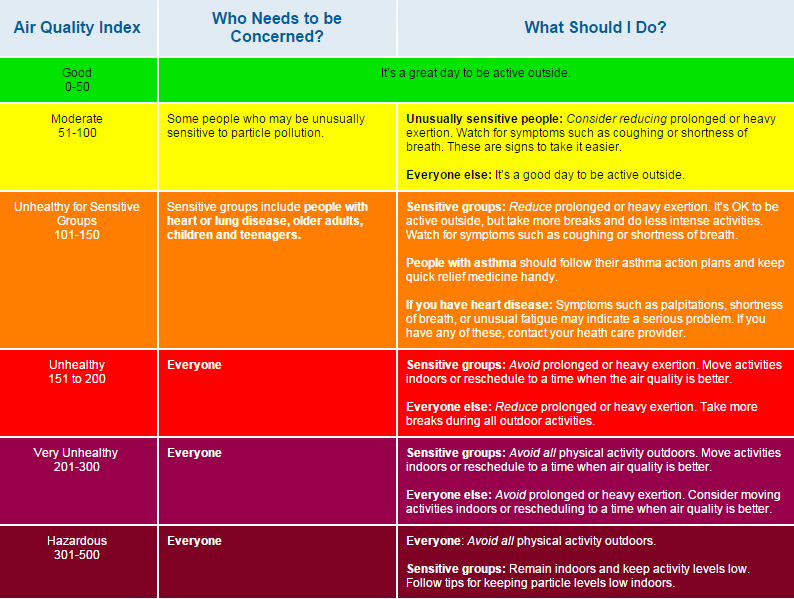
The AQI is a scale for reporting and forecasting air quality across the nation. It is used to report information about air pollutants in the environment, including those related to wildfire smoke. The AQI tells the public how clean or polluted the air is using descriptors: Good, Moderate, Unhealthy for Sensitive Groups, Unhealthy, Very Unhealthy, and Hazardous. To check the current air quality where you live, visit AirNow.gov.

Wildfire smoke can irritate your eyes and lungs and worsen chronic lung and heart diseases. When the air quality is poor, stay indoors, and keep doors and windows closed. Avoid smoking, burning candles and wood, using gas stoves, or running a vacuum, which all contribute to indoor air pollution. Consider creating a clean room to protect your indoor air quality during a wildfire.
The Forest Service Pacific Northwest Research Station’s AirFire Research Team is part of the Interagency Wildland Fire Air Quality Response Program, which monitors wildland fire smoke risks and shares information with the public, and fire personnel. By developing tools and resources that help forecast when and where smoke will travel, the AirFire Team helps public health agencies and communities to prepare for smoke impacts in advance of wildfire events, helping us all breathe a little easier.