


Employee Perspective: Planting seeds to grow healthier, thriving communities

On April 12, I had the privilege of joining USDA Under Secretary for Natural Resources and Environment Dr. Homer Wilkes, White House Senior Advisor for Clean Energy Innovation and Implementation John Podesta, U.S. Senator Cory Booker (D-NJ), and other key partners for a tree-planting ceremony and stakeholder roundtable at Lincoln Park in Newark, New Jersey. That’s where we announced the availability of $1 billion for urban forestry to invest in the health and wellness of our communities.
Along with the open grant funding opportunity, the USDA Forest Service is providing up to $250 million to states and territories to further local efforts to support urban communities through equitable access to trees and the benefits they provide.
Numerous studies conducted by the Forest Service and our partners show planting trees and expanding green spaces in our urban communities have benefits beyond the ecological ones, such as carbon sequestration, reduced air pollution, and reduced storm water runoff. Other critical benefits include improving health outcomes and quality of life and increasing social interactions and physical activity. In addition, these benefits are associated with reduced crime and create economic opportunities for years to come.
Adding more trees and green spaces in urban communities is also critical to making communities more resilient to extreme heat and mitigating the effects of climate change.
The benefits are vast, but we can’t sustain our urban forests alone.
Thanks to the $1 billion investment from the Biden Administration’s Inflation Reduction Act, the Forest Service’s Urban and Community Forestry Program can work more closely with states, municipal governments, local nonprofits and other partners in urban spaces across the country to ensure that all people have equitable access to green spaces and trees where they live work and play.
These investments will strengthen local economies and create new jobs in disadvantaged urban communities.
The competitive grant process is an equal opportunity competitive project application submission and evaluation process that is open now and closes June 1 at 11:59 ET.
Grant funding opportunities align with and advance the Justice40 Initiative, which aims to ensure at least 40% of the overall benefits of federal investments flow to disadvantaged communities that are marginalized, underserved, and overburdened by pollution. The IRA funding is available until Fiscal Year 2031 or when all the funds have been expended.
We will continue to work with community-based organizations, state agencies, and tribes to get the word out about this funding. Our goal is to reach new partners and leverage existing relationships to ensure disadvantaged communities across the country benefit from the funding to strengthen the urban canopy.
In closing, I’d like to thank our entire team of Urban and Community Forestry Program managers. Their passion, dedication, and teamwork are appreciated and make a meaningful difference in our communities.
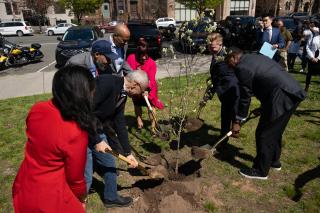
USDA Under Secretary for Natural Resources and Environment Dr. Homer Wilkes, U.S. Senator Cory Booker and White House Senior Advisor for Clean Energy Innovation and Implementation John Podesta announced historic funding through President Biden’s Investing in America agenda to expand access to urban nature, combat the climate crisis and advance environmental justice, after meeting with local and state stakeholders, April 12, 2023, in Newark, New Jersey. USDA photo by Christophe Paul.