


Forest Service workshop champions importance of restoring peatland

MINNESOTA — Ever heard of a peatland? Maybe not—but these often-overlooked natural features play a crucial role in the environment.
You might have encountered one without even realizing it while out on a hike, tramping through squishy, spongy terrain.
As their name suggests, peatlands are packed with peat—partially decomposed organic material that stores huge quantities of carbon and other greenhouse gases.
This absorption of greenhouse gases is a big deal for our planet in the fight against climate change, as these wetlands store more than half as much carbon as all of the world’s forest biomass combined while occupying a fraction of the footprint—only 3% of the Earth’s landmass.
Unfortunately, draining peatland for agricultural and other uses releases vast stores of greenhouse gases back into the atmosphere.
Enter PeatRestore, a Infrastructure Investment and Jobs Act and Wildfire Crisis Strategy-funded initiative tasked with identifying and mapping peatlands and their condition, allowing policy-makers and land managers to restore and protect these landscapes.
Erik Lilleskov, a research ecologist with the USDA Forest Service’s Northern Research Station, has been studying peatlands for well over 15 years. Early in his work, he and his colleagues realized that there were no comprehensive maps of peatland location and condition in the United States.
“How can you protect peatlands if you don’t even know where they are?” Lilleskov reflects. “We wanted to methodically identify these locations and develop tools to save them.”
Initiated by the USDA Forest Service, Michigan Technological University, The Nature Conservancy, and the University of Minnesota, PeatRestore now works with a broad range of partners to facilitate effective, science-based peatland restoration.
Beyond creating maps, PeatRestore assists researchers and field practitioners through the hosting of workshops aimed at promoting peatland restoration. Minnesota has more peatlands than any other state in the contiguous United States, so it was the natural choice for the program’s inaugural gathering.
The two-day September workshop for over thirty professionals began with a day of presentations and discussion groups at the Cloquet Forestry Center, led by a presentation on peatland restoration techniques by Professor Rod Chimner of Michigan Technological University.
Participants then had the opportunity to share their own restoration projects and goals, followed by a series of smaller topic-based break-out discussions focused on sharing perspectives on the challenges and opportunities faced by peatland restoration—culminating in the development of working groups to continue the collaboration.
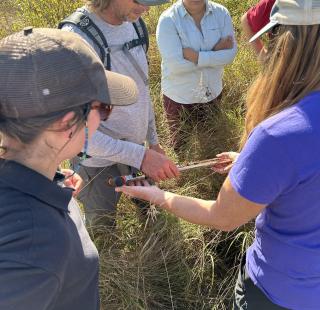
The second day of the workshop consisted of a field tour in the Sax-Zim Bog, where attendees saw examples of peatland restoration projects being led by Ecosystem Investment Partners and University of Minnesota Duluth’s Natural Resources Research Institute.

The workshop was just the beginning.
“We hoped to develop working groups that could produce high quality peatland restoration guides and planning tools,” Lilleskov says of the gathering. “I’m pleased to see that there was a great deal of enthusiasm for this.”
Ultimately, his hope is that the workshop was not just about advancing PeatRestore’s goals, but everyone's.
“After two days of collaboration, it looked to me like there was a lot of energy building towards developing a community of practitioners who can support each other,” Lilleskov added.
Lilleskov is optimistic for future workshops—the next gathering is set for Colorado next year, focusing on mountain peatland ecosystems, led by Professor Rod Chimner.
“I’m excited to begin working with practitioners to develop concrete products—maps, restoration guides and decision support tools—to make their jobs easier,” he says. “I’m also excited to see this collaboration and relationship-building continue into the future.”
Interested in becoming involved in PeatRestore? Contact Erik Lilleskov (erik.a.lilleskov@usda.gov)
