What do you do when you can't entirely stop something bad from happening? You mitigate the damage it might cause. Natural disasters, like hurricanes, tornadoes and wildfires, can never be completely stopped. In fact, wildfire is an important part of many healthy ecosystems. That doesn’t mean it won't pose an existential threat to people's lives and property, so dealing with the threat it poses remains a high priority for agencies like the U.S. Department of Agriculture’s Forest Service.
An important part of addressing the wildfire threat is mitigating, or reducing, the factors that can cause or exacerbate a wildfire. When actions are taken before a wildfire arrives, like removing excess vegetation around homes, safely storing and operating machinery and many other activities, the damage from wildfires can be significantly reduced. At the Forest Service, we’re committed to helping mitigate the risk of destructive wildfires, and one way we can help is through our participation in Community Mitigation Assistance Teams.
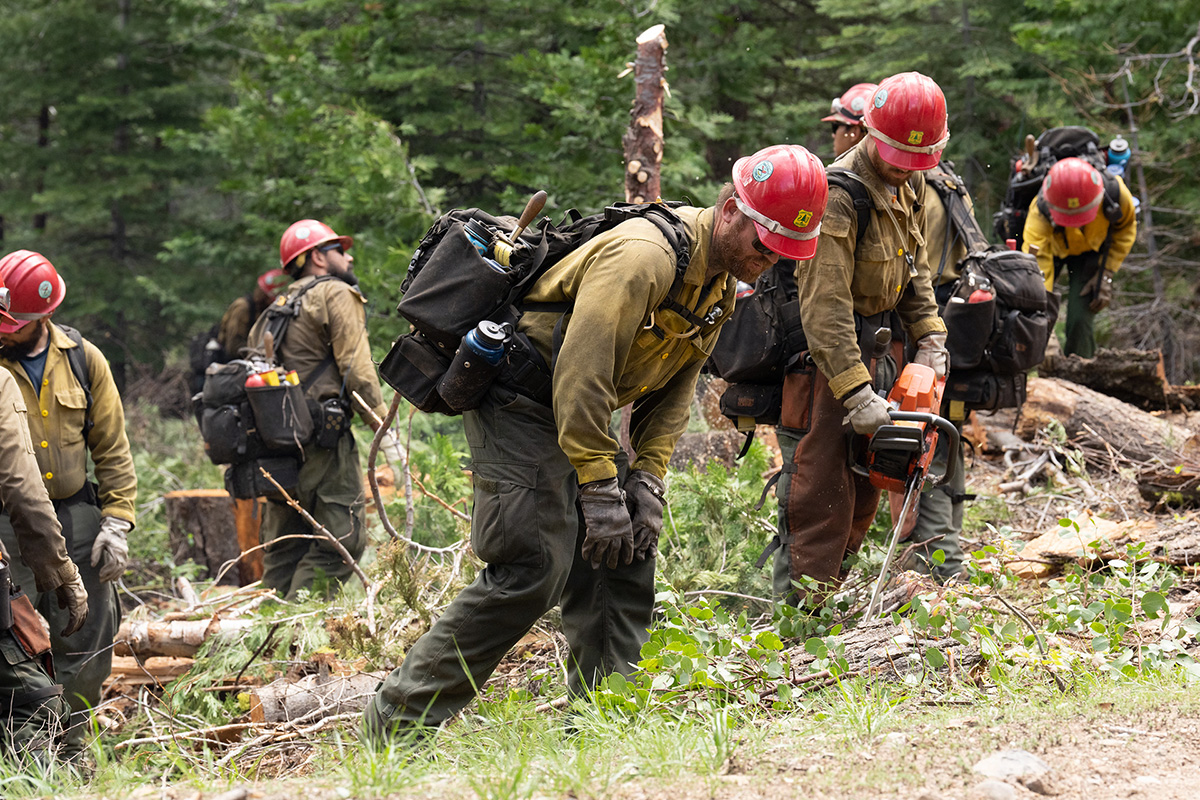
Working hand in hand with people across the United States, Community Mitigation Assistance Teams—known as CMATs—help reduce the risk of destructive wildfires. These teams don’t just arrive with advice, members roll up their sleeves and work alongside community members, leaving behind stronger connections, better tools and momentum that carries communities forward long after the team leaves.

Building sustainable, local capacity
Over the past 10 years these interagency teams have served over 1 million people. Community Mitigation Assistance Teams have helped communities get over $2.5 million in grants to reduce wildfire risk. They have worked with more than 100 governmental and non-profit organizations, five tribal nations, 500 individual residents, and countless volunteers and partners. They supported wildfire risk assessments on nearly 16,000 parcels of land, even helping write the book on it: the NWCG Wildland Urban Interface Mitigation Field Guide (PDF, 12.9 MB).
Because there is no single way to mitigate wildfire risk, Community Mitigation Assistance Team support is tailored to the unique needs of each community. Their people-first approach helps community members develop solutions that are “bottom up” for their specific social, political and ecological landscape. By organizing and connecting communities with resources, they help overcome social and institutional hurdles like outdated city codes and ordinances that often stall risk reduction efforts.
As CMAT member and forester for Spring Branch Forestry Jamie Gomez describes it, “Building sustainable local capacity is, in many ways, one of the very best tools that we have for securing the future of our communities, ecosystems, watersheds and economies from the threats posed by unplanned, high intensity, high severity wildfire.”

From mitigation to active response
Last year, for the first time, a Community Mitigation Assistance Team was ordered to an active wildfire—the Wapiti Fire in Lowman, Idaho. The Boise National Forest and the complex incident management team in command of suppression efforts saw a need to provide advice to residents about what they could do to immediately protect their homes and other structures from wildfire.
The CMAT supported the Lowman Volunteer Fire Department and Boise County Emergency Management on five community-level and nearly 60 parcel-level wildfire risk evaluations, helping build trust with owners and residents for long-term collaboration along the way.
“Thank you to the CMAT members and for the foresight of the forest to order them as a resource to mitigate the effects of future wildfires,” said Paul Rekow, chief of the Lowman Volunteer Fire Protection District.
Today, the Lowman community and Boise County are taking the lead. They're updating wildfire information online, offering home assessments and planning a mitigation project and a chipper day this summer—all efforts born from the momentum CMAT helped create.
This video gives a further introduction into Community Mitigation Assistance Teams. (USDA Forest Service video)
Long-term, community-driven wildfire resilience
Because the importance of mitigating wildfire never ends, the support continues long after the team leaves. Through a partnership with Coalitions and Collaboratives funded by the Forest Service, communities can access ongoing assistance through COCO’s Action, Implementation & Mitigation Program. This program provides technical support, on-the-ground mentorship and direct funding for wildfire mitigation actions.
CMATs aren’t a one-time intervention, they’re a launchpad for long-term, community-driven wildfire resilience. By building community through helping people mitigate wildfire threats to their homes, CMATs help neighborhoods take responsibility for their future. Learn more how you can request a CMAT (PDF, 973 KB) or even join one (PDF, 243 KB)!
Subscribe to our newsletter to keep up with all Forest Service feature stories!