A career day at Chaparral High School in Temecula, California. That’s what changed Cole Weissgerber’s life. Before then, he wasn’t really sure what he wanted to do with his life (who really does know what they want to be at age 17?). But the USDA Forest Service’s presence at the school that day drew Weissgerber into the fire service. Oddly enough, it wasn’t the thought of saving communities or the “macho” aspect of wildland firefighting that drew him in. It was the idea of seeing different parts of the country.
“We were never able to travel as kids,” said Weissgerber. “So, the thought of fighting fire around the country really appealed to me.”
Starting out in Southern California

At first, though, Weissgerber spent most of his time working in suppression in Southern California, which includes the Stanislaus, Inyo, Sierra, Sequoia, Los Padres, Angeles, San Bernardino and Cleveland National Forests.
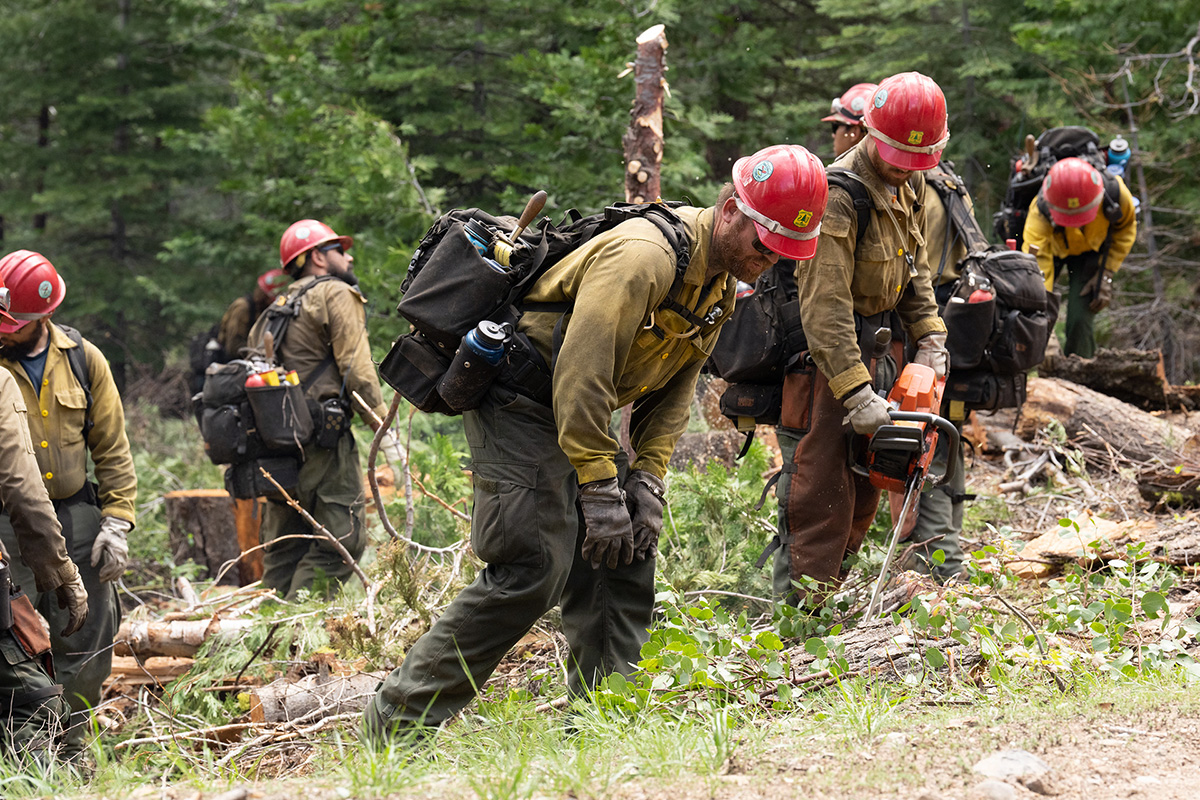
He started out as an administratively determined employee on a Type 2 hand crew on the Cleveland National Forest in 2006. ADs, as they are more commonly called, are hired on an as-needed basis to deal with emergencies like wildland fires. Type 2 hand crews are entry-level positions that often work long days in hot, smoky conditions using hand tools and chainsaws to build firelines across rugged terrain.
Despite the brutal working conditions and low pay, Weissgerber fell in love with working in fire. In fact, it was this job that really sold him on pursuing a full-time career as a wildland firefighter.
“The day I felt most successful was the first day I got hired on the AD Type 2 crew,” he said with a smile. “Every day since then, I have focused on improving, learning and taking the next step.”
Thankfully, his friends and family completely understood his “new love.”
“My friends and family knew I wanted to be in the fire service and were very supportive,” Weissgerber continued. “I’ve also been helped by many wonderful people throughout my career through mentoring, teaching, leadership and, quite often, simply by setting a good example.”
Tragedy strikes—the Esperanza Fire
Later that year, however, Weissgerber would experience one of the worst moments in his career. While working as a temporary crew member on a Type 3 Engine on the Cleveland National Forest, he found himself assigned to the Esperanza Fire. This large, wind-driven, arson-caused fire started west of Palm Springs, California. The fire killed five U.S. Forest Service Engine 57 crew members as they attempted to protect an isolated residential structure from the fire: Captain Mark Loutzenhiser (43) and firefighters Daniel Hoover-Najera (20), Pablo Cerda (24), Jason McKay (27) and Jess McLean (27).
“When I was starting out, I think I felt invincible—I would read about bad things that happened to firefighters and would think, ‘That can’t happen to me,’” he said, shaking his head. “Very early on in my career I was on the Esperanza Fire. That fire really opened my eyes to the dangers we face. For me and my peers…that was a very formative fire. It really made me realize just how dangerous wildland firefighting can be.”
“The longer you spend out in the field, the more you realize the dangers we face every day. I became more protective of those that work with and for me, constantly trying to stay vigilant.”
From helicopters to engines

Like many on the Esperanza Fire, Weissgerber would be forever changed by those events. But his experience there didn’t deter him from moving forward. He worked on several engines and then got a position on the Santa Ynez Flight Crew on the Los Padres National Forest.
“There I was, a young kid, fighting wildfires from a helicopter,” he said. “I knew there were risks involved, but I still kept thinking to myself, ‘I can’t believe I’m getting paid to do this.’”
While also on the Cleveland National Forest, Weissgerber trained as an Incident Commander Type 4, leading firefighters in initial attack, line construction, engine placement and working with aviation personnel. He also worked on several Type 3 engines, serving with his fellow firefighters all-season long, working long hours and hard shifts, and developing friendships that would last a lifetime.
“Coming up in the Forest Service in fire is, to say the least, an exhilarating challenge,” Weissgerber said. “Traveling and fighting fire in some of the most beautiful places on Earth is something that I will always cherish. That said, it was also very challenging, particularly early on. Making ends meet financially was always a struggle.”
Struggling to pay the bills

As a wildland firefighter with valuable experience and much-needed skillset, Weissgerber was still only a GS-5. Although he was fortunate to work within the Los Angeles-Long Beach CA Locality Pay Area, which is designed to reduce the disparity between federal and private sector pay, it was still hard to keep up with the high cost of living, including housing.
According to the County of Riverside Economic Development Agency, when Weissgerber lived there in 2013, median home prices were $244,780 and increasing by 25% or more each year. During those same years, a GS-5 salary ranged from $34,881 to $45,804. Even with the historically low interest rates at the time, the most Weissgerber could afford to pay for a house was about $100,000. So, buying a home was simply a non-starter.
“I almost left for better pay on several occasions early on, but it’s the Forest Service mission that always made me stay,” Weissgerber said. “I have always loved and believed in our mission. I love wildfire suppression and I especially love prescribed fire. If you believe in the ‘why’ of what you’re doing, then no matter how challenging the task, you always have a positive experience.”
Weissgerber stayed with the Cleveland National Forest for two more years, long enough to receive a promotion as a GS-06 assistant fire engine operator. Then in 2017, he was offered an opportunity that would take him out of suppression and into the world of intelligence—a detail as an intelligence officer at the Southern California Geographic Coordination Center.
How one detail made a difference

“That detail, unbeknownst to me at the time, would open a slew of opportunities and a whole new career path,” he said.
While working at the coordination center, Weissgerber got an assignment to work with the National Fire Desk in a support role. Although it was a completely different type of work, he knew it was time for a change.
“My wife and I were planning to have children and I knew I would not want to be on the road nearly as much,” Weissgerber said. “I wanted stability and opportunities for growth without having to live out of a red bag.”
His desire to move to the National Fire Desk required a lot of patience. Weissgerber detailed for the fire desk many times, hoping a permanent position would eventually come open.
“I kept reminding myself to be patient,” he said. “Things happen in due course, and this career is a marathon, not a sprint. I’ve tried to remind myself to enjoy each step of the way, no matter how challenging.”
Finally, in 2021, the National Fire Desk deputy manager position came open and Weissgerber was selected. Two short years later, he was hired as the National Fire Desk manager.
Professional changes led to personal blessings

Changes in Weissgerber’s professional life opened up a wonderful opportunity in his personal life as well. Weissgerber and his wife, Evee, welcomed their daughter Kendall into their lives in 2022. It doesn’t matter whether he’s sharing pictures of Kendall’s first boat ride or telling a story about her latest trip to the park, it’s clear that she has completely transformed Weissgerber’s life. And to him, that made his career change completely worth it.
“When I started out as a firefighter, my family supported me—they have always been my foundation,” he said. “Now, Evee and Kendall sustain me. Of course, work-life balance is always a challenge, some years more than others.
But the one thing I’ve learned in fire that is true in life as well—there is always something to learn, always something to take away. Whether I’m working as a Forest Service employee or fulfilling my roles as husband and Daddy, I continue to try to improve each and every day.”