“Made in the USA: Supporting American manufacturing jobs and promoting sustainable forest management” —a series that spotlights how Wood Innovations Program grant recipients are putting Americans to work and ensuring healthy forests of the future.
This article was developed in collaboration with Matt Bonsall of Wood and Co.

The Jackson Paper Manufacturing mill in Sylva, North Carolina faced a stark choice: invest in overhauling their 40-year-old boiler that burns biomass or convert their aging system to natural gas.
It was a hard choice for managers. Converting to natural gas was cheaper than overhauling the old boiler system and continuing to rely on wood fuel. However, shutting down the biomass boiler would jeopardize hundreds of local jobs, like the truckers who haul chips and even jobs at other local wood products mills.
The Forest Service’s Wood Innovations Program—which provides competitive grants to foster innovation in the wood products sector and supports markets for wood products and wood energy across the country—was able to step up to help Jackson Paper Manufacturing cover the cost of keeping their biomass boiler system running.
Thanks in part to that support, the mill was able to secure American jobs and strengthen the local wood products economy.
“We decided to install new controls and continue to use biomass with the cost difference covered by a Forest Service Community Wood grant,” said Carr Tyndall, president of Jackson Paper Manufacturing. “We will continue to purchase over 80,000 tons of biomass each year for boiler fuel, which makes the economics much better for the wood products businesses in our region.”

An interconnected wood products economy
Forest products are a fundamental building block of the U.S. economy: the industry generates nearly $300 billion annually and accounts for approximately four percent of the total U.S. manufacturing gross domestic product. Forest products are among the top ten manufacturing sector employers in 45 states, and the Jackson Paper Manufacturing mill is a prime example of what that looks like on the ground.
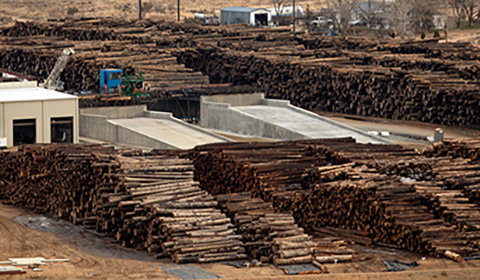
What makes the Jackson Paper Manufacturing mill so important is that it sources the fuel for the boiler system from local mills. They buy leftover material from the wood products manufacturing process like wood chips, sawdust, and other odds and ends. The paper mill turns this material into energy that powers the manufacturing process.
In 2023, keeping the Sylva-based mill’s biomass boiler running became even more important when a major pulp and paper mill in the region shuttered. Suddenly, Jackson Paper Manufacturing became the only remaining customer for about 30 wood product manufacturers in western North Carolina, eastern Tennessee, and upstate South Carolina in the market for low value biomass leftover from the manufacturing process.
“Facilities like Jackson Paper Manufacturing are key piece of the puzzle for the local wood products economy and for forest management more broadly,” said Marcus Taylor, wood innovations coordinator for the Forest Service’s Southern Region. “The ability for regional mills to sell this material to Jackson Paper Manufacturing instead of paying to send their biomass to the landfill improves the economics of the manufacturing process and helps keep regional wood products manufacturers in business. This in turn keeps loggers working in the woods doing very important forest management activities on public and private lands.”

Improving efficiency, reliability and competitiveness
Jackson Paper produces 100% recycled containerboard. The process starts with bales of old corrugated containers from recycling centers that source from places like local grocery store chains. The corrugated containers are fed into a large blender, called a pulper, which mixes them with water to form pulp. Contaminants, such as dirt, staples, tape, plastic, and adhesives, are removed to yield a clean pulp, which is processed into high-quality recycled paper.
The upgraded biomass boiler is improving the efficiency of the system. Thanks in part to the Forest Service grant, the mill installed a programmable logic controller system, which reduces the air going through the boiler and ensures less energy is wasted on heating excess air. Because of the upgrade, the mill can stick to burning biomass, a more sustainable fuel with a more stable price tag, than other alternatives. The more efficient system also means the system produces more energy for the same amount of fuel.
The overhaul is also helping the mill compete in the industry. It is giving the operators much better troubleshooting tools. These tools are not only more accurate, but they are safer because operators are interacting with the programmable logic controller system and not directly with the boiler’s mechanical systems.
“The boiler upgrade has also improved reliability by replacing the boiler’s north wall, as well as replacing damaged generating tubes and inlet air preheating tubes. These changes will reduce tube failures and result in less downtime for the boiler,” said Josh Carnes, assistant production and quality manager at Jackson Paper Manufacturing.
A sonic soot blower was also installed as part of the upgrade. The sonic soot blower prevents ash and particulates from building up. It uses high-energy, low-frequency sound waves that debond particulates. Sonic soot blowers eliminate concerns about corrosion, erosion, and mechanical damage and do not produce effluents.
The wood fuel that supports the biomass boiler and the wood that supports the papermill are harvested from the forest as part of commercial thinning, a process that allows loggers to remove specific trees to both improve forest health and use the harvested wood to manufacture valuable products. (USDA Forest Service video)
For more information about how the Forest Service is supporting American jobs and sustainable forest management, visit Wood Innovations Program webpage.