


Fall Colors
Find your fall colors on national forests

Ready for a fall adventure?
If you're craving fresh air, stunning scenery, and a break from the everyday, there's no better time to explore your national forests than autumn. Whether you're a weekend wanderer, a seasoned hiker, or just someone who loves a good scenic drive, fall colors offer a one-of-a-kind experience that’s tailor-made for you.
Depending on location, you will encounter vibrant aspens, oaks, maples, cottonwoods, and even golden larches, each contributing to a rich palette of reds, oranges, and yellows. The expansive landscapes provide deep groves of trees or uninterrupted views of rolling hillsides, sweeping valleys, and dramatic ridgelines—perfect for leaf peeping, photography, and peaceful reflection.
Safety First: Know Before You Go
Exploring public lands in autumn is deeply rewarding—but it also requires preparation. Before you head out:
Check the weather: Conditions can change quickly, especially in higher elevations.
Tell someone your plan: Share your destination and expected return time.
Pack essentials: Bring extra water, food, warm layers, and emergency supplies.
Stay on marked trails: In some areas, leaves can cover trails, obscuring your a safe route.
Carry a map: Cell service may be limited—know your route and terrain. Make sure get the map you need before heading out on your adventure.
For more tips, visit our outdoor safety resources and make sure you're ready for a safe and enjoyable adventure.
Whether you're planning a weekend getaway or a scenic drive, fall is the perfect time to reconnect with nature. Discover your favorite forest or grassland—and let the colors guide you.
Golden Needles and Glacier-Carved Valleys

From glacier-carved valleys to golden hillsides, the Northern Region offers a quiet, expansive canvas for fall exploration. Whether you're driving scenic byways, hiking alpine trails, or photographing golden larches against snow-dusted peaks, this region delivers a uniquely northern autumn experience. The lands cover a vast stretch from the Great Plains to the rugged peaks of the Northern Rockies. The Northern Region has more than 25 million acres across 12 national forests and four national grasslands.
Featured Forests and Fall Destinations in Montana and Idaho:
Nez Perce-Clearwater National Forests, Idaho: Larches light up the rugged Bitterroots as you travel the Lochsa River Corridor, making one of Idaho's most scenic drives even brighter.
Kootenai National Forest, Montana: Drive the Lake Koocanusa Scenic Byway to witness golden western larches glowing before they shed their needles. Cottonwoods line the riverbanks with soft yellow hues, and the forest’s location within the Crown of the Continent ecosystem offers dramatic mountain views.
Flathead National Forest, Montana: Bordering Glacier National Park, this forest features alpine lakes and valleys framed by quaking aspens, cottonwoods, and larches, with evergreen ridgelines adding depth to the color.
Lolo National Forest, Montana: Near Missoula, explore the Rattlesnake National Recreation Area and Rock Creek Canyon, where golden aspens and larches contrast with dense stands of Douglas-fir and spruce.
Bitterroot National Forest, Montana and Idaho: The Bitterroot Valley and Lost Horse Canyon offer quiet trails through glowing groves of aspen, birch, and cottonwood, backed by granite peaks and conifer forests.
Tree Species That Define the Season:
Western larch – golden needles in late fall, unique among conifers
Quaking aspen – bright yellow leaves that shimmer in the breeze
Cottonwood – soft yellow foliage along rivers and lowlands
Birch – pale gold leaves in moist, shaded areas
Douglas-fir and spruce – evergreen contrast to deciduous color
Peaks of Gold and Canyon Flame

Alpine lakes framed by golden aspens to canyon drives ablaze with oak and maple give the Rocky Mountain Region a bold and breathtaking fall color experience. Whether you're hiking high ridgelines, photographing iconic peaks, or exploring quiet forest trails, this region offers autumn in its most elevated and expansive form. The region’s 40 million acres includes 17 national forests and seven national grasslands where dramatic elevation changes and diverse ecosystems create vivid seasonal displays.
Featured Forests and Fall Destinations
White River National Forest, Colorado: Home to the famed Maroon Bells, this forest showcases vast groves of quaking aspens that turn brilliant gold in late September. Their fluttering leaves and white bark create a luminous contrast against rugged alpine terrain.
San Juan National Forest, Colorado: The Million Dollar Highway between Ouray and Silverton is one of the most scenic fall drives in the country, with golden aspens blanketing steep slopes and deep canyons.
Arapaho and Roosevelt National Forests, Colorado: Near Denver and Boulder, explore Brainard Lake, Peak to Peak Scenic Byway, and Guanella Pass, where aspens, Gambel oak, and cottonwoods light up the foothills and alpine basins.
Black Hills National Forest, South Dakota and Wyoming: The Spearfish Canyon Scenic Byway offers dramatic fall color from maples, birch, and oak, set against towering limestone cliffs and waterfalls.
Medicine Bow-Routt National Forests, Wyoming and Colorado: The Snowy Range Scenic Byway and Steamboat Springs area feature golden aspens, willows, and cottonwoods, with sweeping views of high mountain meadows.
Tree Species That Define the Season
Quaking aspen – golden leaves that shimmer in the breeze
Gambel oak – rusty red and orange in foothills and dry slopes
Rocky Mountain and boxelder maple – red and orange in canyons and riparian zones
Cottonwood – soft yellow along rivers and floodplains
Birch and willow – golden tones in moist areas
Ponderosa pine, Douglas-fir, and spruce – evergreen contrast across elevations
High Desert Gold and Mountain Flame

From the golden aspens of the White Mountains to the fiery maples of New Mexico’s canyons, the Southwestern Region offers a bold and varied fall color experience. The Southwestern Region offers a striking blend of desert basins, volcanic plateaus, and forested mountain ranges, creating a dramatic setting for fall color. The region’s 20 million acres include 11 national forests where elevation changes and diverse ecosystems produce vivid seasonal transitions.
Featured Forests and Fall Destinations
Santa Fe National Forest, New Mexico: The Aspen Vista Trail near Ski Santa Fe is one of the region’s most iconic fall hikes, with golden aspens glowing across the Sangre de Cristo Mountains. The Jemez Mountains also offer colorful drives through mixed conifer and hardwood forests.
Lincoln National Forest, New Mexico: Explore the Sunspot Scenic Byway and Cloudcroft area, where high-elevation groves of aspens, maples, and oakbrush light up the Sacramento Mountains.
Coconino National Forest, Arizona: Near Flagstaff, the Snowbowl Road and Inner Basin Trail in the San Francisco Peaks showcase brilliant aspen color framed by volcanic ridgelines and ponderosa pine.
Apache-Sitgreaves National Forests, Arizona and New Mexico: The White Mountains offer expansive views of golden aspens, cottonwoods, and willows, especially around Big Lake and Hannagan Meadow.
Gila National Forest, New Mexico: Remote and rugged, this forest features fall color along the Gila River, with cottonwoods, sycamores, and maples adding warmth to canyon landscapes.
Tree Species That Define the Season
Quaking aspen – golden groves at high elevations
Bigtooth maple and Rocky Mountain maple – vibrant red and orange in canyons
Cottonwood – yellow foliage along rivers and floodplains
Oakbrush and Gambel oak – rusty reds and browns
Sycamore and willow – soft gold in riparian zones
Ponderosa pine & Douglas-fir – evergreen contrast across elevations
Canyon Color and Alpine Gold
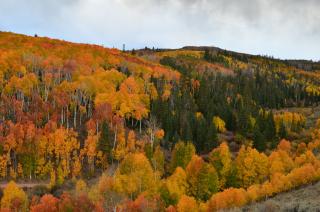
The Intermountain Region contains a striking blend of desert plateaus, alpine peaks, and canyon country, creating a dynamic canvas for fall color. Whether you're hiking high ridgelines, driving scenic byways, or exploring quiet desert valleys, this region delivers a bold and unforgettable autumn journey. The region’s 34 million acres span 12 national forests where elevation changes and varied ecosystems produce vivid seasonal transitions.
Featured Forests and Fall Destinations
Uinta-Wasatch-Cache National Forest, Utah: Explore Logan Canyon Scenic Byway, Mirror Lake Highway, and Mount Nebo Loop, where bigtooth maples, quaking aspens, and cottonwoods ignite the slopes in red, orange, and gold.
Caribou-Targhee National Forest, Idaho and Wyoming: Near Teton Valley and Mesa Falls Scenic Byway, fall brings golden aspens, cottonwoods, and colorful shrubs set against volcanic cliffs and conifer forests.
Sawtooth National Forest, Idaho: The Sawtooth Scenic Byway and Stanley Basin offer dramatic views of golden aspens and willows, framed by jagged peaks and alpine lakes.
Humboldt-Toiyabe National Forest, Utah: The largest national forest outside Alaska, it spans vast high desert and mountain terrain. Fall color appears in cottonwoods, mountain mahogany, and aspens, especially in the Spring Mountains and Ruby Mountains.
Dixie National Forest, Utah: Near Bryce Canyon and Cedar Breaks, this forest features glowing maples, aspens, and oakbrush along scenic drives like Highway 14 and Brian Head Peak.
Fishlake National Forest, Utah: The largest aspen clone, known as Pando, is a site any time of the year. Pando is a single male quaking aspen organism that covers about 106 acres and weighs an estimated 13 million pounds, considered the largest and heaviest known living organism. While you do visible see the connecting roots,
Tree Species That Define the Season
Bigtooth maple – brilliant red and orange in canyons and foothills
Quaking aspen – golden groves at mid to high elevations
Cottonwood – yellow foliage along rivers and valleys
Willow and alder – soft gold in riparian zones
Oakbrush and mountain mahogany – rusty reds and browns
Pine, fir, and spruce – evergreen contrast across elevations
Sierra Gold and Coastal Flame

From the golden aspens of the Eastern Sierra to the fiery oaks of coastal canyons, the Pacific Southwest Region offers a rich and varied palette for fall exploration. Whether you're hiking alpine trails, driving scenic byways, or photographing quiet lakes, this region delivers a distinctly western autumn experience. The region’s 20 million acres spans 17 national forests and seven national grasslands across California.
Featured Forests and Fall Destinations
Sierra National Forest: Near Yosemite National Park, this forest features glowing aspens, black oaks, and dogwoods along Kaiser Pass and around Huntington Lake, framed by granite peaks and alpine lakes.
Inyo National Forest: In the Eastern Sierra, the June Lake Loop and Bishop Creek Canyon are iconic fall destinations. Groves of quaking aspens turn brilliant gold, contrasting with rugged terrain and early snowcaps.
Shasta-Trinity National Forest: Northern California’s volcanic landscape offers colorful hikes around Castle Lake, the McCloud River, and Lake Siskiyou, with vibrant displays from bigleaf maples, canyon live oaks, and dogwoods.
Lassen National Forest: Near Lassen Volcanic National Park, fall color appears in aspen groves, willows, and mountain alder, especially around Hat Creek Rim and Lake Almanor.
Los Padres National Forest: Along the Central Coast, explore Big Sur, Ventana Wilderness, and Santa Barbara backcountry, where valley oaks, sycamores, and maples light up canyons and ridgelines.
Angeles National Forest: Just outside Los Angeles, high-elevation trails near Mount Baldy and San Gabriel Canyon offer bursts of fall color from maples, oaks, and cottonwoods.
Tree Species That Define the Season
Quaking aspen – golden groves in high elevations
Bigleaf maple – large yellow leaves in moist forests
Black oak and canyon live oak – orange and russet tones
Dogwood – pink to red foliage in shaded areas
Sycamore and cottonwood – yellow along rivers and canyons
Willow and alder – soft gold in riparian zones
Pine, fir, and cedar – evergreen contrast across elevations
Rainforests, Volcanoes, and Fiery Maples

From coastal rainforests to volcanic ridgelines, the Pacific Northwest Region offers a rich and varied canvas for fall color exploration. You can hiking through misty valleys or drive scenic byways beneath glowing canopies that is uniquely a Pacific autumn experience. The region’s 24 million acres span 16 national forests and one national grassland.
Featured Forests and Fall Destinations
Mt. Hood National Forest, Oregon: Explore the Hood River Valley and Timberline Trail, where vine maples and bigleaf maples blaze in red, orange, and yellow beneath the towering summit of Mt. Hood.
Willamette National Forest, Oregon: The McKenzie Pass–Santiam Pass Scenic Byway and Proxy Falls offer lush, mossy trails framed by colorful maples and golden underbrush.
Gifford Pinchot National Forest, Washington: Near Mount Adams and the Wind River area, fall brings golden western larches and vibrant vine maples, set against deep green conifers and volcanic terrain.
Olympic National Forest, Washington: Bordering Olympic National Park, this forest features maples, alders, and cottonwoods glowing in river valleys and foothills, especially along the Quinault River and Hood Canal.
Deschutes National Forest, Oregon: Near Bend, the Cascade Lakes Scenic Byway offers high-elevation views of aspens, larches, and colorful shrubs set against volcanic peaks.
Tree Species That Define the Season
Vine maple – fiery red and orange, especially in understory and canyon areas
Bigleaf maple – large golden leaves that light up forest floors
Western larch – deciduous conifer with golden needles in late fall
Cottonwood and alder – yellow foliage along rivers and wetlands
Douglas-fir, western hemlock, and cedar – evergreen contrast to fall color
Appalachian Gold and Ozark Fire

The Southern Region offers one of the most expansive and ecologically diverse leaf-peeping experiences in the country. Spanning over 13 million acres, it includes 13 national forests across 13 states—from the Appalachian Mountains to the Gulf Coast. From the misty peaks of the Appalachians to the hardwood plateaus of the Ozarks, the Southern Region offers a warm and vivid autumn experience. Whether you're hiking forested ridgelines, driving scenic byways, or camping beneath golden canopies, this region delivers unforgettable fall color across its diverse landscapes.
Featured Forests and Fall Destinations
Pisgah and Nantahala National Forests, North Carolina: The Blue Ridge Parkway, Craggy Gardens, and Linville Gorge showcase fiery displays of sugar maples, red maples, and hickories, framed by sweeping mountain views.
George Washington & Jefferson National Forests, Virginia: Explore Mount Rogers, Douthat State Park, and Whitetop Mountain, where maples, poplars, and oaks light up the highlands in mid to late October.
Ozark-St. Francis National Forests, Arkansas: The Scenic 7 Byway, Whitaker Point, and Mount Magazine offer dramatic fall color from black gum, sweetgum, and southern red oak, set against rugged cliffs and river valleys.
Chattahoochee-Oconee National Forests, Georgia: Leaf peepers flock to Brasstown Bald, Tallulah Gorge, and Anna Ruby Falls for golden hickories, scarlet oaks, and tulip poplars.
Daniel Boone National Forest, Kentucky: The Red River Gorge and Natural Bridge State Resort Park feature brilliant foliage from maples, beech, and sycamore, with sandstone arches and cliffs adding to the drama.
Tree Species That Define the Season
Sugar maple and red maple – vibrant reds and oranges
Hickory & oak (white, red, scarlet) – golden and russet tones
Tulip poplar – bright yellow
Sweetgum and black gum – deep red and purple
American beech – soft bronze
Eastern hemlock and pine – evergreen contrast
Lakes, Ridges, and Maple Majesty

From the maple-covered mountains of New England to the birch-lined lakes of the Upper Midwest, the Eastern Region offers a classic and unforgettable fall color experience. Whether you're hiking forest trails, paddling quiet waters, or driving scenic byways, this region delivers autumn in its purest form the Great Lakes to the Appalachian Highlands and across the Northeast. The region’s 12 million acres includes 17 national forests and one national grassland across 20 states.
Featured Forests and Fall Destinations
White Mountain National Forest, New Hampshire and Maine: The Kancamagus Highway is one of the most celebrated fall drives in the country, with sweeping views of sugar maples, birch, and beeches lighting up the slopes of the Presidential Range.
Green Mountain National Forest, Vermont: Explore Route 100, Camel’s Hump, and Mount Equinox, where fiery red maples, golden birch, and bronze beech create a quintessential New England autumn.
Allegheny National Forest, Pennsylvania: The Longhouse Scenic Byway and Kinzua Bridge State Park offer dramatic views of oak, maple, and cherry trees in full color, set against rolling hills and river valleys.
Superior National Forest, Minnesota: Paddle through the Boundary Waters Canoe Area Wilderness or drive the Gunflint Trail, where birch, aspen, and tamarack turn golden alongside deep green conifers.
Huron-Manistee National Forests, Michigan: Near Lake Michigan, explore M-22 Scenic Drive and Nordhouse Dunes, where maples, oaks, and poplars create a vivid shoreline contrast.
Mark Twain National Forest, Missouri: The Ozark Highlands Trail and Glade Top Trail showcase fall color from hickories, oaks, and sassafras, with panoramic views of the Ozark Plateau.
Tree Species That Define the Season
Sugar maple and red maple – brilliant reds, oranges, and yellows
Birch & beech – soft gold and bronze tones
Oak (white, red, black) – russet, brown, and deep red
Aspen and poplar – bright yellow in northern forests
Tamarack (larch) – golden needles in late fall
Cherry, basswood, and sassafras – varied hues from yellow to purple
Spruce, fir, and pine – evergreen contrast across the region
Wild Gold at the Edge of America

The Alaska Region offers a raw and expansive autumn experience, where fall color sweeps across boreal forests, glacial valleys, and coastal fjords. Whether you're hiking glacial valleys, driving coastal highways, or exploring remote wilderness, the bold and elemental autumn experience is unlike anywhere else in the country. The region’s 22 million acres includes the Tongass and Chugach national forests, which together form the largest contiguous area of national forest land in U.S.
Featured Forests and Fall Destinations
Tongass National Forest: Covering nearly 17 million acres across Southeast Alaska, Tongass is the largest national forest in the country. Fall color appears in cottonwoods, alders, and willows, especially around Mendenhall Glacier, Haines Highway, and the Stikine River Valley. The contrast between golden foliage and deep green Sitka spruce and western hemlock creates a dramatic coastal mosaic.
Chugach National Forest: Spanning 5.4 million acres from Prince William Sound to the Kenai Peninsula, Chugach offers vivid fall color along the Seward Highway, Portage Valley, and Turnagain Arm. Birch, aspen, and cottonwood trees turn brilliant yellow, while tundra shrubs and alpine plants add reds and oranges to the landscape.
Tree Species That Define the Season
Birch – bright yellow in upland forests
Aspen – golden groves in interior and mid-elevation zones
Cottonwood – soft yellow along rivers and floodplains
Alder and willow – golden and rust tones in riparian areas
Tundra shrubs (blueberry, dwarf birch, Labrador tea) – red, orange, and burgundy hues
Sitka spruce and western hemlock – evergreen contrast in coastal rainforests