Eastern Kingbird (Tyrannus tyrannus)Reliability of Model: Low 

Climate Change Scenario Maps Help »

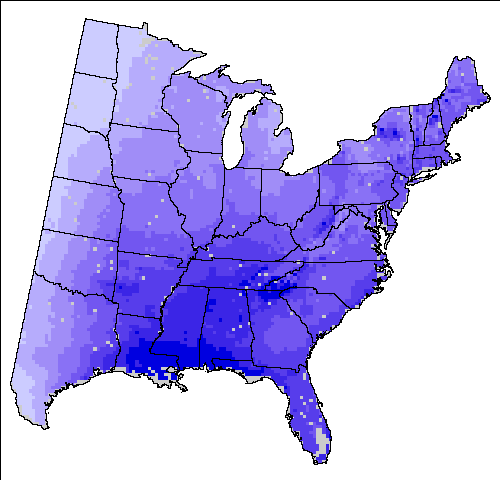
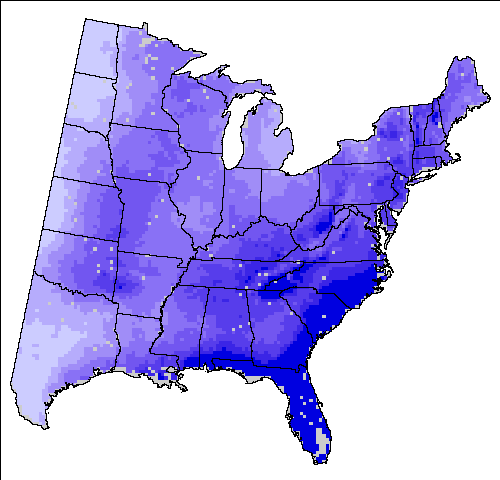
HadleyCM3 – A1FI (High, "Harsh") Climate Scenario
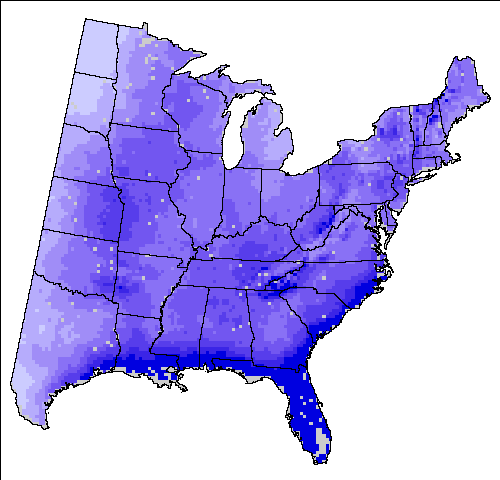

Potential Changes in Abundance and Range (Future) |
|||||||||
|---|---|---|---|---|---|---|---|---|---|
| GCM SCENARIO | % Area Occ | Ave IV | Sum IV | Future/Current IV | |||||
| Current Modelled | 95.1 | 0.54 | 5015.7 | ||||||
| Current Breeding Bird Survey | 8.4 | 0.744 | 608.5 | ||||||
| HadleyCM3 – A1FI (High, "Harsh") Climate Scenario | 97.2 | 0.447 | 4243.2 | 0.846 | |||||
| PCM – B1 (Low, "Mild") Climate Scenario | 94.4 | 0.52 | 4790.9 | 0.955 | |||||
| Avg. of 3 GCMs – A1FI (High) Climate Scenario | 95.6 | 0.46 | 4300.5 | 0.857 | |||||
| Avg. of 3 GCMs – B1 (Low) Climate Scenario | 94.8 | 0.494 | 4576 | 0.912 | |||||
Notice:
This is an version 2 of the Climate Change Bird Atlas. You can view the previous Eastern Kingbird page or browse the previous Bird Atlas. Version 2 of the Bird Atlas is based on Version 3 of the Climate Change Tree Atlas.

Photograpger: K.T. Karlson
Species Information
- Family:
- Tyrannidae
- Breeding Status:
- neotropical
- Primary Breeding Diet:
- insects
- Habitat:
- unclassified
Search for Trees & Birds:
 Click and drag the orange handle over the maps to compare.